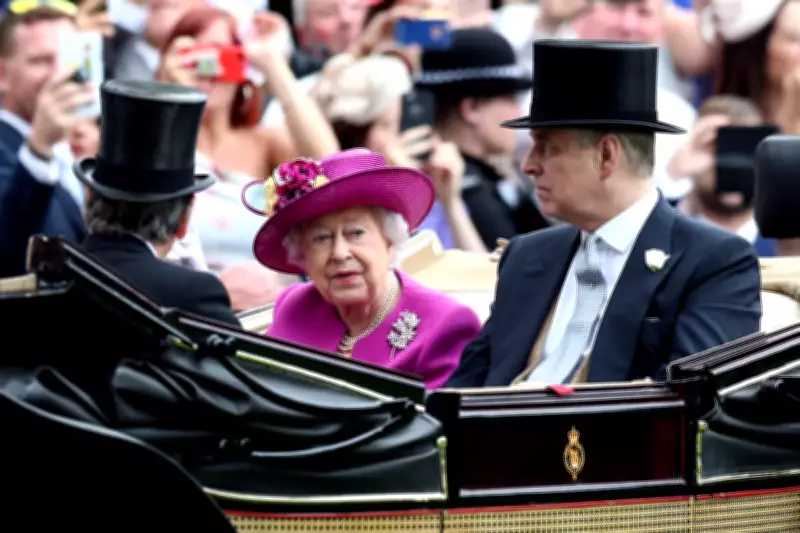
Newly released government documents have revealed that the late Queen Elizabeth II was "very keen" for Prince Andrew to assume a "prominent role in the promotion of national interests" prior to his appointment as the UK's special representative for international trade and investment.
Memo Reveals Queen's Wish
In a memo addressed to then-Foreign Secretary Robin Cook, senior official Sir David Wright stated that the monarch's "wish" was for the then-Duke of York to succeed her cousin, the Duke of Kent, in the trade envoy position. Sir David, who was chief executive of British Trade International (BTI) at the time, recounted a "wide-ranging discussion" with the Queen's private secretary and proposed identifying a "suitable role" for her son as his career in the Royal Navy was concluding.
Sir David suggested that the role would involve some regional travel and two to three overseas visits per year, along with leading a "major trade mission from time to time." He noted that he "did not envisage that the Duke of York would want to be burdened with the regularity of meetings of the board" of BTI or "the burden of paper which goes along with the board membership."

The Duke of Kent was planning to step down from his role as a special representative for trade, and the Queen wished for Andrew to succeed him. "The Duke of Kent is to relinquish his responsibilities around April next year. That would fit well with the end of the Duke of York's active naval career," Sir David wrote.
Golfing Restrictions and Media Management
Another document revealed efforts to prevent Andrew, who earned nicknames such as "Air Miles Andy" and "Playboy Prince" for his extensive travel and apparent fondness for leisure, from golfing abroad. A letter from Kathryn Colvin, then-head of the protocol division, stated: "Captain Blair (Andrew's then-personal private secretary) particularly asked that the Duke of York should not be offered golfing functions abroad. This was a private activity and if he took his clubs with him he would not play in any public sense."
Staff at BTI were also cautioned that Andrew's "high public profile (not, of course, exclusive to his BTI function)" would necessitate "careful and sometimes strict media management." An internal telegram from September 2001 indicated that this would be "an important factor in considering engagements for inclusion in the programme," with initial proposals requiring a media strategy to be developed jointly with the Palace.
Andrew's Preferences and Redactions
According to the files, Andrew "tended to prefer the more sophisticated countries." Ms Colvin wrote that she had been informed the former prince was "particularly good on high-tech matters, trade, youth (including primary schools and outward bound projects), cultural events, with a preference for ballet rather than theatre, the Commonwealth and military and foreign affairs." Several lines in the documents have been redacted, with the government stating this is to "remove the bare minimum of personal information and information whose release would prejudice international relations."
In a memo dated January 2000, Ms Colvin said Sir David Wright would "welcome" the then-prince, who already conducted some overseas trips, taking on "more commitments," and had "in mind that the Duke of York would play a similar role to that of the Duke of Kent."
Appointment and Controversy
Andrew became the UK's special representative for international trade and investment in 2001 but stepped down a decade later amid the controversy over his friendship with convicted paedophile financier Jeffrey Epstein. He received no salary for his global travels promoting British business interests, but criticisms were raised about the thousands of pounds spent annually on his expenses and travel costs.
His resignation came in the same year he was photographed with his arm around Virginia Giuffre, his primary accuser, who claimed she was trafficked to Andrew at the home of convicted sex trafficker Ghislaine Maxwell. Ms Giuffre alleged she had sex with Andrew on three occasions: at Maxwell's London home, at Epstein's New York townhouse, and on Epstein's Caribbean island, Little St James. Andrew paid Ms Giuffre millions of pounds to settle a civil lawsuit in 2022, despite claiming he had never met her.

The former duke also faces accusations of sharing sensitive information with Epstein during his tenure as trade envoy.
Publication and Vetting Concerns
The documents were released on Thursday following a Liberal Democrat motion in the Commons demanding the government release files related to Andrew's appointment, including any vetting and correspondence from former US ambassador Lord Peter Mandelson.
In a written statement, Trade Minister Sir Chris Bryant said the government had found "no evidence" of any formal due diligence or checks being carried out before Andrew assumed the role. He described this as "understandable" given that the appointment was a "continuation of the royal family's involvement in trade and investment promotion" and followed the Duke of Kent's similar position.
Andrew was arrested in February on suspicion of misconduct in public office and later released under investigation. He has vehemently denied any wrongdoing.
Criticism and Future Releases
The Liberal Democrats criticised the "small paper trail" released by the government. Chief whip Wendy Chamberlain stated: "The lack of documentation provided is itself concerning, as is the time it has taken to get this far. We must get the full files from government without delay."
Downing Street confirmed that a further tranche of files relating to the appointment will be published at a future date, with materials being released "as quickly as possible." When asked whether it was acceptable that no vetting was carried out, a spokeswoman reiterated that no evidence of formal due diligence was found, attributing this to the role being a continuation of royal family involvement in trade promotion.