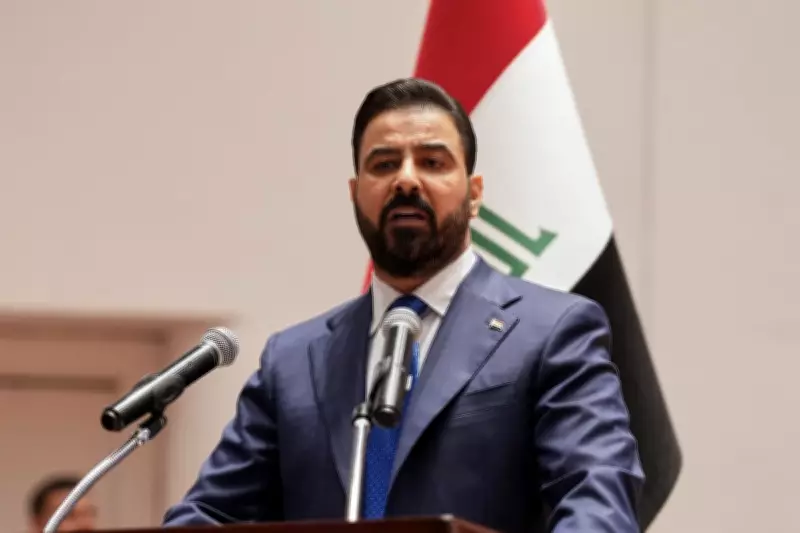
Iraq's parliament voted on Thursday to approve the government program and part of the Cabinet lineup proposed by Prime Minister-designate Ali al-Zaidi, but negotiations stalled over several ministerial appointments, highlighting the persistent political fragmentation in the country.
Approval of Partial Cabinet
Among the 270 lawmakers present, 14 ministers out of a total of 23 were confirmed. Most appointees are newcomers to government, although Foreign Minister Fuad Hussein retained his position. The nominees for interior minister, higher education minister, and planning minister failed to secure parliamentary approval. Voting on other key posts—including defense, labor, housing and reconstruction, and education—was postponed indefinitely.
Power-Sharing Dynamics
Iraq's political system relies on a complex power-sharing arrangement among factions. The dominant parliamentary bloc, the Coordination Framework—a coalition of Shiite parties allied with Iran—selects 12 ministers. Sunni parties choose six, Kurdish parties four, and religious minorities one. This arrangement often leads to deadlock and lengthy political vacuums.

Challenges Ahead
The incoming government must address the political and economic repercussions of the U.S.-Israeli war against Iran, which has spilled into Iraq. The closure of the Strait of Hormuz has disrupted oil exports, a vital source of revenue. The approved government program prioritizes improving public services, tackling the electricity crisis, supporting economic stability, combating corruption, reforming public administration, and strengthening the rule of law.
Militia Disarmament Stalled
The program includes provisions to restrict weapons to the state, a measure likely difficult to enforce. Multiple Iran-backed militias operate in Iraq and launched frequent attacks on U.S. bases during the recent conflict. Washington has urged Baghdad to control these groups, but Tehran resists disarmament. Two Coordination Framework officials, speaking anonymously, revealed that Quds Force commander Esmail Qaani instructed Shiite leaders to avoid disarmament steps until U.S.-Iran negotiations progress. Qaani also called for postponing votes on ministries linked to factions with armed affiliates.
Al-Zaidi's Emergence
Al-Zaidi, a businessman without political experience, emerged as a consensus candidate after weeks of internal debate within the Coordination Framework. He secured backing from both the U.S. and Iran, reflecting Iraq's delicate balancing act between the two rivals. U.S. envoy Tom Barrack congratulated al-Zaidi on X, expressing encouragement for "fresh leadership" and collaboration on shared interests. Iran's Foreign Minister Abbas Araghchi also congratulated al-Zaidi and Foreign Minister Hussein, emphasizing Tehran's priority of expanding friendly relations with Baghdad.