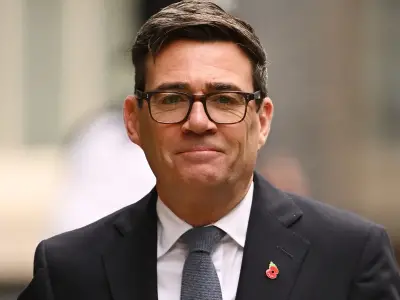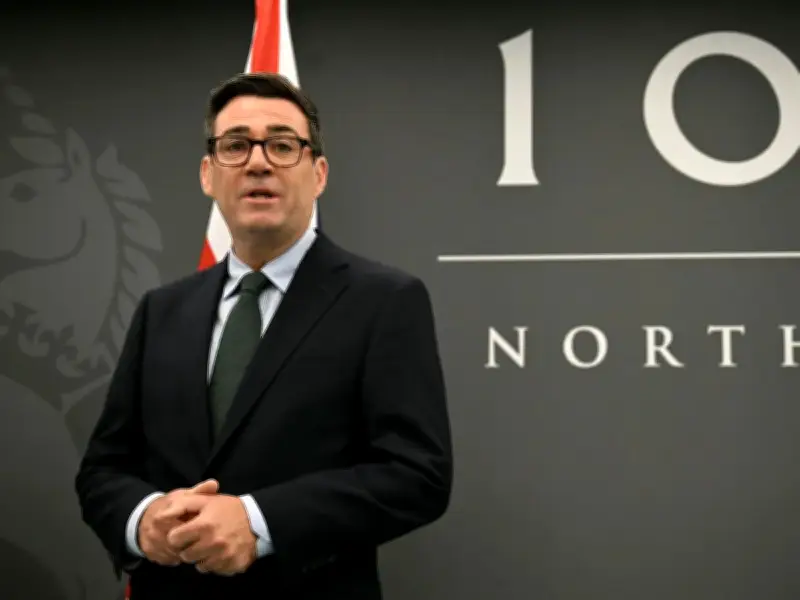
Greater Manchester Police (GMP) officers responsible for protecting Prime Minister Andy Burnham at his home and No 10 North are at "breaking point," according to the chair of the Greater Manchester branch of the Police Federation, Sgt Mike Peake.
Exhausted officers are routinely being ordered to cancel rest days to patrol the prime minister's office at Heron House in Manchester city centre and his home when he heads north, Sgt Peake told the Manchester Evening News.
Strained resources and mutual aid
GMP's stretched resources are being augmented by "mutual aid," with help from forces around the country sending officers to Manchester to bolster ranks. These officers are being put up in hotels, adding to a predicted £10m overspend in GMP's budget, according to sources cited by the Manchester Evening News.
The sources also claim the PM's office regularly gives GMP very late notice of the PM's movements. His diary is often revealed on a Monday for that Monday and the rest of the week, frequently giving GMP bosses just hours to ensure the right resources are on hand for any visits.
Operation Ember and its impact
One of Mr Burnham's first acts as PM was to set up No 10 North as part of an effort to decentralise power and decision-making previously always at Whitehall in London. It prompted a huge security operation by GMP, dubbed Operation Ember.
Sgt Peake said: "It all happened very quickly which left GMP in a difficult position where they had to hurriedly provide security at No 10 North. Obviously he's the prime minister and he does also reside in the area and we have to provide security for him."
He said rest days were routinely being cancelled to provide security, with GMP initially seeking volunteers before then having to require officers to cancel rest days as not enough volunteers came forward.
Fatigue, sickness, and funding concerns
"We have got extra officers providing that security and it's done on overtime. While police officers are paid additional money, fatigue and burn out are causing a real issue in GMP," he said. "It's leading to sickness issues for police officers in GMP."
Increasing demands on cops in the force was causing "stress, anxiety and PTSD because they just cannot cope with the workload," said Sgt Peake, who pointed to an average five assaults per day on cops in GMP.
Asked if officers had reached breaking point, he said: "We have got to that point, yes. I think policing is broken."
Sgt Peake said he expected the Home Office to foot the bill for the extra resources ultimately, but meanwhile it was being paid for by GMP. He noted No 10 North may remain even if the government changes and so it required proper funding.
"Even if Andy Burnham went away and there's a change of government, it will be a bold decision to get rid of No 10 North now it's been established. It's a potential vote winner for people in the north. It would be the same for any subsequent prime minister further down the line," said Sgt Peake.
Official responses
A GMP spokesperson said: "Policing is a job like no other and we value the extraordinary commitment and hard work of our officers day-in day-out. They put their own safety on the line to protect those who live and work in Greater Manchester."
Chief Constable Sir Stephen Watson told the Manchester Evening News: "GMP is well led, well managed and full of determined public servants. Whilst there are many areas in which we seek to continue to improve, the force is currently performing well and is in a strong position."
A government spokesperson said: "Number 10 North is central to the Prime Minister's commitment to bring government closer to the communities it serves. Police force funding this year is at a historic high of £18.5 billion, with Greater Manchester Police seeing a cash increase of £33.3 million."
Security arrangements for the PM when he is in Greater Manchester are an "operational matter" for GMP, according to the government. Officials point to a £33.3m increase in funding for GMP this year, increasing its budget for 2026/27 to £911.5m and putting the force among the top ten constabularies in terms of funding increase per person in the local area.