Tulsi Gabbard's Exit Highlights Divide in Trump Administration
Gabbard Exit Highlights Trump Administration Divide

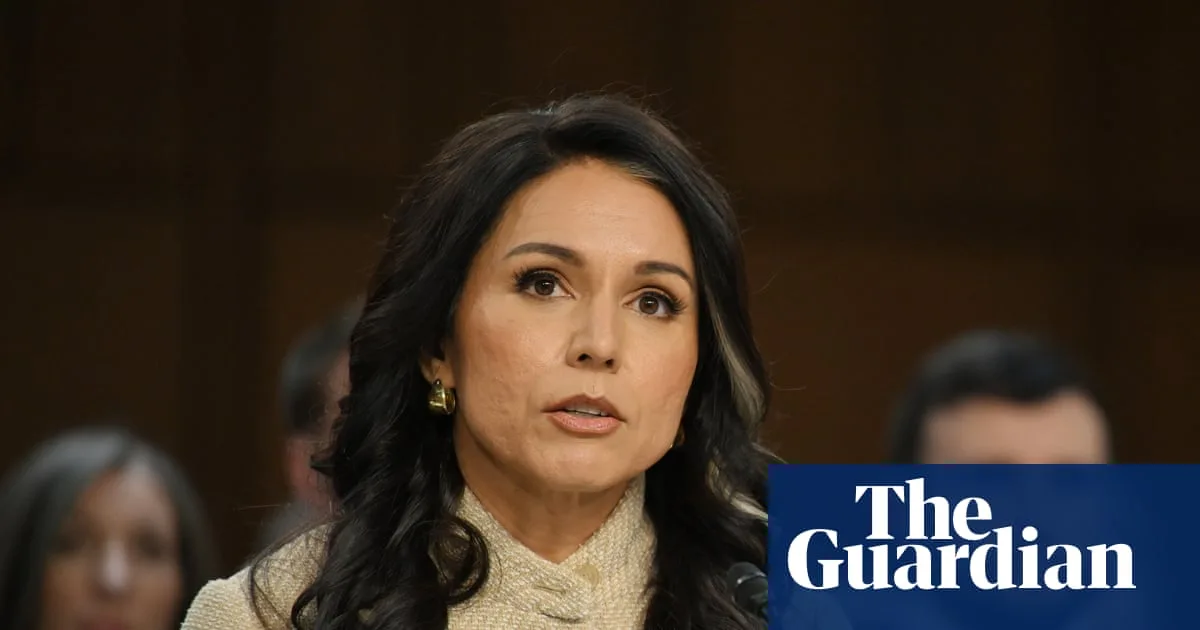
As the White House orchestrated the dramatic capture of Venezuela's Nicolas Maduro, a rather cruel joke reportedly circulated behind the scenes — that Tulsi Gabbard's title of DNI stood for 'Do Not Invite.' Officials denied that the president's top spy had been excluded from critical planning meetings or that she had ever been referred to as anything other than Director of National Intelligence. However, the incident pointed to a fundamental dissonance that plagued Gabbard's presence in President Trump's inner circle.

The 44-year-old Iraq War veteran's entire political career had been built on opposition to U.S. military adventures, or what she would consider misadventures, overseas. This conviction she shared with Vice President JD Vance, who also served in Iraq and had his worldview shaped by that experience. Perhaps the most significant lasting impact of Gabbard's departure is that it will now deprive Vance of a key ally in the Cabinet.

With Secretary of State Marco Rubio at the forefront of America's interventions in Venezuela, Iran, and potentially soon Cuba, the isolationist Vance now appears increasingly isolated himself. As his ideological support within the Cabinet evaporates, speculation is mounting that Vance is no longer Trump's natural successor for 2028.

Wide Pickt banner — collaborative shopping lists app for Telegram, phone mockup with grocery list

Key Events Highlighting the Divide

Two events make this conclusion hard to avoid. First, on February 28, as Trump launched Operation Epic Fury from Mar-a-Lago, the key players huddled with him were Rubio, Chief of Staff Susie Wiles, CIA Director John Ratcliffe, and top general Dan Caine. Vance remained in the Situation Room in Washington, and sitting at his right hand was Gabbard.

Second, in March 2025, early in Gabbard's tenure, it was Vance who defended her from the president's ire when she appeared less than enthusiastic about the case for war on Iran. On that occasion, Gabbard testified to Congress that there was no intelligence suggesting the Islamic Republic was trying to develop nuclear weapons. Trump publicly disagreed with her assessment, declaring: 'I don't care what she said. I think they were very close to having one.' Vance then issued a statement saying: 'Tulsi is a veteran, a patriot, a loyal supporter of President Trump and a critical part of the coalition he built in 2024. She's an essential member of our national security team, and we're grateful for her tireless work to keep America safe from foreign threats.' The key word in that statement was 'coalition,' implying that they were not aligned on all points.

If Vance is a non-interventionist member of the Trump 'coalition,' as his past statements suggest, then he has lost a fellow traveler in Gabbard. Her departure also means that the four Cabinet secretaries who have left since March, for various reasons, are all women. She follows Homeland Security Secretary Kristi Noem, Attorney General Pam Bondi, and Labor Secretary Lori Chavez-DeRemer out the door. Bondi was a close personal friend of Gabbard.

Personal and Professional Pressures

In the end, it was an awful development in Gabbard's personal life — the diagnosis of her husband with a rare form of bone cancer — that prompted her to step down. But for weeks, she had been at the top of the betting markets as the likeliest Cabinet secretary Trump would let go. As Trump set out to fix Venezuela, Iran, and perhaps Cuba next, Gabbard had been left in the invidious position of having to provide the reasons for the president to launch military operations that she herself had long opposed.

While her personal relationship with the president was widely described as good, there had been a series of inflammatory missteps. In early June last year, Gabbard published a bizarre AI-generated video on social media slamming 'warmongers' and warning of potential 'nuclear annihilation,' the video showing San Francisco being laid waste. It followed her own visit to Hiroshima, but the purpose was clear: an attempt to influence Trump against joining Israel in strikes on Iran. Trump was said to have been privately infuriated, ignored her concerns, and went on to launch Operation Midnight Hammer days later.

Pickt after-article banner — collaborative shopping lists app with family illustration

This was the latest in a long line of anti-war statements from Gabbard. In 2019, as a Democratic congresswoman, she had warned against regime change in Venezuela, saying, 'We don't want other countries to choose our leaders, so we have to stop trying to choose theirs. When we look throughout history, every time the United States goes into another country and topples a dictator, or topples a government, the outcome has been disastrous for the people in these countries.' After Maduro's capture, she was quiet for days before eventually praising Trump for 'confronting narcoterrorism.'

Gabbard's Political Journey

Gabbard became nationally known in 2020 when she ran for the Democratic presidential nomination on a platform that included opposing U.S. involvement in foreign wars. She even sold 'No War with Iran' t-shirts to fund her campaign. 'For decades, our foreign policy has been trapped in a counterproductive and endless cycle of regime change or nation-building,' she said. 'The old Washington way of thinking is something we hope is in the rear view mirror.' During her unsuccessful campaign, she was widely credited with having gotten the better of Kamala Harris in a heated encounter on the debate stage.

Two years later, she became an independent, accusing the Democratic Party of being an 'elitist cabal of warmongers.' She later endorsed Trump, who was also a strong critic of past U.S. 'forever' wars in the Middle East. Although she had no intelligence experience, Trump went on to appoint Gabbard to lead the Office of the Director of National Intelligence, which oversees the country's 18 intelligence agencies. Some of his officials believed that ODNI, which was set up in the wake of 9/11, was no longer needed. The role has always sat awkwardly with the big players at the CIA and FBI, who have their own direct lines to the president. It soon became clear that Trump did not see Gabbard as his intelligence boss; instead, he very publicly made John Ratcliffe, the CIA Director, his point man for Iran.

Ongoing Controversies

Gabbard's frustrations went deeper than Iran, and a few weeks ago, her department became embroiled in a new brewing controversy with the CIA. She had taken office with the promise of cracking down on the so-called Deep State and, in April 2025, launched the Director's Initiatives Group (DIG) to investigate some of the most explosive unanswered questions in American history. Its portfolio was a MAGA wish-list: the JFK, RFK, and MLK assassinations, the origins of Covid, Havana Syndrome, the Crossfire Hurricane probe into alleged Trump-Russia collusion, the Biden administration's domestic surveillance, and UFOs.

But as Gabbard's team began its investigations, it has been alleged by a whistleblower to Congress that the CIA was spying on them. CIA Senior Operations Officer James Erdman III told the Senate Homeland Security and Governmental Affairs Committee on May 12 that spies had wiretapped Gabbard's staff. 'These were Americans being spied upon illegally while executing duties directed by the President and under the authority of the Director of National Intelligence,' Erdman testified. He told senators that spooks had snooped on their phone calls and had fired a whistleblower just one day after he met with the DIG. A DNI official told the Daily Mail that the Intelligence Community Inspector General had been made aware of the allegations of CIA spying on Gabbard's team and is working to uncover any wrongdoing.

There were further complications with the White House this week when Gabbard testified to Congress that last year's strikes on Iran had 'obliterated' its nuclear program, and that there had been no subsequent effort to rebuild. That statement seemed to contradict Trump's repeated assertions that Iran posed an imminent threat. His DNI, rather evasively, told Congress: 'It is not the intelligence community's responsibility to determine what is and is not an imminent threat.' She also dodged questions about whether the White House had been warned Iran could close the Strait of Hormuz in retaliation.

On Tuesday, her right-hand woman, Amaryllis Fox Kennedy, an ex-CIA officer and RFK Jr.'s daughter-in-law, stepped down. Fox Kennedy strenuously denied reports that she had quit over Iran. Gabbard's close political ally Joe Kent, Trump's counter-terror chief, had already quit in March, issuing a blistering resignation letter claiming Trump had been duped into the Iran war by Israel. Kent told Tucker Carlson on the night of his exit that intelligence did not support the war's rationale and that Gabbard, had she been in the room, could have provided a 'sanity check' for the president. The view of one source familiar with Gabbard's departure was that the White House had been 'unhappy' with her for quite some time. One senior figure who, by contrast, is presumably very unhappy to see her leave, is Vance, who is now left fighting a lonely battle inside the administration.