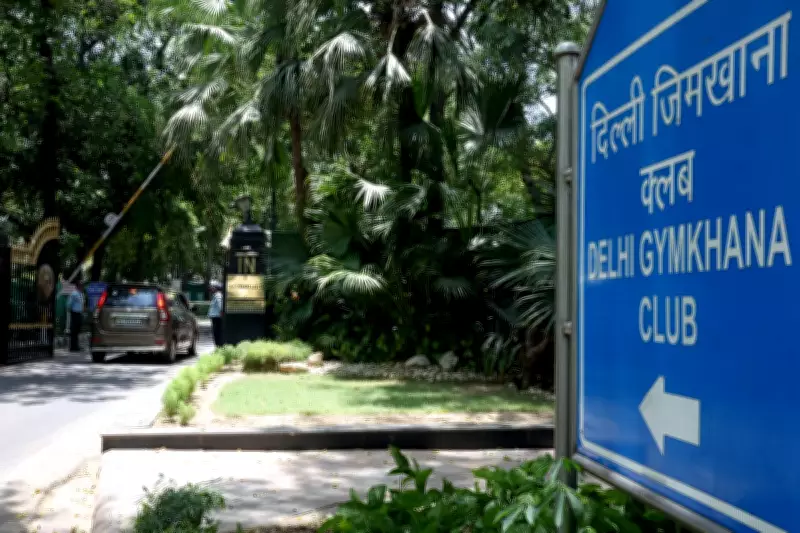
The Indian government has abruptly terminated the lease of one of the country's most elite and historic private members' clubs, the Delhi Gymkhana Club, sparking a debate over its colonial history and the loss of a cultural institution. The club, founded in 1913 during British rule as the Imperial Delhi Gymkhana Club, has been ordered to vacate its 27.3-acre property in central Delhi by 5 June, with the government citing urgent defence and security needs.
Historical Background and Evolution
The Delhi Gymkhana Club was originally established under British colonial administration, with London-born Spencer Harcourt Butler serving as its first president. After India's independence in 1947, the word 'Imperial' was dropped from its name, and the club evolved into a popular yet exclusive venue for Indian bureaucrats, diplomats, military officers, and influential families. Membership fees are reportedly over Rs 2 million (about £15,500) annually, making it inaccessible to most Delhi residents.
Government's Justification and Dispute
The government's Land and Development Office (L&DO) sent three notices between September 2025 and May 2026 demanding approximately Rs 475 million (£3.7 million) in unpaid ground rent and other dues. The L&DO warned that non-payment could lead to reclaiming the property under lease conditions. In its eviction order, the government stated that the land, located next to Prime Minister Narendra Modi's official residence, is 'critically required for strengthening and securing defence infrastructure and other vital public security purposes'. Officials in Modi's government have long questioned the justification for elite private clubs occupying prime public land.

Allegations of Political Motives
Critics describe the eviction notice as a political manoeuvre, arguing that the Modi administration has targeted institutions with cultural links to the opposition Congress party and Jawaharlal Nehru's legacy. For instance, in 2023, the Nehru Memorial Museum and Library Society was renamed the Prime Ministers' Museum and Library Society, a move critics say reduced Nehru's centrality in India's independence narrative. Senior opposition politician Rashid Alvi accused the government of targeting Gymkhana because Congress leader Rahul Gandhi is a member. 'What can be a greater fault of the Gymkhana Club committee than that it made Rahul Gandhi a member and did not make people considered close to the Prime Minister as members? This is enough to demolish it and take it over,' he told The Times of India.
Cultural and Heritage Significance
The club's main building, constructed in the early 1930s, was designed by British architect Robert Tor Russell, who also designed Connaught Place and Teen Murti House, the former home of Jawaharlal Nehru. Historian Swapna Liddle told the Press Trust of India that while the institution has elitist roots, the focus should be on reforming it to be more accessible. 'It is a pity that cultural institutions are shrinking; they must evolve, not ossify,' she said. In an interview with India Today, she cited the club's sports facilities and library as having cultural value, adding, 'I would be sorry to see it getting erased... It is an important cultural institution, as well as very historic. It's a heritage space, part of the New Delhi landscape.'
Member and Employee Concerns
Club member Rumnita Mittal told ANI that it is a 'myth that Gymkhana Club belongs to super-rich people with big cars or a lot of money'. She noted that most permanent members are retired armed forces personnel or bureaucrats. 'It is a sports club used by veterans and retired people. So it would be very unfair to them that overnight you take away their place,' she said. The club's current management has raised concerns about the future of its approximately 14,000 members and over 500 employees if forced to vacate.

Legal Proceedings and Reactions
Club member Vijay Khurana and the Staff Welfare Association filed a lawsuit in the Delhi High Court against the government order. On Tuesday, the High Court declined immediate intervention after the government assured that no forcible eviction would occur without due legal procedure and prior notice, according to legal news website Bar and Bench. The club has expressed a desire to continue operating and seeks talks with the government. A government spokesperson told the BBC: 'It is a property leased by the government. Everything has happened according to the rule book and relevant laws.'
Not everyone is opposed to the closure. One social media user wrote that the club was 'built by highly privileged people, for the enjoyment of highly privileged people, on government land', noting that the club pays only about Rs 1,000 per year in rent for 27 acres of prime land while charging membership fees in lakhs.