Verónica Caré explains that there is nothing good to say about Cuba. That is why she avoids writing to her relatives and friends in the United States. She prefers to send photos of her three children and say little. In her 39 years, she does not remember a worse moment than the one she is living through now. She says that not even in the Nineties – the economic crisis that began after the collapse of the Soviet Union, dubbed Cuba’s “special period” – did things feel this desperate.
There are days when Verónica and her husband have to eat bread and divide the last chicken thigh that remains in the refrigerator among their three children. Days when her daughters, 10 and three years old, miss daycare and school because they have had nothing to eat. Aitana, the eldest, has gone up to two weeks without attending classes because she was too hungry to go. The youngest turned one not long ago. He still does not speak. But when he feels hungry he starts to scream. “So imagine that the other two also stand next to you and start: ‘Mom I’m hungry, I’m hungry, I’m hungry...’ And you have absolutely nothing to give them, not even a piece of stale bread or a glass of soda or a glass of milk or a glass of yoghurt. I have thrown myself on the floor to cry,” she says.
Economic Collapse and Blackouts
Cuba is currently going through its worst crisis since the triumph of the revolution in 1959. In April 2019, Cuban economist Mauricio de Miranda published an article warning about what is now happening. Its title could not have been more accurate: “Cuba at the gates of a new economic crisis”. With the economy severely contracting, De Miranda made several recommendations to prevent the crisis, which did not depend on political decisions in the United States nor on the lifting of the embargo. However, those recommendations, like so many others since, were ignored.
By the end of 2025, GDP contracted by close to 5 per cent, a figure that now places the Cuban economy as the one with the lowest growth in Latin America and the Caribbean. A recent report by the Economic Commission for Latin America and the Caribbean announced that the Cuban economy will suffer a contraction of 6.5 this year – the worst performance among the 33 countries analysed. Although at the end of March, Trump gave the green light to a sanctioned Russian tanker to carry 100,000 tons of crude to Cuba, the oil ran out at the end of April because it represented one-eighth of what the island needs per month.
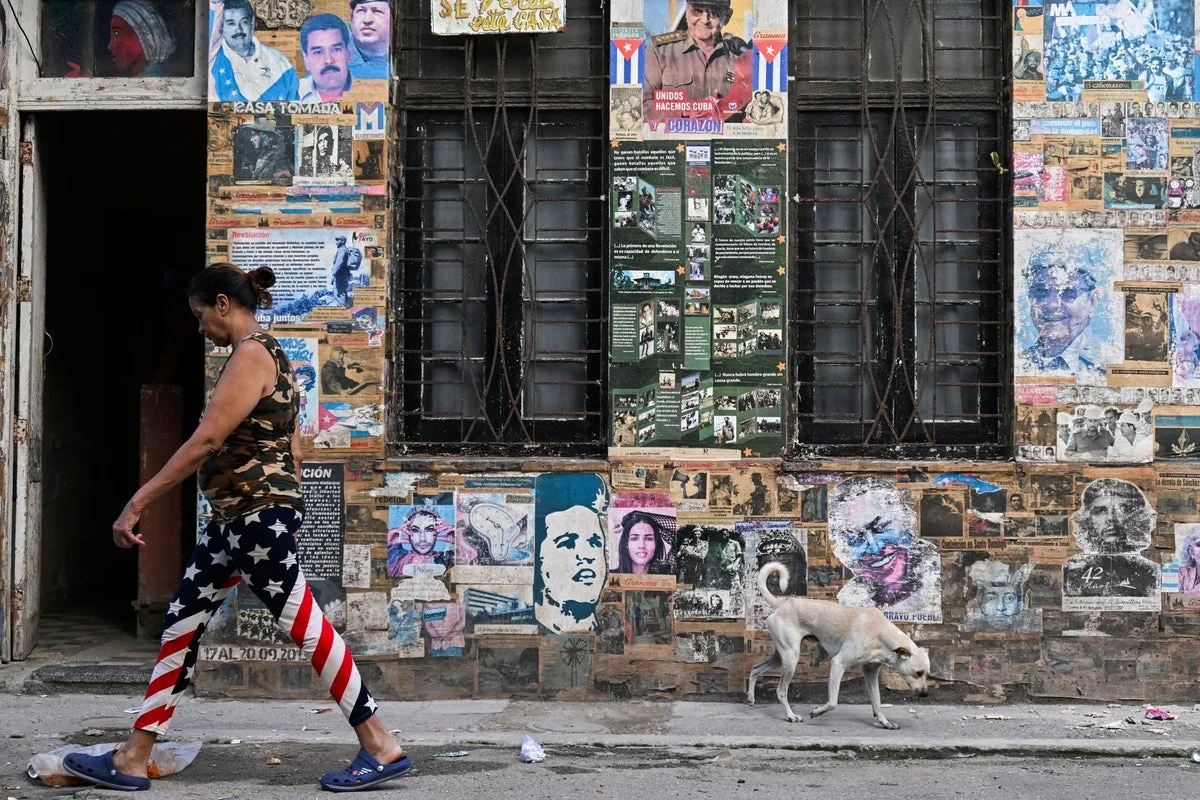
Inside the island, the crisis is noticeable everywhere. The streets are empty. Public transportation is sporadic at best, there is neither the money nor the desire to go out. Blackouts and water shortages have become the norm. Verónica says that the challenge is not only getting food, but getting money, because everything is very expensive.
Survival Strategies
Nevertheless, she wants it to be known that her case is not the worst. Her husband is a blacksmith, a trade that is still in demand and means he can still support the household. She and her husband have always found a way to ease shortages. Months ago, for example, they sold their wedding rings. “I was not going to have gold on my hand while the girls were going hungry,” she says. Her family has managed to escape the blackouts, for now. Her home is on the same electrical circuit as a paediatric hospital, a water supply system and a maternity home, and that protects her. However, in Pinar del Río, the province where she lives, the westernmost in the country, most people organise their lives with two or three hours of electricity a day. “Electricity can return at any moment and, when it does, everything must stop, or you must wake up, if it is in the early hours, to cook, charge devices, turn on the motor that pumps water to the cistern – if there is water – and wash dirty clothes.”
Demographic Decline and Emigration
Cuba is now the most aged country in Latin America and the Caribbean: a quarter of its population – 25.7 per cent – is now over 60 years old. For the past five years, statistically, deaths have exceeded births. One of the fundamental reasons for that demographic decline has been emigration. Four months after the popular protests of July 2021, Cuba began to experience the largest exodus in its history since 1959, facilitated by a visa exemption approved by the Nicaraguan embassy. Driven by a growing desire for change, “the volcano route” emerged, named so because those who travelled to Nicaragua supposedly went to visit its volcanoes, and did not stop until reaching the southern border of the United States.
With the growing fear of internal uprising, Cuba’s leader, Miguel Díaz-Canel, was following the same strategy that Fidel Castro had used in moments of tension: to create a release valve for the discontented. With Donald Trump’s return to the White House in January 2025, this came to an end. However, Cubans – who have the resources – have continued to leave, heading anywhere else. While the United States has always been the preferred destination, Spain, Brazil, Mexico, and Uruguay have also stood out among the options. In the last five years, nearly 2.8 million people, mostly between 15 and 60 years old, have left Cuba, with the population now shrunken to around eight million, according to the economist Juan Carlos Albizu-Campos Espiñeira.
Javier Bobadilla, a 47-year-old mathematician who works as a delivery driver, has been left practically without family in Cuba. The last person he said goodbye to was Yolanda, his grandmother, a little over a month ago. She emigrated at 93 years old, without really knowing where she was going, because, most of the time, she was not clear about where she was. Javier’s aunt decided to take her to Spain along with her husband and two young sons.
All of them had become Spanish nationals thanks to the laws of historical and democratic memory – implemented in 2022 and 2007, respectively – which granted that right to grandchildren and children of exiles from the civil war and Francoism. To join the community of nearly 300,000 Cubans that exists in the Iberian nation, they also had to sell their two homes in Cuba. “If she dies, she dies there. Here, I cannot put her in a hospital if something happens to her,” Javier says his aunt told him, to explain her decision, and he understood. Yolanda’s other two children – one of them, Javier’s father – have lived in the United States for many years. Javier explains that it would have been riskier to leave her on the island, and that the day after arriving, his aunt sent a photo of his grandmother and he even saw her looking younger. “At any moment she will regain her mind,” he said.
Healthcare Crisis
The great fear of those who go and leave behind an elderly relative is that this person will fall ill and need medical attention. Even before the coronavirus pandemic, the Cuban health system faced a major deficit of general practitioners and specialists, deterioration in its facilities and shortages of supplies, equipment and medicines. “Nothing works. The hospital is a place where they advise you and then you go and figure it out,” Javier commented. The elderly are, without a doubt, one of the most vulnerable groups at this moment. The minimum pension is 4,000 Cuban pesos a month, equivalent to about $8, and a carton of 32 eggs can cost between 2,500 and 3,000 Cuban pesos. Those who do not receive shipments of food from abroad survive in extreme poverty. Many now feed themselves by rummaging through garbage or collecting leftovers in restaurants. Others rely on the solidarity of neighbours who distribute food in the streets.
Due to monetary and exchange unification promoted by President Díaz-Canel at the beginning of 2021, the Cuban peso depreciated and the purchasing power of wages decreased drastically. Five years later, the result is 77 per cent inflation. “The government made the decision to carry out that reform at the worst possible moment, when the economy was totally contracted, with almost no foreign currency income, because tourism was paralysed,” De Miranda tells me.
Political Repression and Dissent
In Cuba, there are thousands of households now surviving with three and four hours of power a day. But the blackouts didn’t begin in 2026. They have been prompting civil disquiet since July 2021, when there was a blackout in the town of San Antonio de los Baños, in the province of Artemisa, southeast of the capital. Almost immediately, the protesters began to shout “down with the dictatorship” and “freedom”, and of the more than 1,200 political prisoners currently on the island, according to independent records, most were detained in that context.
Wilber Aguilar is the father of one of those prisoners. His son Walnier – who has disabilities due to a brain injury – was detained a week after participating in the protests that took place in his neighbourhood, in La Güinera, in the Havana municipality of Arroyo Naranjo. The same neighbourhood as Diubis Laurencio Tejeda, the only protester who died in July of 2021 from a gunshot fired by a police officer. Walnier was 21 years old at the time and was sentenced to 23 years of deprivation of liberty for the crime of sedition. Later, his sentence was reduced to 12 years. Now his father, together with his granddaughters, Walnier’s daughters, makes a journey of about 600 kilometres once a month for a two-hour visit. “And it is up to 40 hours without sleeping, preparing everything, preparing his two girls,” he says. Before, his son was in a penitentiary centre in Havana, but he was transferred to another one in Sancti Spíritus at the end of last year. Wilber says it was because he has never kept quiet, he has never stopped demanding justice and freedom for Walnier and all political prisoners. “We relatives are their voice, because no one interviews them,” he states.
US Threats and Escalation
What is undeniable is that, after the United States attacked Venezuela on 3 January, the crisis worsened. The regime lost the fuel supply from its ally Nicolás Maduro, both for domestic consumption and for commercialisation, and Trump capped it off by imposing an oil blockade at the end of that same month. While in mid-February, the American press reported that secretary of state Marco Rubio and Raúl Guillermo Rodríguez Castro, the favourite grandson of Raúl Castro, were holding friendly talks. This week, Trump’s administration slapped explosive criminal charges on the former Cuban leader.
President Trump dramatically turned up the heat on Thursday, openly discussing the possibility of US military action. Speaking from the Oval Office, Trump hinted he could be the president who finally takes direct action against Havana after decades of failed threats from Washington. “Other presidents have looked at this for 50, 60 years,” Trump said. “It looks like I’ll be the one who does it.” These shocking comments came as Rubio, a longtime Cuba hawk and the son of Cuban immigrants, warned that the White House is done “playing games” with the regime.
Water Crisis and Despair
As Cubans brace themselves for what could come next, the deterioration of the essential utilities continues. According to official media, 200,000 people in the capital now suffer some kind of disruption in supply to their water. Art instructor and activist Adel Bonne, resident in the municipality of Diez de Octubre, says that in his building, they have gone up to eight days without water. “We have been left without water even to drink, and you cannot ask other neighbours for water, because the neighbours do not have any either. Very little is coming in and it arrives without pressure,” he said. His main fear right now is that life will become even more difficult, but without the internet getting their desperate stories out the regime will tell the world that Cubans are ready to fight. “Everyone here wants this to end now,” he stated. His wish is that Cuba and the United States reach a peaceful agreement.
Yoani Sánchez, director of the independent newspaper 14ymedio, says: “We are in ‘pre-traumatic stress’, we know that the worst is coming and we are suffering it in advance”.