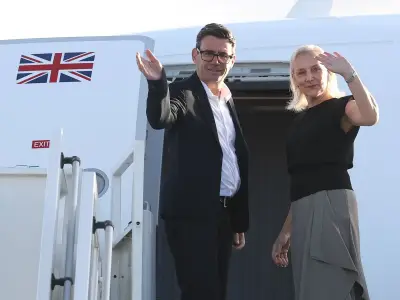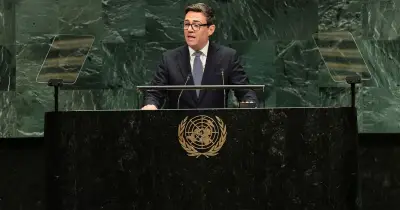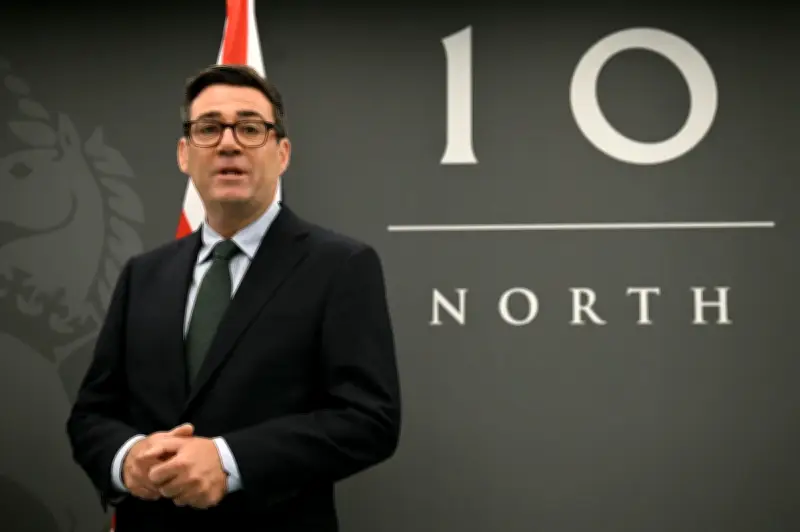
Prime Minister Andy Burnham has used a marathon broadcast round to “knock dead” a rumour he is considering an early general election, as he heads to Liverpool to front the Labour Party’s annual conference for the first time.
The Prime Minister will head to Merseyside alongside party delegates and activists for the event, which begins at the weekend and will end on Wednesday.
Conference guide message
Writing in this year’s conference guide, Mr Burnham described attending the conference as his party’s leader as “a huge honour”.
He added: “I joined our party when I was 15 for the same reason so many of you did – to help change our communities and to build a better, fairer country.
“And that is the focus of this Labour Government.
“For too long, politics has not been working for people across Britain. We need to do better – and we will.”
Mr Burnham took the keys to No 10 from Sir Keir Starmer in July this year, having taken a seat on the House of Commons’ green benches after the Makerfield by-election the previous month.
Election speculation denied
Before heading to Liverpool, the Prime Minister took questions from more than two dozen broadcasters in a marathon media round.
Asked about media reports in recent days he was weighing up the prospect of an election as early as next year, Mr Burnham replied: “No, no election any time soon.”
He told BBC West: “I see all the speculation and it just races ahead. The media love to do that.”
He added: “I’m focused on the job as Prime Minister doing what I said I would do.
“I will lay out a big speech in Liverpool next week, which will say further about the direction I want to take the country in the coming period.
“The focus is on that: helping people with the cost of living, helping businesses with the costs of running a business.
“These have got to be the priorities right now rather than throwing the country into a backward-looking process where we are arguing again amongst ourselves.
“The time has come, draw a line, get the country looking forward, pulling together, people feeling a bit of hope in their lives again, that’s what I’m trying to do and I hope to take it further in the coming period rather than putting people back into an election cycle.”
Water reform and fuel costs
Mr Burnham also hinted water sector reform would be high on his conference agenda.
In a pre-conference teaser, he told ITV West Country: “What we need to do is start to lay out a programme for reform – and we will.
“And we can expect to hear an answer to that (at the) conference.”
The Prime Minister was asked about South West Water, which charity Friends of the Earth this year named “top of the flops” for having the highest total duration of pollution events since 2024, averaging annually at 574,323 hours.
He said he was “well aware of the strength of feeling in the region” and continued: “It was a difficult summer for people in relation to water supply.”
Speaking to BBC South, he said ministers were “looking at all of the options” to rescue another water supplier – Thames Water – which has a debt mountain of around £20 billion.
On the cost of living, Mr Burnham faced calls to say how he would ease the cost of driving, as diesel prices teeter on record highs.
According to the RAC, the average price of diesel has hit 198.32p.
Simon Williams, the automotive firm’s head of policy, has forecast “the record of 199.09p will almost certainly be surpassed over the weekend”, as the conference gets under way.
Asked whether he will cut taxes on diesel, the Prime Minister told BBC East Yorkshire and Lincolnshire: “People will have to wait for the Budget on this one.”
He added: “I am well aware, though, of the pressure on people and particularly the cost of fuel.”
But he warned the cost rise was “barely in” the UK Government’s control and said: “Obviously, it’s driven by world events and the supply of fuel or the restriction on the supply of fuel in the Middle East.”
Immigration and Brexit
On immigration, the Prime Minister said Brexit had hampered the Government’s ability to stop migrants crossing the English Channel in inflatable dinghies.
He told BBC South East the UK and European Union “had a more co-operative system, if you like, in the past” to prevent small boats crossing sea between France and Great Britain.
“We are not able to have the same levels of collaboration that we used to have, but I don’t put that forward as a reason why we won’t keep working until we get the crossings right down,” he said.
The Prime Minister said he would not name a date by which the Government would stop all crossings.
“But what I will say to you is I will not stop, nor will the Home Secretary (Shabana Mahmood), until we bear down every element of this criminal, illegal activity,” he added.