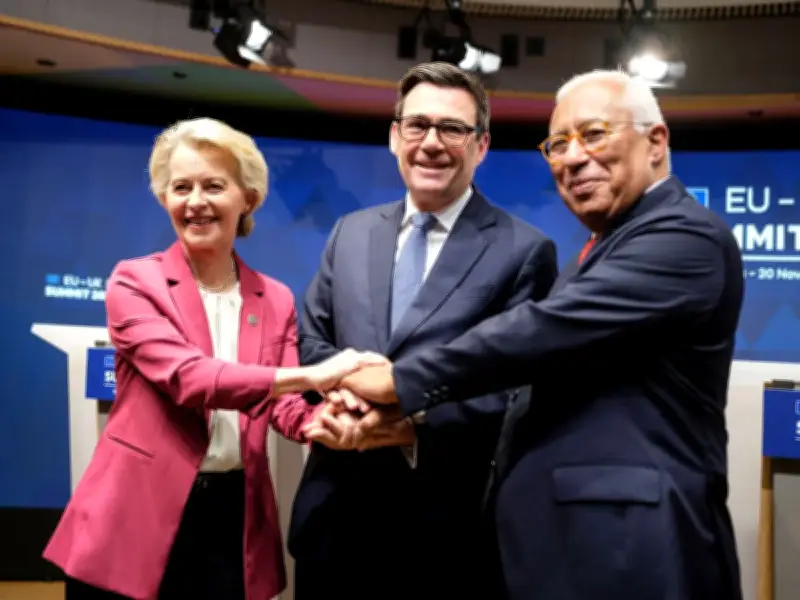
Prime Minister Andy Burnham has declared that a landmark agreement between the UK and the EU opens a "new chapter" in relations, while acknowledging that Britain has six months to agree to or negotiate an alternative to the bloc's demand for reduced university tuition fees for European students.
Speaking after signing the deal, Mr Burnham claimed it would help people worried about "the cost of the weekly shop", following agreements on food exports, youth mobility and carbon emissions.
Deal aims to cut costs and boost trade
Mr Burnham said: "Ten years on from Brexit, today we open a new chapter. Repairing a broken status quo with a Britain that is closer to Europe." He described the agreement as "a win-win", saying it "cuts costs for business, helps with the cost of the weekly shop, and creates opportunities for young people".
On food, European Commission President Ursula von der Leyen hailed the agreement to scrap most checks on British food exports in return for the UK following some EU regulations as "a big success". Under the deal, Export Health Certificates, which can cost up to £200 each, will be scrapped, with fresh produce expected to reach supermarket shelves faster, with less waste and lower costs.
Major brands including Morrisons, Tesco, Asda, Lidl, Co-op and M&S have described the deal as a big win, saying it will slash unnecessary paperwork and border checks. The government claims the food and drink deal could add up to £5.1 billion a year to the UK economy by 2040.
Angela Eagle, Secretary of State for Environment, Food and Rural Affairs, said: "British businesses have been lumbered with costly paperwork, burdensome checks and unnecessary barriers when trading with Europe. No more. This deal will help shoppers by relieving pressure on their food bill. It will help businesses grow, support jobs and strengthen our food supply chains while maintaining the high standards that the public rightly expect."
Tuition fees and youth mobility under scrutiny
A new "youth experience scheme" will allow 100,000 young people to spend time in "each other's countries" to work, volunteer, study or travel. However, the two sides need a further six months to agree on a deal on tuition fees. The EU wants rates reduced for students from member states at British universities, which could mean cuts from up to £38,000 a year to £9,970.
Under current rules, EU students are classed as international students. Any agreement would also apply to UK students in the EU. The Russell Group, which represents 24 leading universities across the UK, has warned this could "put pressure" on university places for young Britons and "take more money out of UK higher education".
Dr Hollie Chandler, director of strategic policy, said: "Our education and research links with the EU are incredibly important and EU students make a valuable contribution to our universities. However, any reduction in EU student fees would put pressure on UK student places and take more money out of UK higher education, without necessarily achieving the ambition of growing opportunities for EU students to study in the UK. It is clear from the statement today that the UK Government and the EU are aware of these risks and have agreed to take the time to fully consider the unintended consequences before taking any final decisions."
Emissions trading and Ukraine support
The 14-page document also states that talks on linking the EU and UK emissions trading systems have concluded, with an aim to apply the agreement from 2028. It will exempt £6.5 billion of British exports, including steel and aluminium, from the bloc's Carbon Border Adjustment Mechanism (CBAM), removing a major post-Brexit barrier to trade.
Support for Ukraine remains a priority for both partners, building on the £260 million package, including 1,000 long-range drones, that the Prime Minister announced at the Coalition of the Willing meeting in Berlin on Thursday.
Mr Burnham revealed that Anneliese Midgley, the Chief Whip, will introduce a bill to Parliament next week to implement Labour's Brexit "reset" deal, which the Prime Minister claims will boost GDP by 0.5 per cent. He said Friday's agreement was the "limit" of what can be achieved in this Parliament, but planned to "brainstorm" ideas for Britain's future relationship with the EU next year.
Political reactions divided
In its 2024 manifesto, Labour ruled out rejoining the EU single market or customs union and any return to freedom of movement. At the press conference in Brussels, Mr Burnham reaffirmed he would continue to honour those promises, saying: "Public opinion, I would argue, has been ahead of politicians on this question, with three quarters of people saying they wanted closer ties. So we are delivering those closer ties today, but entirely in keeping with our manifesto, which talked about the red lines that would have to be respected, so we are honouring the manifesto in full."
Nigel Farage, Reform UK leader, condemned the deal, calling it a betrayal of Brexit voters. In a post on X, he said: "Naive Andy Burnham has gone to Brussels and been hit by the stark reality I've warned about for decades. Flexibility is a fantasy. They've used this moment to strong-arm the British prime minister over tuition fee cuts for hundreds of thousands of EU students, and have absolutely no concern for the impact it will have on Britain. It's the same old game, and he's fallen for it out of sheer inexperience."
Lib Dem leader Ed Davey welcomed the deal but insisted it did not go far enough, saying: "Andy Burnham has raised everyone's hopes on Europe, but so far all it amounts to is signing off on Keir Starmer's tweaks to Boris Johnson's failed deal. A Youth Mobility Scheme is a big step forward, but nowhere near enough. We need a new deal that works for Britain, and fast."
Oliver Lewis, chairman of the Stay Out campaign, opposed to Britain returning to the EU, said: "Burnham has been played like a fiddle by Brussels, which took one look at how badly he wants a deal and decided British taxpayers should foot the bill for cheaper fees for EU students before it will sign anything."