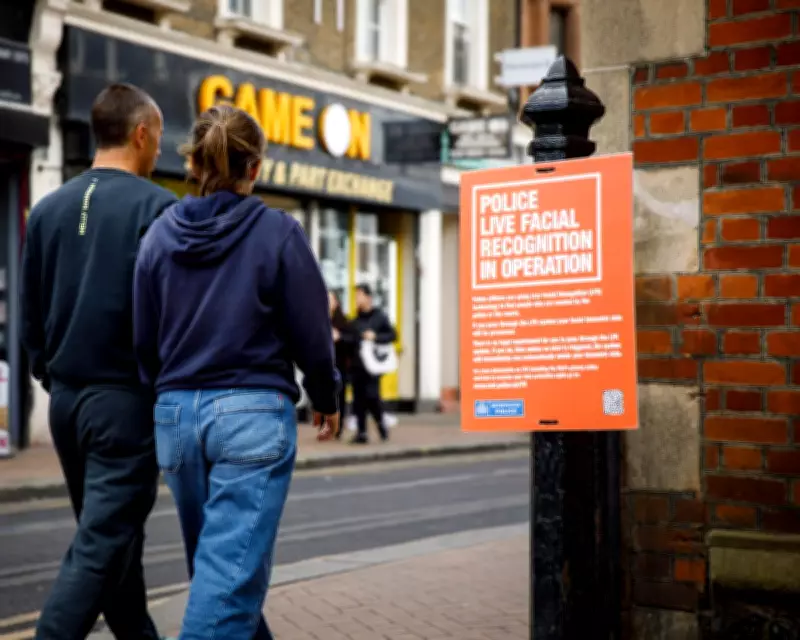
Over the last couple of days, the Guardian has reported that facial recognition technology is being rolled out across the UK at a pace that appears to be outstripping the rules designed to govern it. Police forces are increasingly using live systems to scan members of the public in real time, while retailers are deploying similar tools to identify suspected shoplifters.
Advocates of the technology argue that facial recognition is effective and here to stay. Critics warn it risks creating a system where people are monitored – and sometimes wrongly flagged – without clear safeguards.
For today's newsletter, I spoke to the Guardian's UK technology editor, Robert Booth, about how the technology works, how widely it is now being used and what happens when it goes wrong. First, this morning's headlines.

Five Big Stories
- Middle East crisis | Donald Trump has threatened that Iran will be “blown off the face of the earth” if it attacks US vessels trying to reopen a route through the Strait of Hormuz.
- Delivery industry | More than 7,000 Just Eat couriers are taking legal action against the food delivery company in an attempt to gain better employment rights, including the minimum wage and holiday pay.
- Europe | At the European Political Community summit in Yerevan, Keir Starmer has called on Europe to “face up” to tensions with the Trump administration, as heads of government gathered to discuss the EU's loan scheme for Ukraine.
- UK news | Keir Starmer will call for a whole-of-society response to rising antisemitism on Tuesday, saying that it is not enough simply to condemn the scourge, but people “must show it” through their actions too.
- Cost of living | Food prices are set to be 50% higher by November compared to 2021, according to research by the Energy and Climate Intelligence Unit.
In Depth: 'There's a Sense That It's Happening in a Creeping Way'
One afternoon recently in Croydon, Robert Booth watched as police officers trialled a deployment of live facial recognition cameras. Mounted high above the street, the cameras were switched on for a few hours at a time. Nearby, uniformed and plainclothes officers lingered, waiting. When someone on a watchlist passed through the camera's field of view, an alert was sent to officers' phones. What happened next was striking.
“It was like a trap snapping shut,” Robert tells me. Within seconds, officers converged on the individual – “a kind of net closing” – often before the person had any idea they had been identified. In one case, he saw a man taken to the ground by several officers in a matter of moments.
“It all just happens in a flash,” he says. “That kind of thing happening in the public sphere, enabled entirely by technology, feels quite new.”
How Does It Work – and Why Now?
Live facial recognition systems, as Robert wrote in this explainer, scan faces captured on camera and compare them against watchlists compiled by police or private operators. If the system identifies a potential match, it alerts officers, who can then decide whether to intervene.
Part of the appeal is clear: it can be effective. Police say it has led to arrests, and businesses claim it acts as a deterrent to shoplifting.
But the rapid uptake of facial recognition reflects a broader pattern seen with other technologies, from social media to age verification, where adoption has outpaced the development of clear regulatory frameworks to govern it. And use is rocketing: so far this year the Metropolitan police in London has scanned more than 1.7 million faces, up 87% on the same period in 2025.
The 'Edge Cases' Where Concern Arises
On Monday, social affairs correspondent Jessica Murray reported on the case of Ian Clayton, a retired health and safety professional from Chester. He is one of a number of people who have spoken to the Guardian after being falsely identified as a thief by shops using Facewatch, a live facial recognition system. He described the experience of being thrown out of a store after his face was flagged as “very Orwellian”, adding “it was like I was guilty until proven innocent.”

“These are straightforwardly difficult and wrong situations. The question is how widespread those cases are,” Robert says. “The technology itself may improve, and the systems around how it's used may improve, too,” he adds. Even so, a small error rate can easily become significant if the technology is deployed more widely.
Beyond individual errors, there is a broader concern about the cumulative effect of the technology – that simply moving through public space increasingly involves being unknowingly monitored and checked against databases.
What Do the Public Think?
Robert spoke to people in Croydon when he was observing the police using the system. “Some take the view that if you've got nothing to hide, there's nothing to worry about,” he tells me. “They also point out that our faces are already used in lots of different ways online and for unlocking our phones.”
Others are more concerned. “They worry about the risk of mistaken identity, and the fact they may not even have noticed the cameras. There's a sense that it's happening in a creeping way.”
There are also people who are very much opposed to its use. Robert says they consider hundreds and thousands of faces being scanned in public as “a clear infringement of their liberties”. The campaign group Liberty have warned that, as the situation stands, police could use the tool as a means of intimidation at protests, retroactively on any image or footage they hold, and have used it to track children as young as 12. Data has also shown that systems are more likely to incorrectly include black and Asian people than their white counterparts in search results.
What Happens Now?
“The key question is whether regulators can make sure the downsides of the technology don't happen – so that people can feel they're getting the benefits without the harms,” Robert says.
One thing is clear – oversight is fragmented. Several bodies are involved, including the Information Commissioner's Office and the Equality and Human Rights Commission. Watchdogs have warned that this patchwork approach is struggling to keep pace with the technology's rapid development. The Home Office has said it is considering a new legal framework for the technology.
For now, the direction of travel is clear. “The technology is clearly going to keep advancing,” Robert says. “The question is whether the rules around it can keep up.”