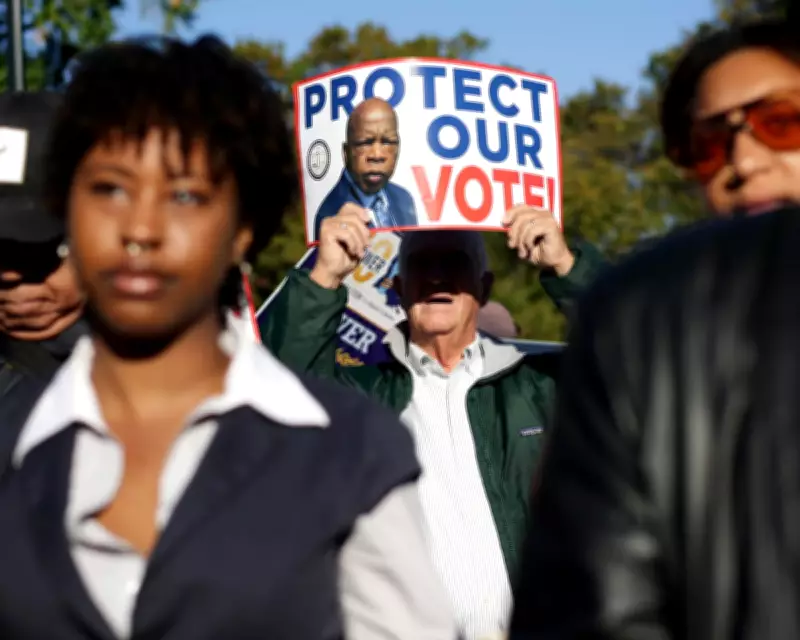
The US Supreme Court has dealt a significant blow to the Voting Rights Act, striking down a major section of the landmark 1965 civil rights legislation. In a 6-3 decision along partisan lines, the court effectively gutted Section 2 of the act, which had been the primary tool for preventing racial discrimination in voting. The ruling, which centered on Louisiana's congressional map, threatens to weaken the voting power of minorities across the United States.
Details of the Supreme Court Ruling
The Supreme Court found that Louisiana's congressional maps violated the equal protection clause. Writing for the majority, Justice Samuel Alito argued that Section 2 does not require states to draw majority-minority districts, a practice that had been used for decades to ensure fair representation for minority voters. This decision marks the culmination of a long campaign by Justices John Roberts and Samuel Alito to roll back civil rights legislation.
Reactions from Lawmakers
Representatives Terri Sewell and Shomari Figures, who now face the risk of losing their seats in Alabama's Black congressional districts, have condemned the decision. They stated that it sends the nation "backwards" and undermines decades of progress in voting rights.

Impact on Midterm Elections
The ruling leaves little time to redraw congressional maps before the upcoming midterm elections. Political analysts are assessing how the decision could reshape the electoral landscape, with both parties potentially gaining or losing seats depending on redistricting outcomes.
Trump Threatens to Reduce Troops in Germany
In a separate development, former President Donald Trump has threatened to reduce the number of US troops stationed in Germany. This comes after German Chancellor Friedrich Merz criticized the US for being "humiliated" by Iran. Trump's statement, made on Truth Social, has raised concerns in Berlin and across Europe, especially given his previous threats to withdraw from NATO.
Merz's Response
Merz sought to downplay the situation, but Trump's threat adds to tensions between the US and its European allies. The German leader had earlier suggested that Trump's team was being outmaneuvered by Tehran's tactics.
Elon Musk's Legal Battle with Sam Altman
The trial between Elon Musk and Sam Altman over the control of OpenAI continued with intense cross-examination. Musk accused Altman of stealing a charity and endangering humanity with artificial intelligence. OpenAI's lawyers pressed Musk on his claims, leading to heated exchanges in court. Musk argued that Altman and co-founder Greg Brockman violated the founding agreement of OpenAI, which was to develop AI for the benefit of humanity, by converting the non-profit to a for-profit structure.
OpenAI's Defense
OpenAI has rejected Musk's allegations as "motivated by jealousy," asserting that Musk was always aware of the company's plans and left only after a failed attempt to take it over.
Other News Highlights
- New York City Mayor Zohran Mamdani snubbed King Charles, refusing a private meeting and calling for the return of an Indian diamond taken by the British crown in 1849.
- The AI coding tool Cursor accidentally wiped a business's entire database and backups, admitting it violated its own principles.
- Former FBI Director James Comey appeared in court after being indicted over an Instagram post, part of a renewed effort to prosecute political enemies of the president.
Oil Prices Surge
The price of Brent crude oil jumped more than 13% in 24 hours, exceeding $126 a barrel for the first time since 2022. The surge follows Donald Trump's statement that the US blockade of Iranian ports could last for months, as peace talks stall.
Climate Check: WPP's Role in Oil Industry Advertising
A new analysis reveals that UK-based advertising corporation WPP helped oil companies ExxonMobil, Chevron, Shell, and BP spend an estimated $1.5 billion on ads in the US since the 2015 Paris climate agreement. A congressional investigation concluded that these companies used deceptive communications strategies to obstruct policies aimed at reducing reliance on fossil fuels.

Last Thing: Rendlesham Forest UFO Mystery
In 1980, two US airmen reported a suspected extraterrestrial sighting near a military base in England. The Rendlesham Forest incident remains unexplained, with theories ranging from a deer and a lighthouse to a genuine UFO encounter. Journalist Daniel Lavelle traveled to the US to investigate, concluding that while it may boil down to a case of mistaken identity, the mystery endures.