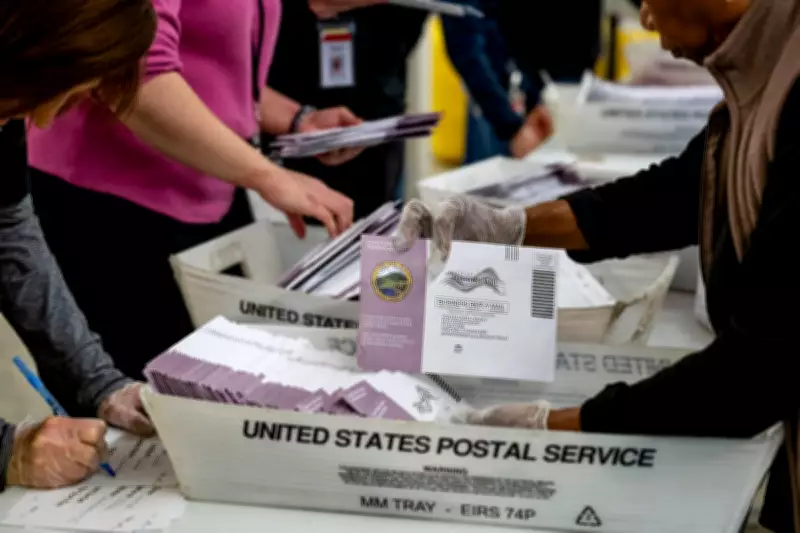
US Supreme Court Appears Set to Limit Mail-In Ballot Counting Ahead of Midterms
In a pivotal hearing on Monday, the US Supreme Court signaled a potential shift in how mail-in ballots are counted if they arrive after election day. This case, which could reshape election procedures in more than a dozen states, centers on a challenge brought by the Republican National Committee against a Mississippi state law.
Case Focus and Broader Implications
The justices are deliberating on Watson v Republican National Committee, a dispute over Mississippi's 2020 law that allows mailed ballots to be counted within five business days of election day, provided they are postmarked by that date. Initially enacted during the Covid-19 pandemic, this law is now under scrutiny as the Republican party argues it violates federal statutes setting election day as the first Tuesday of November.
Beyond Mississippi, fourteen states, Washington DC, and three US territories have similar provisions permitting late-arriving ballots to be counted. Some of these jurisdictions offer even longer grace periods and do not require postmarks, broadening the case's potential impact on national election administration.

Judicial Questions and Arguments
During the hearing, conservative justices, including Samuel Alito, raised concerns about election integrity and the potential for outcomes to shift if ballots are tallied after election night. They posed hypothetical scenarios, questioning the limits of such grace periods and whether Congress intended to prohibit post-election day ballot receipts.
In response, Mississippi Solicitor General Scott G Stewart defended the state's authority, stating, "History shows that election administration is dynamic. States have wide leeway. They just have to make sure that the voters make a choice by election day." He emphasized that no historical examples exist of voters recalling mailed ballots to change their votes.
Liberal justices, such as Elena Kagan, offered more supportive inquiries, highlighting federal laws like the Uniformed and Overseas Citizens Absentee Voting Act that acknowledge grace periods. They suggested the challenge might inadvertently target early voting practices, which are widespread across the United States.
Background and Political Context
The RNC initially lost this case in district court but prevailed in the fifth circuit court of appeals. Ally Triolo, the RNC's election integrity communications director, argued that the principle is straightforward: "ballots must be received by Election Day" to prevent prolonged elections and maintain public trust.
However, voting rights advocates, military voters, and overseas voter groups have filed amicus briefs supporting Mississippi, warning that eliminating grace periods could disenfranchise those facing unique voting barriers. They contend that such rules are essential for ensuring all ballots are counted fairly.
Mississippi, in its brief to the Supreme Court, asserted that the appellate decision was "wrong," arguing that federal law only requires voters to cast ballots by election day, not for all ballots to be received by then. The state maintains that its law aligns with this interpretation, allowing election officials time to verify signatures and cure ballots as needed.
Broader Political Ramifications
This case unfolds amid national Republican struggles with mail voting, a common practice in many states. While figures like Donald Trump have advocated for banning mail voting entirely, others recognize that Republican voters also rely on it at high rates. Curtailing grace periods could inadvertently harm Republican candidates by affecting their own supporters.
The Trump administration has sought greater control over elections, including attempts to override state laws via executive orders and push for stringent voter ID legislation. This Supreme Court decision could significantly influence those efforts and the broader landscape of US voting rights as the midterm elections approach.