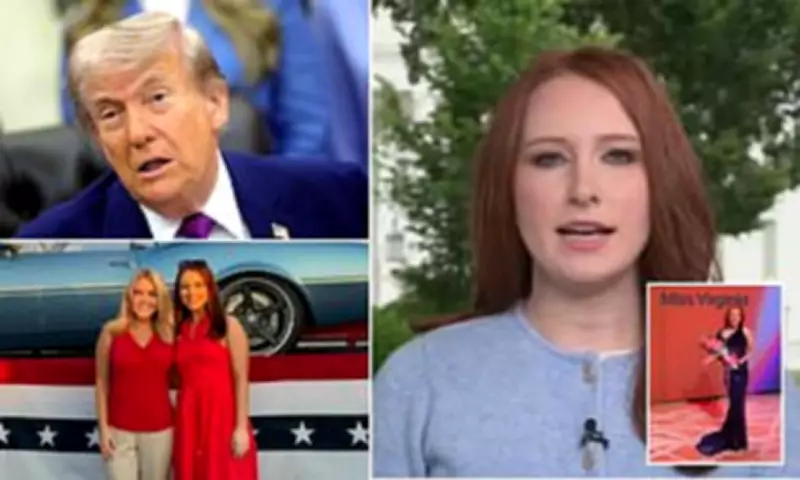
White House spokesperson Anna Kelly on Monday defended President Donald Trump's controversial proposal to turn Venezuela into the 51st American state, sparking debate over the feasibility and legality of such a move.
Kelly's Defense of the Plan
Kelly, a former beauty pageant competitor and principal deputy White House press secretary, has stepped into a larger role with press secretary Karoline Leavitt on maternity leave. During an interview on Fox News Channel, journalist John Roberts pressed Kelly on Trump's remarks, which he made earlier that day in a phone interview. Roberts noted that Trump told him, 'I'm very serious about this,' and asked Kelly to elaborate.
'Well, John, I won't get ahead of what the President was comfortable sharing with you as far as those plans go,' Kelly responded. 'But look, this is a President who is famous for never accepting the status quo.'

Constitutional and Diplomatic Hurdles
Making Venezuela a state would require approval from the U.S. Congress, as well as the consent of Venezuela, a sovereign nation. Roberts pointed out that the United States has never absorbed another country, but Kelly did not address how such a process would work. Instead, she emphasized Trump's willingness to consider unconventional options.
'He is always considering a host of options to improve our country,' Kelly said. 'And of course, Venezuela, now led by President Delcy Rodríguez, is working incredibly cooperatively with the United States, so I won't get ahead of any plans that the President may have to that effect.'
Background on Venezuela and Trump's Actions
In January, Trump ordered the capture of Venezuelan dictator Nicolás Maduro, leaving his deputy, Delcy Rodríguez, in charge. The President bypassed Venezuelan opposition leader María Corina Machado, even after she gifted Trump her Nobel Peace Prize in mid-January. With Trump's focus now on Iran and Americans weary of war, the White House has sought to portray Venezuela as a success story.
'This has been a tremendous success,' Kelly argued. 'The United States is revitalizing our relationship with Venezuela and, in turn, improving the economic situation of both countries and our people.'
Trump's History with Statehood
Trump has traditionally opposed adding more U.S. states due to political considerations. Statehood is overwhelmingly supported in Washington, D.C., where approximately 700,000 residents lack voting representation in Congress but vote in presidential elections. In the 2024 election, 90.3% of D.C. residents voted for Democratic nominee Kamala Harris, while only 6.5% voted for Trump. Puerto Rico, another territory pursuing statehood, remains divided on the issue.
Last month, at an event on Trump-branded retirement accounts, the President warned that if Democrats regained the Senate, they would quickly seek to make D.C. and Puerto Rico states. 'That would mean automatic four senators go into the Democrat column,' Trump said. 'And there's not even a chance they don't do it and don't do it immediately.'
Kelly's comments underscore the administration's unconventional approach to foreign policy and territorial expansion, though significant legal and diplomatic obstacles remain.