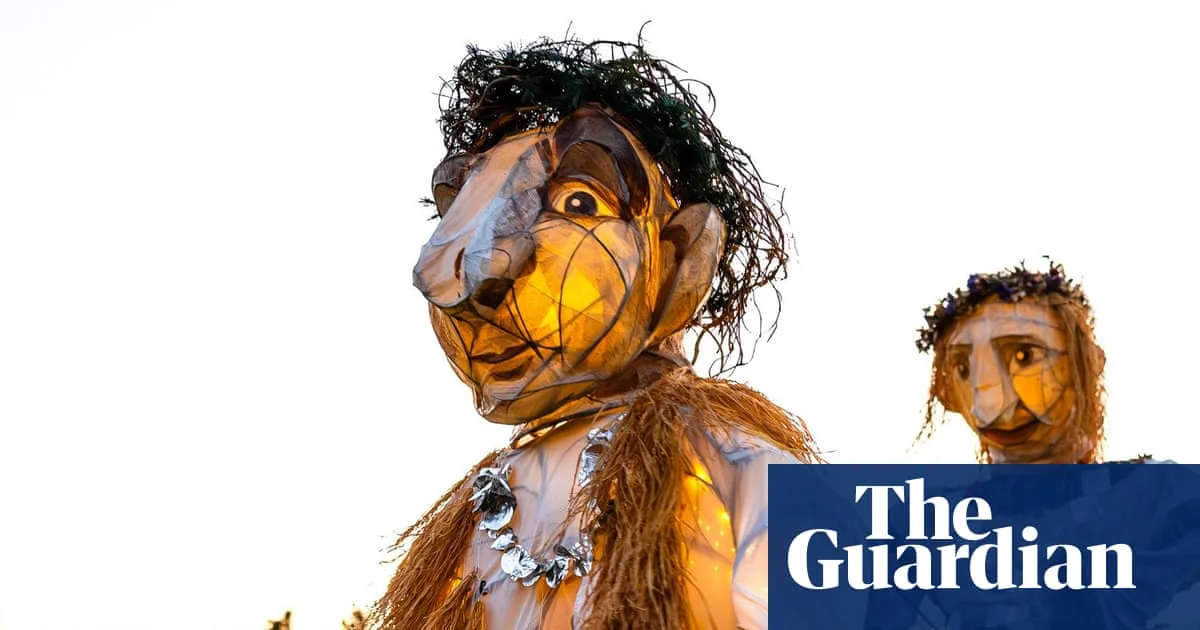
On New Year's Eve 2025, environmentalist and author Lisa Schneidau experienced something extraordinary in Lostwithiel, Cornwall. She welcomed 2026 surrounded by giants. "At a certain time of the evening, they started appearing from all over the town. Then everyone flooded out of their houses and congregated into a massive procession of giants and lights and drums and music. It was absolutely extraordinary."
This fairytale scene was orchestrated by The Lost Giants (TLG), a collective of craftspeople and artists reviving the British tradition of creating enormous effigies. These giants, made of wooden frames, cloth, papier-mache, and card, come alive during community processions.
A Historic Revival
In medieval times, workers' guilds and villages across the UK created giant mascots for festivals. Now, thanks to growing interest in community activism, folk traditions, and craftsmanship, processional giants are making a spirited comeback. TLG has created giants for events ranging from Cornwall's annual lantern parade to a harvest procession at Hauser & Wirth's Somerset gallery. This month, the collective issued a public callout for an environmental group to collaborate on making a new beastie.
The Founders and Their Inspiration
TLG was founded three years ago by theatre designer Ruth Webb and her sister-in-law Amy Webb, a designer and illustrator. Schneidau joined last year after a career with wildlife trusts. Ruth's connection to giants dates back to childhood; her father, John Webb, ran the Cornwall folk festival and brought a giant called Peter to Lostwithiel in 1990, made by Michael and Wendy Dacre of Raven Tales.
Processional giants have long existed in British culture—the Salisbury Giant, created by a tailors' guild in the 1400s, is the UK's oldest surviving giant. Ruth believes the current revival was sparked by European cultural exchange programmes in the 1980s. "Town twinning meant British people saw traditional village giants from Spain and France. Dorset and Cornwall became strongholds for making these statuesque giants," she says. Outdoor theatre companies like Welfare State International also influenced the movement, using puppets and creatures for political statements.
Modern Giants with an Eco Message
TLG's creations blend tradition with modern ecological activism. They have made a sisal mountain goat called Ooelle with a third eye, and brought Old Crockern, the vengeful guardian spirit of Dartmoor, to life using plaited reeds from the River Dart. In October 2024, a squadron of animal giants marched on St Paul's Cathedral to demand the Church of England commit to rewilding land.
"For those without a large voice, giants can show our collective desires and strength," says Ruth. "The scale allows us to think beyond ourselves. Adopting a persona lets us say the unsayable." Schneidau adds that Old Crockern's presence at Dartmoor protests was powerful: "It gave personhood and agency to the land."
Community and Collaboration
This year, TLG received a grant from the Ffern Folk Foundation to create the Big Folk Archive, an online photo archive of giants, and to fund a new giant for an environmental campaign group in the south west. They are now seeking applicants. "We need them to explain why a giant would be important to their group," says Schneidau. "We ask: 'What's the spirit of your land?'"
Ruth emphasises practicality: "It has to be about community. Making a giant offers a different space—we bond while creating something together, which is crucial for any campaign." To apply, visit The Lost Giants website.






