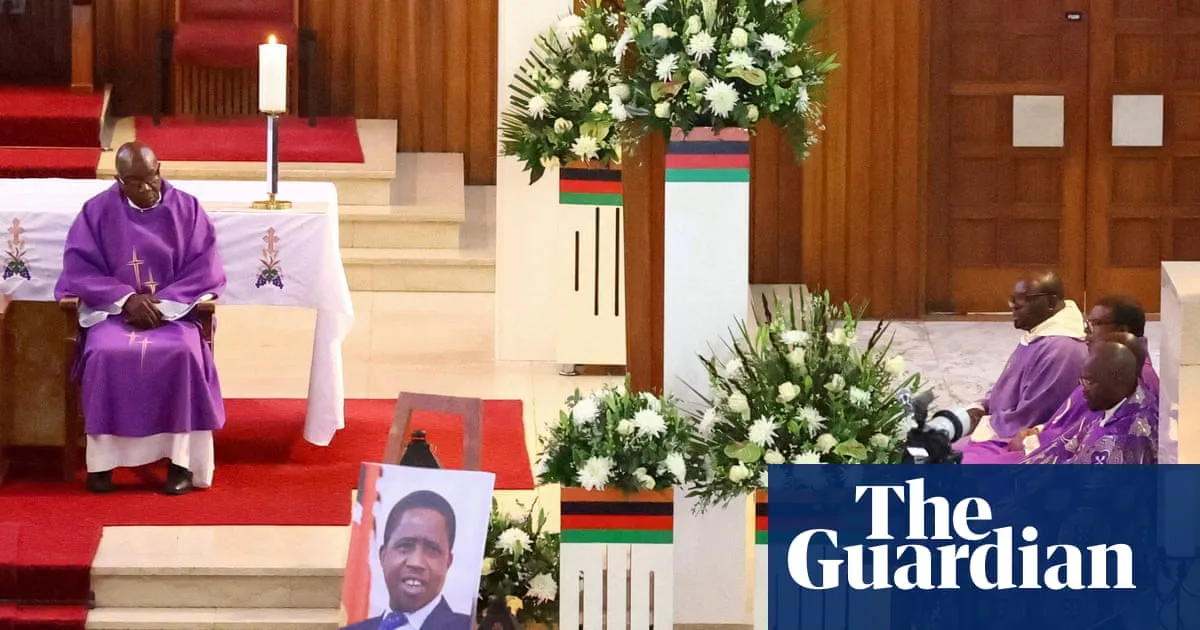
The body of former Zambian president Edgar Lungu remains in South Africa as his family fights to prevent his repatriation for a state funeral presided over by his successor, Hakainde Hichilema. The dispute, now before South Africa's constitutional court, has deepened political tensions in Zambia.
Lungu died in June aged 68 while being treated for an undisclosed illness in Johannesburg. His family claims he explicitly requested that Hichilema not attend his funeral. The Pretoria high court ruled on 8 August that Lungu's body could be returned to Zambia for a state funeral, but the family applied for leave to appeal. The case was adjourned indefinitely on Monday pending a decision by the constitutional court on whether to hear the appeal.
Zambia's attorney general, Mulilo Kabesha, argues that a state funeral is a legal requirement under Zambian law, citing a precedent set by the burial of first president Kenneth Kaunda. Emmanuel Mwamba, a spokesperson for Lungu's Patriotic Front party, countered that a state funeral could proceed without the current president's presence, focusing instead on military honours and protocols.
The feud between Lungu and Hichilema dates back to 2016 when Lungu narrowly defeated Hichilema in a disputed election. In 2017, Hichilema was jailed on treason charges after his convoy failed to yield to Lungu's motorcade; he was released four months later. Hichilema finally defeated Lungu in 2021 amid an economic crisis and has since faced accusations of political repression, including restricting Lungu's movements and bringing corruption charges against his family.
Political historian Sishuwa Sishuwa of Stellenbosch University noted that the burial dispute has exacerbated regional and political polarisation. 'Whatever way the dispute is resolved, it will have a significant bearing on the 2026 elections,' he said, adding that the government's court action aims to avoid the political costs of burying Lungu in exile.