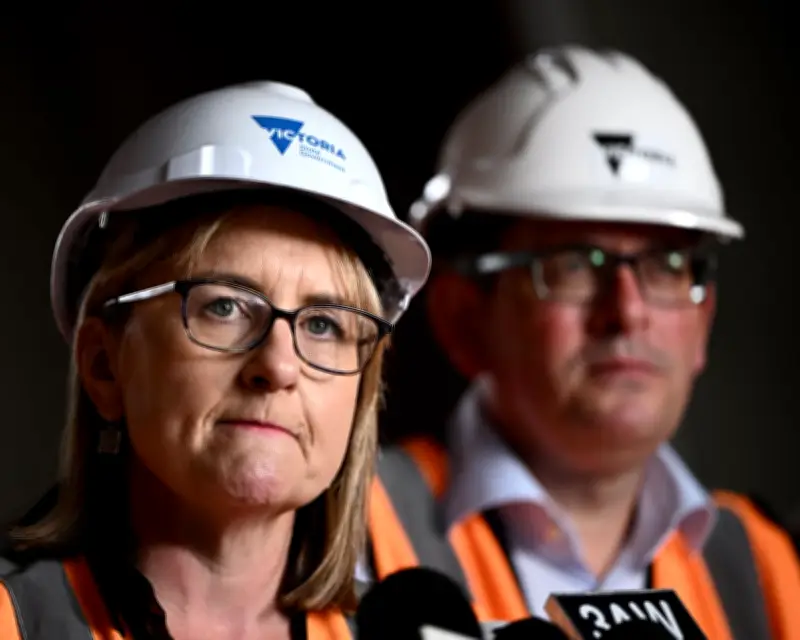
Victoria is in the midst of a historic transport construction boom, but what the Labor government touted as the “largest infrastructure build in the state’s history” has become marred by scandal.
The state government has long spruiked its $100bn-plus “Big Build” and its long-term benefits. Yet it is increasingly dogged by allegations of gangland figures and bikie-linked operators securing lucrative work on its projects and allegations of massive budget blowouts due to the allegedly corrupt influence of the Construction, Forestry and Maritime Employees Union.
The premier, Jacinta Allan – who previously served as the minister for transport infrastructure overseeing the Big Build – has regularly defended the government’s actions while rejecting growing calls for a royal commission.

What is the Big Build?
The state’s biggest infrastructure construction program includes the recently completed Metro Tunnel and level crossing removals. In total, more than 180 projects under the Big Build umbrella are being built across the state, from the Suburban Rail Loop to the regional rail revival. Since 2015, firms have been given around $109bn in public money to complete the various projects – many of which have had major cost blowouts.
Why is it costing so much?
That depends on who you ask. The government has blamed inflation, supply chain disruptions and rising labour costs. In June, Allan declared that “inflationary pressures on projects is not corruption”, after Nine newspapers reported money from the state’s Big Build was being paid to gangland figures.
However, documents – many of which were first reported by the Age – point to union corruption, which added premiums of up to 30% to major project budgets. Geoffrey Watson SC, a director of the Centre for Public Integrity who was appointed by the CFMEU administrator to investigate allegations of corruption and criminal offences within the union, said solely blaming inflation was “nonsense”. “Inflation may have some sort of a role but it’s a relatively minor one, and in any event standard inflation rates would have been built into the earlier estimates as they always are,” he said. Some experts had previously pointed to increased costs of materials and equipment.
Where does the CFMEU fit in?
The scandal engulfing the Big Build involves allegations that organised crime figures and bikie gangs have infiltrated major infrastructure projects, including through the CFMEU. Investigations indicate extortion, violence and billions of dollars in bribery-inflated project costs, with funds allegedly siphoned into ghost shifts, nepotism and payments to underworld figures.
In 2024, then Victorian CFMEU boss, John Setka, quit after 12 years at the helm after a Nine investigation unearthed a raft of misconduct allegations that detailed how some of the highest-ranking bikie bosses had been parachuted into union delegate positions on the Big Build. Upon resigning, Setka said he had been the target of “ongoing false allegations” which had led to “malicious attacks” on the CFMEU.
The prime minister, Anthony Albanese, said Setka had “no legitimate place in the Labor movement” and the construction and general division of the CFMEU, including all its state branches, were placed into administration. Allan sought the suspension of the union’s construction division from the Victorian Labor party over the criminal allegations, asking the state branch to bar all political donations from the union.
In February, Watson’s report titled “Rotting from the Top: The CFMEU in Victoria during the Setka Era” was tendered during a Queensland inquiry into the union. It found that: “Two things are constant – the leadership of John Setka and his team and the role of the Big Build. Things went badly downhill when the Big Build really got going in 2015.” Watson wrote that the “temptation created by the big money proved too great.”
How much of this was known by the government?
It is unclear how much the government knew. There is no evidence Allan personally approved any corruption, but the opposition has referred Allan to Victoria’s anti-corruption watchdog over allegations her office directed builders to cut a deal with the CFMEU and a labour hire company being investigated by police.

In one chapter of his report, Watson alleged the Victorian government “knew and had a duty to know” that corrupt union and underworld figures had infiltrated the Big Build but chose to do “nothing about it”. In a recent op-ed in the Age, Allan acknowledged there had been criminality. “We now know that criminals operated on some of Victoria’s construction sites. There was violence, intimidation and organised criminal behaviour. That is shocking and unacceptable. It should never have happened,” the premier wrote.
She did not address claims – also published in the Age – about her time overseeing the Big Build as transport infrastructure minister. It was reported that government officials told a rail consortium that the then-minister wanted it to cut a deal with the CFMEU over a level crossing removal project. This reportedly resulted in the union forcing its preferred labour hire company on to a level crossing removal site. It was separately claimed that ministerial pressure was applied from Allan’s office in a 2022 dispute between the CFMEU and a rail infrastructure partnership that involved large contractors and government agencies.
In her piece, Allan said it was best for police to investigate any allegations of wrongdoing. “We gave Victoria Police stronger powers to investigate this criminal conduct. They have now laid more than 90 criminal charges,” she wrote. “We gave the Labour Hire Authority stronger powers to cancel construction licences. It has done so for 164 firms. The CFMEU was put into administration, and I kicked them out of the Victorian Labor Party. Construction companies working on government projects are now required to report suspected criminal behaviour, workers have stronger whistleblower protections, and state agencies share intelligence with the federal government so nothing falls between the cracks.”
What’s next and will there be a royal commission?
With a state election four months away, the debate has turned to whether there needs to be a royal commission into the corruption. Allan, who has repeatedly said allegations of construction sector illegality should be referred to police, consistently rejects calls for a royal commission.
Among the loudest voices calling for a royal commission is Watson, whose report estimated $15bn might have been lost to wrongdoing on taxpayer-funded construction sites in Victoria. Allan has previously disputed that figure while members of her government have cast doubt on Watson’s methods.
Former Victorian ombudsman Deborah Glass and the former head of the state’s anti-corruption watchdog Robert Redlich are among critics calling for an urgent royal commission, with Redlich describing it as an “unprecedented historic scandal”. The opposition leader, Jess Wilson, has promised that if elected in November her government will establish a royal commission into what she has labelled “the largest corruption scandal in this state’s history”.