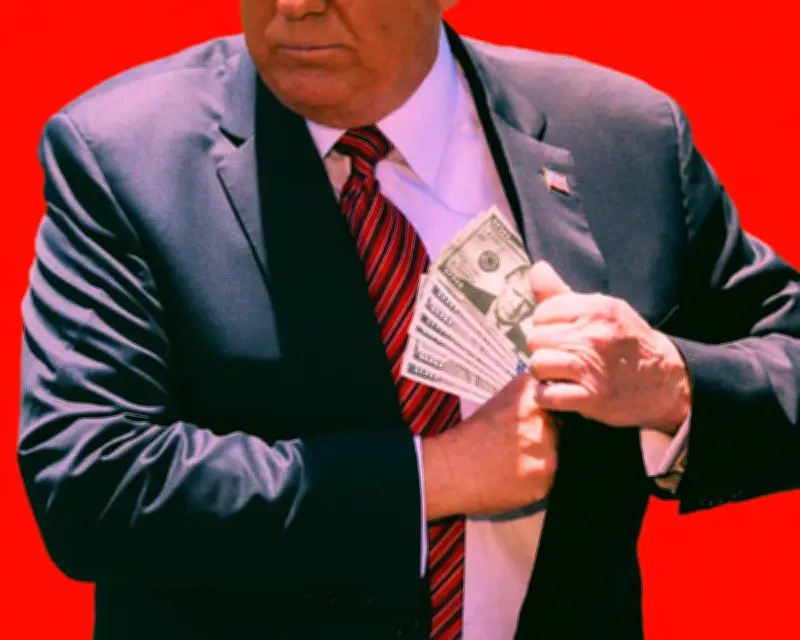
Experts say Donald Trump is vulnerable to a popular backlash amid claims of corruption, as discontent grows over rising prices and the US public has ample cause for complaint.
In Trump's telling, he is a model of incorruptible self-sacrifice. "I'm the only president that donated his salary," he told supporters at a Hispanic heritage month celebration in the White House last week, before conceding that George Washington – "a very wealthy person" – might have beaten him to the punch. "They pay me $550,000 a year, and in my first term, I donated it," he continued. "In my second term I donated it too. I donated it to fixing the White House. I donated the salary into the White House preservation."
Trump's ethical self-depiction was undercut a day later when the crypto company that runs his memecoin offered "the most exclusive dinner in the world" at the president's members-only Trump National club in Washington. The invite to the 185 biggest investors in the Trump coin promised an appearance by "three legends and featured speaker Donald J Trump". The top 29 buyers were promised an invitation to an additional "VIP reception with your favourite president and one of the legends". For the top four donors, a Trump 18-karat gold watch lay in store.
Memecoin profits and political gift
The aim appeared to be to boost sales of the memecoin – called $Trump – over the next two months. Trump personally profits from the coin, and disclosures show he made about $636m from it last year.
With just over a month to go before November's midterm elections, Democrats seized on the dinner invitation as a political gift as they try to convert concerns over Trump's perceived corruption into a groundswell of outrage. They theorize it will power a "blue wave" that could enable the party to retake control of the House of Representatives and the Senate on 3 November. "Donald Trump is vying to become the most corrupt person to ever walk the face of the earth," posted Chuck Schumer, the Democrats' leader in the US Senate.
With the US president's approval ratings already at record lows amid discontent over rising living costs fueled by the unpopular war with Iran, ethics experts say "unprecedented" levels of corruption engaged in by Trump, his family and close associates are sufficiently serious to make him vulnerable to a popular backlash. The question is whether the myriad of accusations – many of them technical in nature – are straightforward enough to carry popular resonance.
Administration rejects assertions
The administration vigorously rejects the assertions, which a White House spokesman, Davis Ingle, called "irresponsible" and likely to "reinforce the public's distrust in what they read". "President Trump only acts in the best interests of the American public – which is why they overwhelmingly re-elected him to this office, despite years of lies and false accusations against him and his businesses," he said in a statement. "There are no conflicts of interest."
"The only special interest guiding President Trump's decision-making is the best interest of the American people," Ingle added, citing actions such as negotiating most-favored-nation pricing deals with major pharmaceutical companies, launching TrumpRx.gov to lower drug prices, ending unfair trade practices, and implementing schedule F to fire unelected bureaucrats. "Through these actions, President Trump is delivering on his promise to empower the forgotten men and women of our country by finally putting their interests first."
Recent surveys, however, indicate American voters are more concerned than ever before about government corruption. A Gallup poll published in September recorded 89% of all adults as saying the problem was widespread. Only Lebanon, Peru, Ghana and Nigeria have registered higher levels of public concern in the past three years.
Areas of potential abuse
Analysts insist the US public has ample cause for complaint. "We're facing an ethics crisis which starts and ends with a president who is constantly using his office to find new ways to personally profit," said Jordan Libowitz, communications vice-president with Citizens for Responsibility and Ethics in Washington, a non-partisan watchdog. "With a new story every day about Donald Trump using the presidency to line his pockets, it's no surprise that Americans are losing faith in their government."
Trump's own filings show he earned $2.2bn from his various business dealings in his first year back in the White House – including $1.4bn from his family's cryptocurrency enterprise, World Liberty Financial. Observers identify at least three main areas of potential abuse: crypto, a venture which Trump denounced as a "fraud" just five years ago; stock trading by government officials, including the president himself; and the predictions markets, represented by companies such as Kalshi and Polymarket, both of which have links to Donald Trump Jr, and which have raised concerns about well-connected figures profiting through putting bets on government decisions and the content of official speeches.
There are also concerns about the growth of "pay to play" practices that have seen wealthy donors being granted special access and favorable decisions, including dropped criminal investigations, in exchange for donations to Trump's campaign and political Super Pac. Presidential pardons and sentence commutations have been doled out to those who have contributed to the president's re-election effort.
As Schumer's post indicates, Democrats have increasingly tried to make corruption a campaign issue. A 30-second advertisement from Chris Pappas, a New Hampshire representative running for re-election, reflects a more widespread mood in favor of putting it center stage. The question is whether the message on rampant graft is cutting through with an electorate that may find inflation and higher living costs easier issues to grapple with.
Voter confusion and apathy risks
Dylan Hedtler-Gaudette, director of government affairs at the Project on Government Oversight, another watchdog group, acknowledged that many voters were confused by the complexity of the accusations leveled at Trump. "Support for the Trump administration and for President Trump himself is declining pretty rapidly," he said. "But it's hard to disentangle. Is it about the corruption? Or is it about the affordability crisis continuing and in some ways getting worse?"
Brendan Fischer, director of strategic investigation at the Campaign Legal Center, said the public had been overwhelmed and "numbed" by a "fire hose" of corruption emanating from Trump's second presidency which, experts agree, has greatly exceeded that of his first administration. "I think the Trump's crypto dealings are incredibly concerning," he said. "His investments in the crypto industry open up new avenues for wealthy special interests to channel money to the president. But it's potentially harder for the public to grasp. So it hasn't broken through in the way that it probably should."
Easier to grasp, he believed, was Trump's acceptance of a $400m plane from Qatar, which the president has said he will use in place of the existing Air Force One. The scale and brazenness of Trump's cavalier disregard for ethical considerations creates a danger of apathy among voters, who may feel they are powerless to change the situation as they grapple with more quotidian cost issues. "It's easy to just throw your hands up and say, 'Everybody's corrupt, nobody's representing my interests, and my life is just not getting any better,'" Fischer said. "That is a dangerous situation for democracy."
Richard Painter, a former White House ethics lawyer under George W Bush, said Trump's decision to go to war with Iran opened up further corruption avenues – citing reports that both Donald Trump Jr and his brother, Eric Trump, have invested in drone manufacturers that have secured government contracts. "Whenever there's a war, there's an enormous amount of money to be made," said Painter, now a corporate law professor at the University of Minnesota. "This is what President Eisenhower talked about with the military-industrial complex back in 1961, but we've never had a president whose family actually made money from the military-industrial complex."
Painter predicted that conditions were ripe for "an enormous public backlash" but said the Democrats had to adopt a credible anti-corruption message after losing the public's confidence by failing to speak out against Hunter Biden's attempts to leverage his White House access when his father Joe Biden was president. "The Democrats had their chance in 2021 when Biden took office, when we should have had our reawakening on ethics, and they failed," he said. "If they want to win races not only in 2026, but in 2028, they'd better get their act together and focus on ethics."
One historical model, Painter suggested, was the anti-corruption crusade championed by Jimmy Carter in his successful 1976 presidential campaign, which took place amid lingering anger at Richard Nixon over the Watergate scandal that drove him from office and his failure to quickly end the war in Vietnam. Democrats have invoked a more recent inspiration: Hungary's recently elected prime minister, Peter Magyar, who mobilized rising resentment over government corruption in April this year to unseat the incumbent, Viktor Orbán – a close ally of Trump – in an election landslide.
Steven Levitsky, a political scientist at Harvard University and co-author, with Daniel Ziblatt, of How Democracies Die, said the key similarity between the US and Hungarian circumstances was the sense of corruption further undermining an already failing government. "Orbán was successful in part because the economy was pretty good for much of his period in office," Levitsky said. "But eventually it slowed down, and corruption became a major factor."
"It's sad but true that in many, many cases in democracies around the world, if incumbents are perceived to be delivering – if the economy is going well, if they brought down inflation, etc – voters will turn a blind eye to corruption," he added. "It's only when you combine poor performance with corruption that it becomes salient. Unfortunately, in the United States, one of the things that's benefited Trump is the perception that all of politics is corrupt, mainly because of the extraordinarily outsized role of money in politics. There are a lot of reasons why Trump is unpopular now. Corruption is one of them but I don't think it's the principal one."