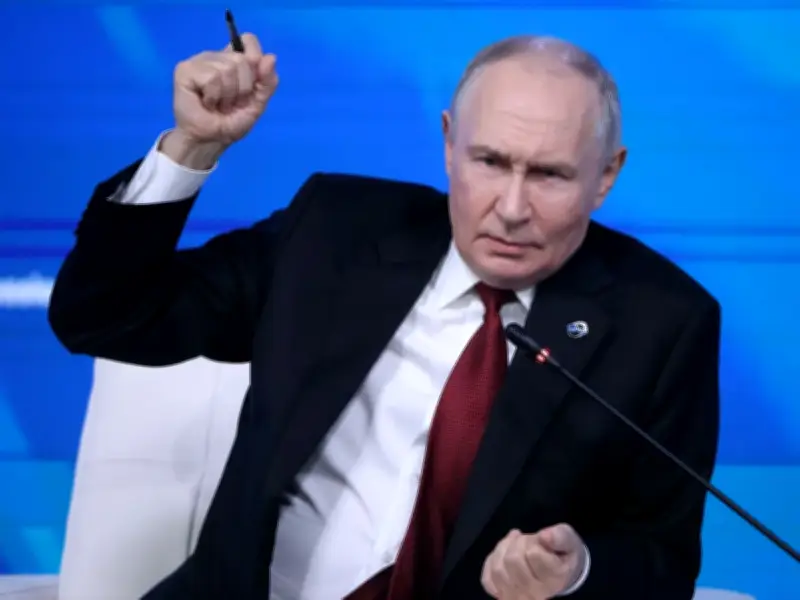
Scots are paying a "Putin Tax" as a result of Russia's "unconventional war" with the UK, a Scottish Labour MP has warned.
A report compiled by Graeme Downie, vice-chair of Westminster's all-party rearmament committee, estimates that taxpayers across the UK are already paying a minimum of £2 billion each year because of hostile activity overseen by the Kremlin.
Cost of Russian hybrid warfare
The new paper, the Putin Tax, has counted up the cost of disruption, recovery and investment in resilience that result from Russian hybrid warfare against the UK.
Recent examples of cyberattacks on British businesses include Jaguar Land Rover, Royal Mail and a variety of NHS suppliers, while the costs of damage to subsea communications cables and related infrastructure runs into the hundreds of millions.
Over 300 cyber incidents since 2022
The report also found there have been over 300 identified Russian-linked cyber incidents that have affected British companies since 2022 - all the real figure is likely to be much higher.
The report adds that 75 per cent of significant cyber incidents that affect critical national infrastructure are linked to hostile states.
Scotland on the front line
Downie, the MP for Dunfermline and Dollar, said the UK could not "deter Russia or anyone else if we aren’t honest with the British people about the threats we face and the cost the ‘Putin Tax’ is already having on our country".
He said it was "striking" that "this is the first serious attempt to measure its true economic cost to Britain", which includes cyber attacks, infrastructure threats, business losses and wider economic disruption.
He told the Record: "Scotland is on the front line of the UK's unconventional war with Russia. Our geographical location and offshore infrastructure makes Scotland a prime target - and Scottish taxpayers are already paying the price of Vladimir Putin's attacks on our country."
Political and expert responses
It comes as Tom Tugendhat, the shadow defence secretary, told the Conservative conference that Russia and Iran were committing "warlike acts" in the UK, which called for "serious, responsible government".
Tom Keatinge, a director at the Royal United Services Institute (RUSI), said: "Russia’s threat to the United Kingdom rightly commands considerable attention. Much debate focuses on the government’s response, including sanctions to constrain Moscow’s ability to sustain its illegal war in Ukraine and its aggression towards the UK and its allies."
"Yet another question receives less scrutiny: what are Russia’s hostile actions already costing the UK economy? This welcome report addresses that gap. It highlights costs borne by British businesses, public services and taxpayers through disruption, recovery and investment in resilience."
"The economic consequences of hostile activity must inform the government’s assessment of the threat, its response and the resources it commits. Measuring these costs is difficult - attribution is complex, information fragmented and consequences extend beyond immediate damage."
A UK Government spokesperson said: "We have been clear that Russia’s continued hybrid attacks are egregious and wholly unacceptable. This government has taken tough action - expelling Russian intelligence officers, sanctioning the GRU, clamping down on illicit finance networks and ensuring Russia’s criminal proxies are disrupted and brought to justice."