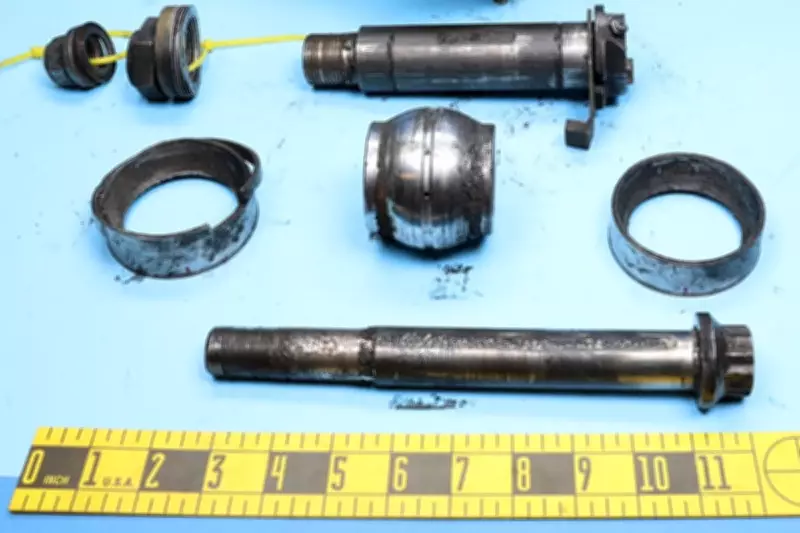
A UPS plane crash that killed 15 people last year might have been prevented if an original inspection schedule had not been relaxed. Mechanics did not get a close look at the parts that should have kept an engine from flying off its wing because federal regulators allowed Boeing to recommend checking them less frequently, according to testimony on Wednesday.
NTSB Hearing Reveals Oversight Failures
The National Transportation Safety Board's questions also drew out that Boeing relied on older data when it asked to extend the inspection schedule in 2015. The planemaker did not seem to account for seven instances on other planes of the same model when the key engine mount parts were failing. The Federal Aviation Administration approved the request after a month's review without seeking more information.
“Safety is a shared responsibility between the airline, the manufacturer, and the regulator. And the NTSB is attempting to parse out the roles and responsibilities of each of those three entities,” aviation safety expert Jeff Guzzetti said. The two-day hearing made clear that key safety information was not being shared among everyone involved. The former crash investigator said the FAA should have been more skeptical about Boeing's request.

Misjudged Risks
Boeing and FAA officials acknowledged that they misunderstood the risks related to the potential failure of a steel bearing and metal sheath in the engine mount before the crash. They did not realize that it could lead to the lugs that secure engines to an MD-11's wings breaking. The bearings are tucked deep inside near the pylons, so problems are hard to spot without removing each engine for detailed inspections.
Boeing succeeded in extending the required inspections from once every 19,900 cycles of takeoffs and landings to once every 29,260 cycles. This allowed airlines to complete more major maintenance tasks simultaneously with less downtime. The planemaker sought the change even after receiving reports about seven flaws in the bearings well before the planes had reached their original inspection limits. In the years after the schedule was relaxed, three more instances were discovered before the crash.
The Crash and Its Aftermath
The plane that crashed after losing its engine while accelerating down the runway at Louisville’s Muhammad Ali International Airport had flown 21,043 cycles. It would have been thoroughly inspected under the original schedule. The crash killed all three pilots and 12 people on the ground, with 23 more injured. There has been only one other crash, decades earlier, involving a similar plane model losing an engine, but that one was blamed on improper maintenance and not the same flaw.
Plane operators are not expected to deviate from federally approved maintenance schedules, said Greg Raiff, who owns several aviation maintenance companies and operates a fleet of planes at Elevate Aviation Group. “I would not expect UPS or any other operator to do it unless it’s specifically on the manufacturer’s design maintenance programs,” Raiff said. “Surely everyone at UPS feels awful about this tragic accident, but it’s not up to individual airlines to reinvent the inspection program for the airplane.”
FAA Should Have Asked More Questions
NTSB Chairwoman Jennifer Homendy said the FAA should have done more to challenge Boeing's request in 2015. Even if regulators did not know about all the flaws, they knew the planemaker had sent out a service letter about them and had previously reported two of them. “I’m confused on why you wouldn’t ask for more information, more testing, and why you would just accept information that Boeing provided in the late 80s during certification, 30 years earlier basically,” Homendy said.

Boeing's Director of Airframe Service Engineering Justin Konopaske did not always have answers about what his company considered at the time because the planemaker did not have the records. The MD-11 and its predecessor the DC-10 were designed and built by McDonnell Douglas before that company merged with Boeing in 1997. Still, he said Boeing should have shared the details of the problems it knew about with FAA when it applied to extend the inspection schedule. “I believe transparency is critical in that process. I don’t know what the engineers were considering or how they were considering, or if they considered those bearing failures in that discussion, I can’t say,” Konopaske said.
The NTSB will continue investigating everything that might have contributed to this crash before issuing its final report likely either late this year or sometime next year. FedEx resumed flying its MD-11s earlier this month after the FAA approved Boeing's plan to ensure their safety. The engine mounts were closely inspected following the November crash, and going forward the spherical bearings will be replaced regularly after every 4,000 cycles of takeoffs and landings. Homendy said the problems documented from 2002 to 2009 all happened between 6,058 cycles and 13,650 cycles.