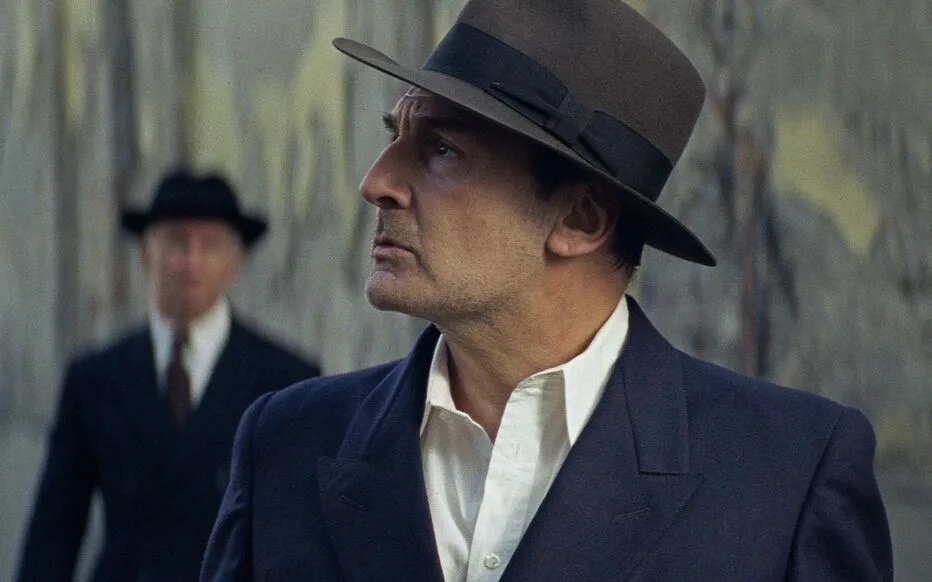
László Nemes, the Hungarian director of the acclaimed 'Son of Saul,' returns with 'Moulin,' a biographical film about French Resistance hero Jean Moulin. Despite its visually arresting style, the drama often falls flat, failing to sustain tension throughout its runtime.
The film opens with colourised footage of Nazi-occupied France, then follows Moulin, played by Gilles Lellouche, as he parachutes into the country disguised as an interior designer. The painterly night photography and booming soundscape create a sense of danger, but the narrative soon becomes bogged down in malformed double entendres and conversations about succession that are never fully explored.
It is only when Moulin is captured by the Gestapo and interrogated by Klaus Barbie, played by Lars Eidinger, that the film gains momentum. Nemes subverts the traditional biopic by starting with a slick, cinematic hero and gradually revealing his ordinariness and fear under torture. Lellouche's performance captures this demythologising, shedding suave poise for morose resignation.
Cinematographer Mátyás Erdély's 35mm photography creates a gorgeous, shadow-filled aesthetic, but the film's linear approach to human anguish becomes repetitive. At over two hours, its points are made clearly but repeated ad nauseam. The film's hyper-focus on Moulin neglects the wider world, including the mystery of who betrayed him, which is half-teased but ignored.
'Moulin' is a more traditionally staged drama than Nemes' suffocating 'Son of Saul,' drawing on midcentury visual conventions. However, it seldom connects its abstract beauty and ugliness to the tangible people within its frame, resulting in a stirring but ultimately conventional resistance drama.