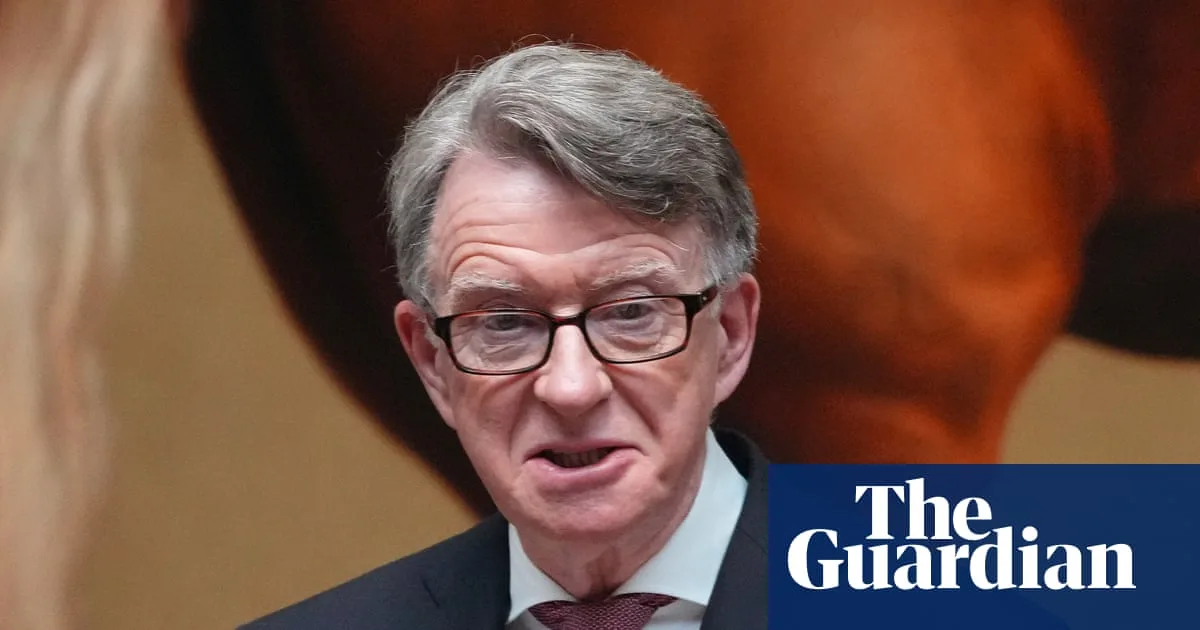
The latest revelations and reaction to them may mean Peter Mandelson has finally encountered a scandal he is unable to outrun. It was the evening of 6 May 2010 and, months after being released from jail for procuring a child for prostitution, Jeffrey Epstein was curious as to the result of Britain’s general election. “Well?” he emailed Peter Mandelson, the then de facto deputy prime minister in Gordon Brown’s government. Twenty minutes later, and a few hours before the polls were due to close, Mandelson responded: “We are praying for a hung parliament. Alternatively, a well hung young man.”
In an interview with the BBC last month that appeared to be an attempt at rehabilitation after being withdrawn as US ambassador over fresh revelations about his ties to Epstein, Mandelson insisted that he had been “at the edge of this man’s life”. If the implication was that he was insignificant to Epstein, that may be arguable. But some of the millions of fresh emails released by the US justice department seem to make clear that Epstein was right at the heart of Mandelson’s world for a number of years.
Mandelson’s relationship with the financier was professional and personal – intimate even – with the boundaries between the two blurred to the point of being non-existent. When the Labour peer seemingly believed that his then-partner, now husband, Reinaldo Avila da Silva had gained access to his text messages in March 2010, it was to Epstein that he turned for help. “I have had v bad setback with R who has somehow got into my texts,” wrote Mandelson, who by then was already number two in the UK government. “What shall I do? You may need to help. How does he see them?” Epstein responded: “This email is probably compromised as well, lets talk.”

On buying a new house and wondering whether he should borrow £4m at a 3% interest rate, it was again Epstein’s advice that he sought. Then there were consultations about how to build his business career when Labour lost the 2010 election. Would taking a place on the board Facebook be a good move, he asked. Got me any “deal(s) yet” he wondered in July 2011. Epstein responded: “Spent the day with Gates, in Seattle, having monstrous fun.” “Need to talk, feeling confused,” Mandelson wrote in April 2009. “Where r u? I miss you”, he emailed on 22 December 2010.
The drip-feed of revelations in recent months about the extent of this relationship has cost Mandelson the job he loved and the status he craves. On Monday, the most damning email yet became public. Mandelson appears to have leaked a sensitive Whitehall document to Epstein, who was still under house arrest at the time, detailing the UK government’s tax plans and intention to sell £20bn in assets. He forwarded the document in June 2009 with the comment: “Interesting note that’s gone to the PM.” Emails had already emerged over the weekend that suggested Mandelson had received three payments of $25,000 each from Epstein when he was a backbench MP in 2003 and 2004. Others showed that his partner had received thousands of pounds in 2009 and 2010 when he was business secretary.
Keir Starmer said on Monday that he should lose his title and seat in the House of Lords, and launched an inquiry into his “conduct during his time as a government minister”. Just eight months ago, Mandelson was standing by Donald Trump’s side in the Oval Office, being complimented for “his beautiful accent” as he signed off on a trade deal that would avoid the US president’s “liberation day” tariffs. How did Epstein end up taking such a cataclysmically central role in Mandelson’s personal and professional life? Mandelson worked as a consultant for the media mogul Robert Maxwell, the owner of the Daily Mirror, in the late 1980s. Maxwell’s daughter, Ghislaine, was a social livewire with a taste for the fin