The international legal order is in shambles. But from the ruins of impunity and lawbreaking, a group of nations is working to enforce accountability.
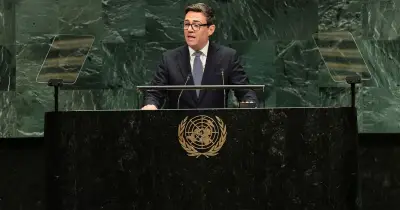
On Monday, the UN general assembly’s high-level meetings opened to news that Washington had drawn up sanctions against the international criminal court, targeting its bank accounts, software, insurers and staff. On Tuesday, the US president stood at the podium and threatened Iran with annihilation. On Thursday at the same rostrum, the Israeli prime minister, Benjamin Netanyahu, wanted by the ICC for war crimes, cast all those seeking accountability as “barbarians who threaten our common civilization”. Palestinian officials were absent, denied travel visas by the United States.
Netanyahu’s defiance and impunity
Netanyahu has never pretended to respect international law. When South Africa brought its Genocide Convention case against Israel’s actions in Gaza, Netanyahu declared: “Nobody will stop us – not The Hague.” This summer, he mused on American television that, should his plane ever be forced down in a country that honours the warrant, Israel’s special forces could be given “a new task”. The American president has promised he will not be arrested on US soil “in any way, shape, or form”.
The message to the world is plain: crimes committed by the allies and acolytes of power will never be punished. This impunity is not limited to Gaza. It’s playing out in the accelerating ethnic cleansing of the West Bank. It has travelled to Lebanon, where Israeli strikes have killed more than 4,000 people this year and displaced more than a million. In southern Syria, Israeli troops shell and raid villages in the countryside around Damascus. In Sudan, massacres are carried out with arms, technology and financing of the United Arab Emirates, an ally of the Israeli government.
Every commander with a patron has learnt the lesson of the past three years. Mass atrocity carries no price if your friends are strong enough.
Punishments for resisting states
States that resist encounter punishments in dizzying varieties – sanctions, tariffs, threats and isolation. South Africa lost US aid after bringing its genocide case to The Hague. Colombia’s president had his visa revoked after speaking out on Gaza in the streets of New York.
This too will not remain confined to the global south. Instruments built for terrorists and drug cartels are now pointed at judges. More than a dozen ICC judges and prosecutors, including the court’s president, already live under US sanctions. A designation of the whole institution would reach every European bank, insurer and technology supplier serving a court that sits in the Netherlands.
Tools like these, once deployed, are never put back in the drawer. Governments in Europe that shrug today should ask how long before the same instruments are turned on their regulators, their competition authorities, their own courts.
Historical precedents and collective action
What can countries do? History points to some answers. In 1962 the general assembly created a special committee against apartheid in South Africa. Newly independent states from Africa, Asia and the Caribbean, dismissed at the time as marginal, pressed for arms embargoes, oil embargoes, sporting boycotts and divestment. In 1977, the security council imposed a mandatory arms embargo on Pretoria. Within two decades, the regime was gone: rendered unsustainable by the force of the national liberation struggle at home and in exile – and because enough states, acting together, raised the cost of its crimes.
We are not lacking for legal clarity. The international court of justice has found Israel’s occupation unlawful and instructed every state not to aid or assist it. The general assembly gave Israel 12 months to end it; that deadline passed a year ago. The court has ordered provisional measures under the Genocide Convention, and the ICC has issued its warrants.
What we need is the courage to act. States must use every tool at their disposal: halt arms and dual-use transfers, deny port access to military cargo, review public contracts and investments tied to the occupation – arrest the criminals and protect the legal officials.
On Friday, ministers and representatives from 40 states gathering at UN headquarters for The Hague Group’s Extraordinary Meeting in Defence of International Law will do just that.
The only response to unilateral bullying is collective action. No single capital can absorb that pressure alone. Forty can. The countries that ended apartheid did not wait for permission from those who armed it. Neither should we. They are few. We are many.