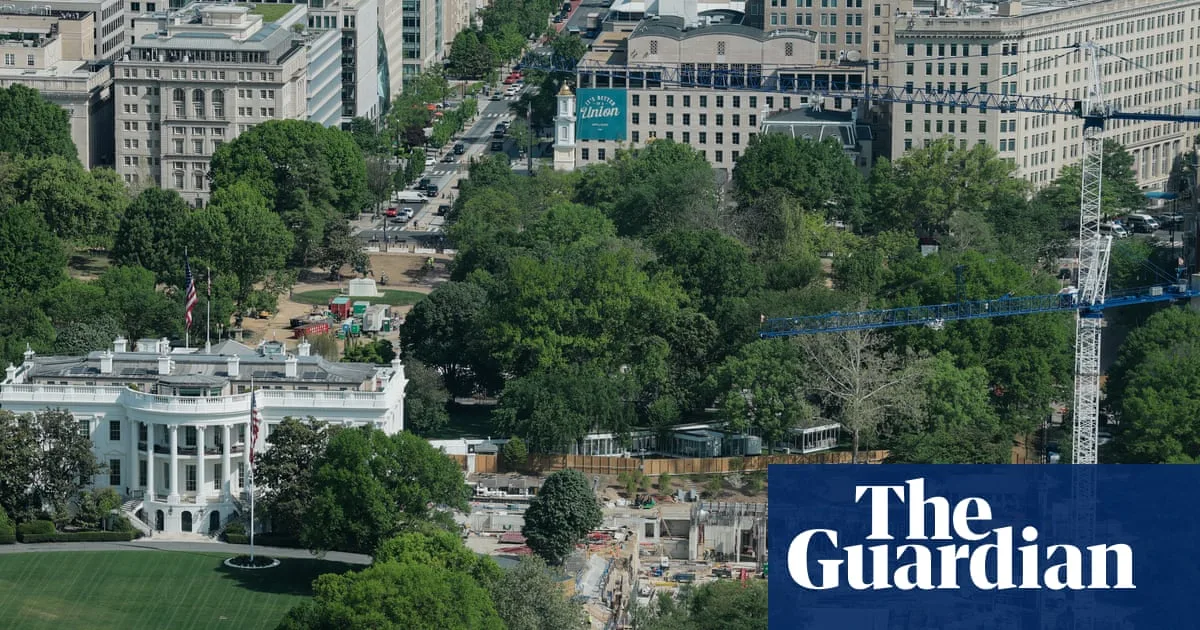
The Department of Justice has argued that a recent shooting near the White House underscores the 'critical need' for President Donald Trump's proposed $400 million ballroom, as government lawyers seek to lift a court order blocking construction.
Shooting Incident Cited in Filing
Acting Attorney General Todd Blanche filed an emergency motion in federal court one day after a gunman opened fire near a security checkpoint, striking a bystander. The suspect, 21-year-old Nasire Best, was fatally shot by Secret Service officers. Trump was inside the White House at the time and unharmed.
The Justice Department's filing, posted on Truth Social, claims the ballroom would provide a 'SAFE HAVEN' from future attacks. It describes the ballroom as 'a knitted, unified, cohesive part of the East Wing Project, which is vital for National Security, and is being constructed to ensure that the President can perform his constitutional duties in a safe and heavily secured facility.'
Top Secret Details Revealed
The four-page filing complains that the court forced the government to reveal 'top secret' details about the project, which it then lists: 'heavy steel, drone proof roof, missile resistant and drone proof columns, bullet, ballistic, and blast proof glass, Military grade venting for air conditioning and heating, and much more,' including 'bomb shelters, a state of the art hospital and medical facilities, Top Secret military installations, structures, and equipment, protective partitioning, and other features.'
The ballroom's rooftop will be 'hermetically sealed to prevent malign forces from contaminating the circulating air, thereby threatening the lives of those inside.' Lawyers wrote that these specifications 'would have been kept secret, as is appropriate, but have been forced to be revealed to stave off the Court's dangerous injunction.'
Arguments Against Injunction
Without the ballroom, the White House would be forced to hold events in 'vulnerable tents' outside, exposing the president, foreign dignitaries, and their families to 'various threats,' including the 'inordinately wet' lawn. 'Over the years, many an evening has been ruined by even moderate rain,' lawyers noted.
The National Trust for Historic Preservation filed a lawsuit to stop the administration from 'illegally constructing a massive ballroom' after demolishing the East Wing. The Justice Department called the lawsuit 'a great attack on our Country' because it forced the revelation of top-secret features, including 'a major drone port and Government sniper facilities on the heavily secured roof of the Ballroom.'
Legal and Funding Disputes
A federal appeals court has allowed construction to continue for now, but a lower-court injunction remains. In March, U.S. District Judge Richard Leon ruled that the president is the 'steward' of the White House but 'he is not, however, the owner!' and that construction requires congressional authorization.
The Justice Department says 'many patriotic private donors' have 'Hundreds of Millions of Dollars' for the project, but the administration has also asked Congress for $1 billion for White House security additions, including the ballroom. The Senate parliamentarian ruled the proposal too 'complex and large in scale' for broader funding legislation, leading to an impasse.
Details of the Shooting
According to D.C.'s Metropolitan Police Department, Secret Service officers returned fire after Best started shooting towards a White House security checkpoint on Saturday evening. Best was pronounced dead at a hospital. A bystander struck by gunfire was hospitalized with non-life-threatening injuries.
Secret Service spokesperson Anthony Guglielmi said: 'A preliminary investigation indicates that as the individual approached, he removed a weapon from his bag and began firing at posted officers. Secret Service police officers returned fire, striking the suspect, who was transported to an area hospital, where he later died.'
Best had reportedly cut off contact with friends and family and claimed to be Jesus Christ, according to The Washington Post. He had been arrested in July for trespassing after using an exit turnstile to access a restricted part of the White House grounds, and was involuntarily committed last June for obstructing vehicle entry to the complex.