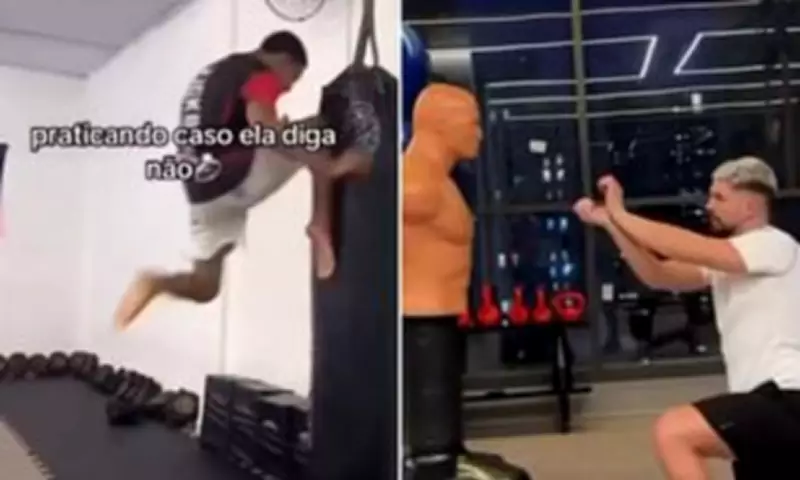
A disturbing new trend on Brazilian TikTok has sparked outrage, with young men posting videos that begin as romantic skits—kneeling and pretending to propose—before turning violent. Captions like 'Practicing in case she says no' precede outbursts where participants simulate stabbing, punching, or shooting women who reject them.
Violent Content Goes Viral
In one video, a man pulls a kitchen knife from his jacket and repeatedly stabs at an invisible woman. Another shows a man viciously punching a pillow on the floor as if it were a person. Some perform the trend in gyms, beating dummies and kicking punching bags while apparently imagining a woman turning them down. Several clips show men mimicking pulling out guns and opening fire. In a particularly alarming video, a man kicks a real woman in the groin after she pretends to reject him.
The trend has spread rapidly across Brazilian TikTok, prompting intervention from Brazil's Federal Police and TikTok itself, which removed the videos. Women's rights campaigners have expressed horror at the content.

Femicide Crisis in Brazil
Brazil recorded 1,470 femicides in 2025, the highest number since the crime was codified in 2015, according to the Ministry of Justice and Public Security. That amounts to roughly four women murdered every day. In many recent attacks, the trigger was rejection.
In April, 20-year-old Alana Rosa was stabbed more than 15 times in her home by a man who had persistently pursued her after meeting at a gym. He broke in and launched a frenzied knife attack; she survived after nearly a month in hospital. In Pernambuco, a 22-year-old woman was stabbed and set on fire by a former co-worker obsessed with her after rejection. In Minas Gerais, a 38-year-old woman was fatally stabbed after rejecting a man who tried to forcibly kiss her. In São Paulo, a man fatally ran over and dragged his former partner, leading to her death after both legs were amputated.
Expert Analysis
Professor Fiona Macaulay, an expert on gender violence in Brazil at the University of Bradford, told the Daily Mail that the TikTok videos reflect broader societal norms where men feel entitled to punish women for refusal. 'It's all about hierarchy, and women are positioned as controllable,' she said. She noted that former President Jair Bolsonaro's hypermasculine image and loosened gun laws have contributed to a climate where violence against women is more acceptable.
Macaulay also highlighted the legacy of the 'honour defence,' which allowed men to claim uncontrollable rage after infidelity or humiliation. Although Brazil's Supreme Court ruled it unconstitutional in 1991, vestiges remain. 'The idea that women should be punished for perceived misconduct still exists,' she said.
The Manosphere Connection
The trend aligns with the global 'manosphere,' a network of online communities promoting aggressive masculinity and misogyny. UN Women defines it as pushing the false idea that feminism oppresses men. Influencers like Andrew Tate have gained traction among young men in Brazil, with one gang-rape suspect turning himself in wearing a 'Regret Nothing' T-shirt, a Tate catchphrase. A senior police officer justified murdering his wife by demanding she be 'obedient' to his 'alpha male' persona.
Brazil's Response and Women Fighting Back
Despite the grim statistics, Brazil has developed ambitious anti-femicide policies, including specialist domestic violence patrols linked to the Maria da Penha law. Women with restraining orders can enroll in protection programmes with regular check-ins. Since 2015, police have improved at identifying femicides, with 60-65% of women's murders now categorized as such.
In March 2026, the Senate approved a landmark bill to criminalize hatred against women as a hate crime, now awaiting a final vote in the Chamber of Deputies. Meanwhile, free self-defence workshops are becoming popular. A recent survey found that six in ten Brazilian women practice or want to take up a combat sport, with over half citing self-protection. Videos of women training in combat sports—punching dummies and executing martial arts throws—are circulating as a counter-trend, ensuring they never become victims.