

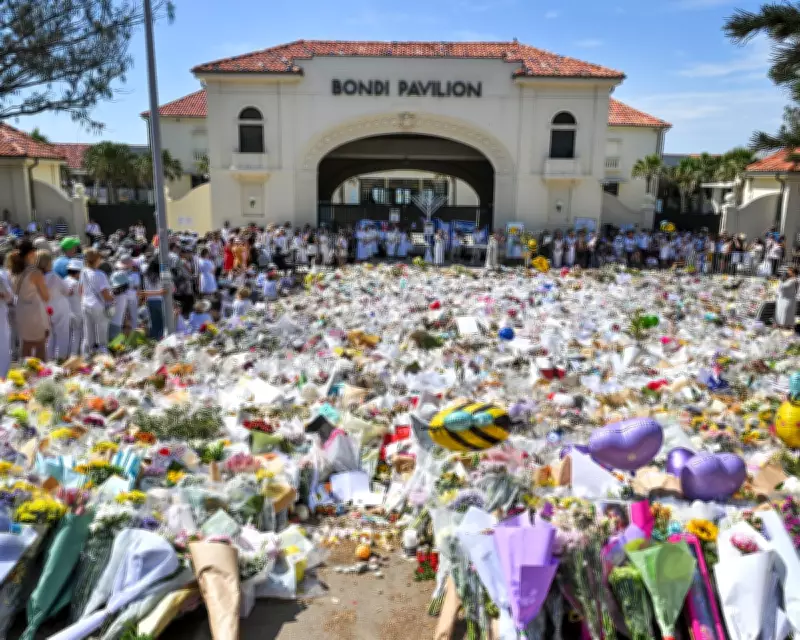
The royal commission into antisemitism and social cohesion has heard that within 30 seconds of opening fire at Bondi beach on 14 December, two gunmen targeting Jewish Australians had shot 11 people, killing 10 of them. The second block of public hearings opened in Sydney on Monday morning, taking evidence about what was known about the two shooters.
Details of the Attack
On the evening of 14 December, two gunmen, Sajid Akram and his son Naveed, allegedly opened fire from a footbridge above Archer Park at Bondi beach, shooting at a beachside Hanukah celebration being held for the local Jewish community. Fifteen people were killed by the gunmen. Sajid Akram was shot dead by police; Naveed was shot and wounded and is in custody facing charges, including 15 counts of murder and one count of committing a terrorist act that investigators allege may have been inspired by Islamic State.
Police Presence and Response
Counsel assisting, Richard Lancaster SC, told the commission the evidence will demonstrate a number of facts about the 14 December attack. The commission heard that a Jewish organisation, the Community Security Group, asked NSW police to provide a static police presence at the Chanukah by the Sea event for the entirety of the celebration. NSW police declined to provide a static police presence for the entire event, instead allocating a mobile tasking, meaning police officers were instructed to attend the event from time to time during the evening. At the time the two gunmen opened fire on Jewish community members, there were four police at Archer Park. Within 29 seconds of the start of the shooting, 11 people had been shot, 10 of them fatally. Three police officers were shot and injured in the course of the attack. Within five minutes, there were 11 police officers on the scene. The first shooter was shot and killed and the second shooter was shot and apprehended within seven minutes and 41 seconds after the start of the shooting.

Intelligence and Warnings
Lancaster said there was no specific intelligence that the beachside Hanukah celebration would be the target of an attack. There is no evidence that any intelligence agency or law enforcement agency had any actual knowledge or specific information to suggest that there might be an armed attack on the Hanukah celebration at Bondi on 14 December 2025. In that sense it was a surprise attack.
The Asio director general, Mike Burgess, told the commission on Monday morning that while Asio's funding had been increased in recent years, the proportion of that funding dedicated towards counter-terrorism had decreased, in favour of resources being reallocated from counter-terrorism to foreign interference and espionage. Burgess was asked directly whether, in retrospect, he considered additional funding and resources would have put Asio in a better position to pursue its counter-terrorism activities over the last five years. He said he did not, stating that in retrospect, he still thinks that their resourcing was sufficient for the problems they face. However, he acknowledged they are stretched and that he has means by which to ask for additional resources if needed.
Later, he was asked again if Asio was sufficiently resourced to counter a deteriorating security environment, in particular the increased risk of lone actors moved to violence without any prior warning. Lancaster asked if the threat level is growing and Asio can already be described as stretched in 2025, can the public be assured that Asio has sufficient resources and powers to respond to antisemitic conduct in the nature of a terrorist attack. Burgess responded that he believes they can be assured that his agency puts its resources where it needs to, and if they have a resource issue he will ask government, and government will consider that through the budget process.

Threat Level and Warnings
The commission heard that while Asio had identified an enduring threat to Jewish interests in Australia, it had no specific intelligence an attack was being planned against Jews. Burgess said Asio recognised the ongoing conflict in Gaza was an emotive issue, and that antisemitic incidents had increased since October 2023. They saw threatening, intimidating behaviour through to the end of 2023, against Jewish Australians, all the way through 2024 until it pivoted to direct targeting of people, businesses, and places of worship in October 2024.
The national terrorism risk remains at the upper end of probable in the aftermath of the Bondi terror attack, Burgess told the royal commission. He said the temperature is higher than when the threat level was raised to probable in 2024, which means a greater than 50% chance someone will plan to undertake an act of terror. In the current security environment, Burgess said there was a concerning trajectory, as in it's getting hotter. There is more permission for violence, and an environment where people can go to violence with little or no warning means we're on the upper end of probable. The next level up is expected, but in the current system, that requires specific intelligence that there is a plan and a location for an act of terror.
Community Security Group Evidence
A Community Security Group (CSG) witness, referred to by the pseudonym ABO, gave evidence about an email sent by the CSG to NSW police, warning that the Hanukah event could be a target for terrorists. The email, sent to police in November 2025, said the likelihood of violent and/or antisemitic incidents is elevated due to the anticipated visibility of identifiably Jewish individuals in public spaces, and the prominence of the festival. It said the Jewish community was experiencing an unprecedented level of vilification and a significant increase in antisemitic incidents. Hostile actors have historically targeted Jewish and Israeli interests in retaliation for developments in the ongoing Middle East conflict, and to intimidate local entities perceived as affiliated with Israel. CSG continues to record unprecedented volumes of antisemitic incidents, reinforcing that the threat environment remains heightened. The risk comes from actors from across the ideological spectrum.
Twelve CSG volunteers were present at the Hanukah by the Sea event, but they were not armed. A later email, sent to police in early December, warned that a terrorist attack against the New South Wales Jewish community is likely, and there is a high level of anti-Semitic vilification. Another CSG witness, known as ABP, told the commission he had a phone call with a NSW police commander in the days before Hanukah, specifically requesting a constant static police presence at the event. Given the number of people expected to attend the event, they were requesting that there be a static presence. Police decided a static presence was not required and that the event could be protected with a mobile police tasking, meaning police officers attending the event multiple times, but not staying. ABP said he told police there would be a lot of unease from the community not having a static police presence on the ground.





