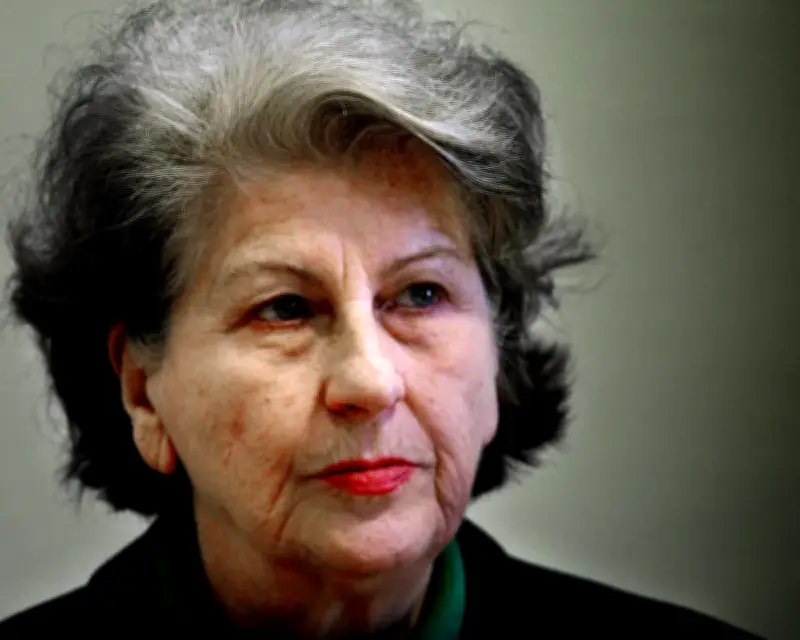
Biljana Plavšić, the only woman among the 161 people indicted by the international criminal tribunal for the former Yugoslavia (ICTY) for ethnic cleansing and other crimes against humanity during the Balkan wars, has died aged 96.
On trial at the ICTY’s headquarters in The Hague in 2002, she admitted her guilt. “I have now come to the belief and accept the fact that many thousands of innocent people were the victims of an organised, systematic effort to remove Muslims and Croats from the territory claimed by Serbs,” Plavšić told the judges.
“Although I was repeatedly informed of allegations of cruel and inhuman conduct against non-Serbs, I refused to accept them or even to investigate. The knowledge that I am responsible for such human suffering and for soiling the character of my [Serbian] people will always be with me,” she added.
Rise to power in a collapsing Yugoslavia
Plavšić was the highest ranking woman to take power anywhere in Yugoslavia as centrifugal forces increasingly challenged the Yugoslav Federation’s authority over its six republics in the 1980s. Slovenia and Croatia declared independence, and the leaders of Muslim communities in Bosnia threatened to do the same.
In 1992, regions of Bosnia with a predominantly Serbian population broke away from the rest of Bosnia and called their statelet Republika Srpska. Plavšić was elected deputy president. The president was Radovan Karadžić, a former psychiatrist. Based in Pale, a small town in the mountains above the Bosnian capital, Sarajevo, they authorised their military commander, Ratko Mladić, to force non-Serbs out of scores of villages. Sarajevo was put under siege. Artillery shells rained down on defenceless civilians for almost three years.
Confession, sentence and retraction
When the war was brought to an end by the US-brokered Dayton agreement in 1995, Karadzic and Mladić laid low and then went into hiding. It took several years before they were arrested and convicted of genocide. By contrast Plavšić came out in support of Dayton and remained openly in Republika Srpska. She was elected in 1996 as president for a two-year term. She later won a seat in the local legislative assembly but announced in 2000 that she was giving up politics.
She hoped for quiet retirement, but the ICTY’s prosecutors decided her wartime activity could not be left without scrutiny. They charged her with war crimes but offered her a plea bargain and a shorter prison sentence if she publicly confessed to guilt. Plavšić agreed. The charge of genocide was dropped and in February 2003 she was sentenced to 11 years in prison for the crime of persecution on racial grounds. She was sent to prison in Sweden and received early release in 2009.
Western governments hoped that Plavšić’s remorse would persuade other former Yugoslav leaders to follow suit and acknowledge the crimes that their ethno-nationalism had provoked. These hopes were dashed. Two years into her sentence, in 2005 Plavšić retracted her confession of guilt. She told interviewers that she had “done nothing wrong” during the war. This prompted outrage from victims’ groups and western officials.
But Plavšić was adamant that she had been right in promoting ethnic cleansing. It was a natural phenomenon whereby “everyone should live with their own tribe”, she told Olivera Simić, an Australian academic who spent many hours with her in preparing a book titled Madam War Criminal (2025). “I had to protect my people,” she insisted. “If I contributed anything in establishing Republika Srpska, our Serb state, and I know I did, there is nothing to regret.”
Early life and academic career
Plavšić’s confession was seen by many Serbs as a national betrayal. Some felt she had buckled under foreign pressure. Others thought she was motivated by cowardice and a wish to spend as little time in prison as possible. When she turned the tables on her accusers many Serbs applauded.
Plavšić was born to a middle-class family in the Bosnian town of Tuzla. Her father, Svetislav Plavšić, taught biology in a local school. Her mother was a housewife. When Biljana was four her father became the director of national sciences at one of Sarajevo’s museums. The family moved to the Bosnian capital.
She was 11 when Nazi forces swept through Croatia and Bosnia in 1941. She witnessed atrocities herself as Serbs were executed in the street. Several members of her extended family were murdered by the Ustaše, a Croatian fascist movement whose paramilitaries collaborated with the Germans.
On leaving school Plavšić embarked on an academic career. She took a degree in her father’s subject, biology, and started work as a teacher at the University of Sarajevo. She won a Fulbright scholarship to support her research for a PhD in botany at Cornell University. Returning to Sarajevo she combined research with teaching. In 1987 she was elected the dean of the faculty of natural sciences and mathematics at Sarajevo University. She published more than 100 scientific works and papers during her career.
Witnessing the rising ethnic tensions in Yugoslavia in 1990 she switched her energy to politics although she was already 60. By then she had developed some virulently racist views. She described Bosnia’s Muslim population as “deformed genetic material” with whom it was impossible to negotiate. She joined the Serbian Democratic party. Her prominence gave her rapid promotion as a political leader.
Legacy and final years
She will be remembered for her ICTY confession of guilt and her subsequent retraction. They illustrated more dramatically than in any other Balkan leader’s case the powerful pressures put on public figures in inter-ethnic conflicts even when violence had abated. The cult of victimhood remained strong in all Balkan communities and few politicians were willing to break free. Those who wanted their communities to acknowledge past mistakes and crimes faced an uphill struggle.
Plavšić married Zarko Banjac, a lawyer, in 1963. They divorced in 1976. Plavšić spent the last decade and a half in Belgrade as a recluse. Biljana Plavšić, academic and politician, born 7 July 1930; died 1 October 2026.