

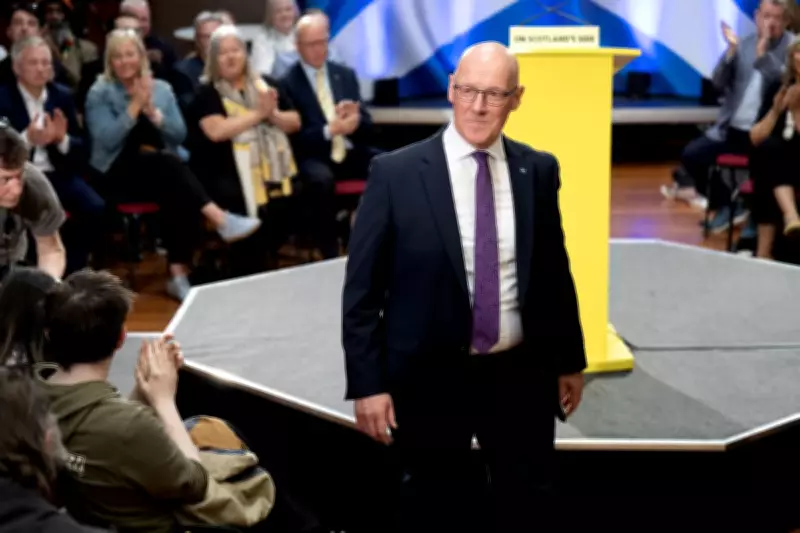
A new poll suggests the Scottish National Party (SNP) remains on course to be the largest party in the Scottish Parliament after the upcoming election, but could fall short of a majority. The survey, conducted by the Diffley Partnership using the Survation online panel, predicts the SNP will return 62 Members of the Scottish Parliament (MSPs) on May 7, three short of the 65 needed for an overall majority.
Reform UK to Become Second Largest Party
The poll indicates that Reform UK Scotland would win 19 seats, making it the second-largest party at Holyrood. Scottish Labour would return 17 MSPs, while the Scottish Greens would secure 12 seats, one more than the Scottish Conservatives. The Scottish Liberal Democrats are projected to win eight seats.
Vote Share Breakdown
The SNP holds a substantial lead on both the constituency and regional list votes, with 38% and 29% support respectively. Reform UK is backed by 20% of respondents on the constituency ballot and 19% on the list. Scottish Labour receives 18% on the constituency vote and 17% on the list. The Scottish Conservatives have 12% support on both ballots, while the Scottish Greens receive 12% on the list but only 2% on the constituency vote. The Scottish Liberal Democrats are supported by 10% on the constituency ballot and 9% on the list.

Independence Referendum Views
Voters remain divided on Scotland's constitutional future. The poll found that 52% would vote Yes in another independence referendum, while 48% would vote No. Additionally, 52% believe that an SNP majority or a pro-independence majority after the election would constitute a mandate for another referendum, while 48% disagree.
Leadership Preferences
When asked about preferred first minister, 58% chose SNP leader John Swinney over Scottish Labour leader Anas Sarwar, while 42% preferred Sarwar. Against Reform UK Scotland leader Lord Malcolm Offord, 68% favoured Swinney and 32% chose Offord. In a head-to-head between Sarwar and Offord, 60% preferred Sarwar and 40% opted for Offord.
Favourability Ratings
John Swinney had the highest favourability rating with a net score of -4, followed by Anas Sarwar at -19 and Lord Offord at -21. Nearly half of voters (47%) expressed a preference for a single-party majority government. An SNP minority government was the most acceptable option, with 42% favourable and 44% unfavourable. A minority Labour government was viewed positively by 34% and negatively by 54%. Meanwhile, 52% of respondents had an unfavourable view of any governing arrangements involving Reform, with 36% holding a favourable view.
Expert Analysis
Scott Edgar, senior research manager at Diffley Partnership, commented: "This polling suggests a complex and finely balanced contest. While the SNP remain clearly ahead and on course to be the largest party, albeit short of an overall majority, support for the other parties is broadly dispersed. If these figures were repeated on polling day, Scotland would be heading towards a fragmented parliament, meaning relatively small shifts in support between now and next Thursday could have a significant impact on the final distribution of seats."
Reactions from Party Leaders
Scottish Greens constitution spokesperson Patrick Harvie said: "We are delighted to see what would be a record number of Scottish Green MSPs elected to Holyrood. It also shows that Scotland is on course to return a clear pro-independence majority. The Scottish Greens believe in democracy. If Scotland chooses a majority of pro-independence MSPs on May 7, then it is undeniable that Scotland should be given a choice on its future."
Scottish Tory deputy leader Rachael Hamilton warned: "This is yet another poll showing the threat of an SNP majority is very real. They are on the cusp of what John Swinney has repeatedly said he will use to demand another divisive independence referendum. The best way for Scots to stop this nightmare scenario from happening is to vote for the Scottish Conservatives on their peach ballot paper on May 7."
The survey was based on responses from 1,012 participants between April 17 and 23.






