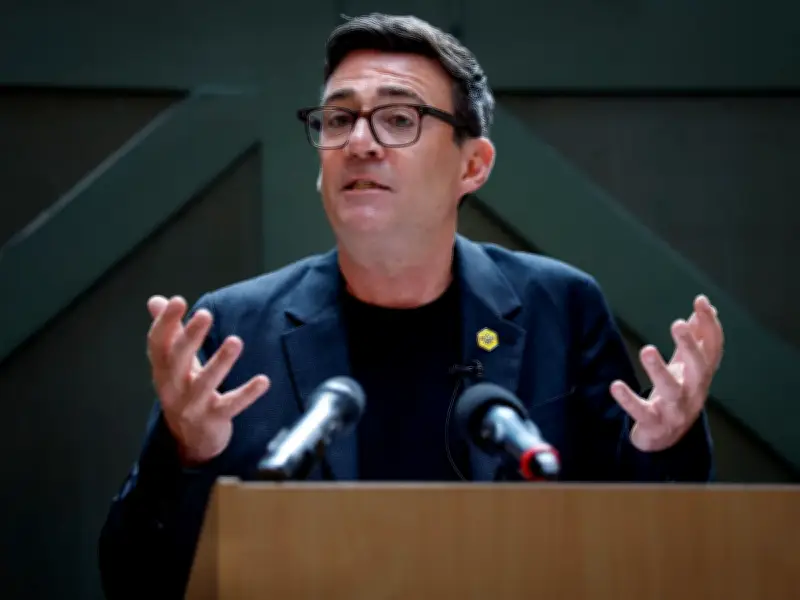
Andy Burnham delivered his first speech as an MP since his return to Parliament, setting out a radical vision to rewire Britain by transferring power from Westminster to the regions. Speaking at the People's History Museum in Manchester on June 29, 2026, the former Greater Manchester Mayor and red-hot favourite to replace departing Prime Minister Sir Keir Starmer announced plans to establish a Prime Minister's office in Manchester, dubbed “Number 10 North,” which he described as “the nerve centre of a rewired Britain.”
Ending Whitehall's Block on Devolution
Burnham declared that “the days of Whitehall fighting the devolution of power into the regions and nations are over for good.” He criticised the over-centralised system, noting that “Westminster and Whitehall are set up for conflict” and require radical change. He promised that “the whole of Whitehall will now be required to get behind our places and work together with them to make quicker, more joined-up decisions.”
Reflecting on his decade as Mayor, Burnham said: “I have had 10 years of fighting the Whitehall machine, blocking this place’s progress, the progress of people here and I am simply not prepared to accept the same for any area coming after Greater Manchester.”

A New Approach: Place-First, Not Party-First
Burnham outlined a new political approach based on “place-first, not party-first; problem-solving, not point-scoring; long-term, not short-term.” He cited the Greater Manchester model, which built strong partnerships across public, private, community, and trade union sectors. As an example, he highlighted the delivery of 1,000 extra work placements for young people linked to T Levels, achieved by rallying hundreds of businesses across the city region.
“That’s a thousand extra young lives changed every year,” he said, “and it shows what a place can do when it works as one.”
Critique of Westminster's Broken Culture
Burnham argued that Westminster has failed the country for decades. “After ten years of political turbulence since Brexit, and twenty years of falling living standards since the 2008 financial crash, Westminster hasn’t been working for people,” he said. He took responsibility, stating: “My generation of politicians – including me – must take responsibility. We haven’t been good enough.”
He criticised the adversarial culture: “It is too adversarial and too much time is wasted with departmental silos battling each other and battling the Treasury rather than getting things done.” He warned that if living standards do not improve, the continuation of “politics-as-usual” is “dangerous and destructive of what remains of public trust in politics.”
Number 10 North and the Makerfield Test
Burnham announced that the Prime Minister’s office would have an extended operation based in Manchester, but emphasised that its purpose is to redistribute power across the UK. “The job of No 10 North will be to make power flow into the Midlands, into the South West, into the East of England and, yes, into London,” he said. “It will be about offering new opportunities to extend devolution in Scotland, Wales and Northern Ireland by taking power deeper down.”
He introduced the “Makerfield Test,” which will ensure that every decision considers how it benefits all postcodes. “The country hasn’t thought in that way before – but, with the Makerfield Test at the heart of decision-making, it will do from now on,” he said.
Good Growth and Reindustrialisation
Burnham outlined a vision of “good growth” based on devolved power, sound finances, and public intervention where necessary. He rejected “the old trickle-down model” and called for “good growth in every British postcode.” He set out a 10-year mission to raise living standards, focusing on three tasks: reform of essential utilities, reindustrialisation, and regeneration of places.
On utilities, he promised to ensure all parts of the UK can take greater public control of water, housing, energy, and transport, learning from Greater Manchester’s bus network reforms. On reindustrialisation, he pledged to support every region to set industrial ambitions and encourage cross-UK partnerships, citing the Cambridge-Manchester collaboration on life sciences.

He also committed to reforming public procurement: “From here on, every pound raised from taxpayers will work harder for them.” He said all eligible public contracts would be subject to proper social value weighting to help British-based companies win contracts.
Education and Housing Reforms
Burnham called for an end to a school system “configured entirely around the university route,” promising parity between academic and technical education. He also addressed the housing crisis, noting that Britain has lost almost 1.5 million council homes since the 1980s and that around the same number of people are on housing waiting lists. He said repairing public housing stock would help reduce the welfare bill.
Inclusive Leadership and Collaborative Politics
Burnham pledged to build an inclusive team at the highest level, reflecting all parts of the party and country. He said he would not announce appointments until the end of the leadership process. He also promised to reach out to other political parties to find common ground. “A greater sense of unity in Parliament will then allow us to give a clearer sense of direction to Whitehall,” he said.
He concluded by invoking the spirit of the People's History Museum: “The time has come to build the broadest possible coalition of people to lift Britain back up to where we all want it to be.”