

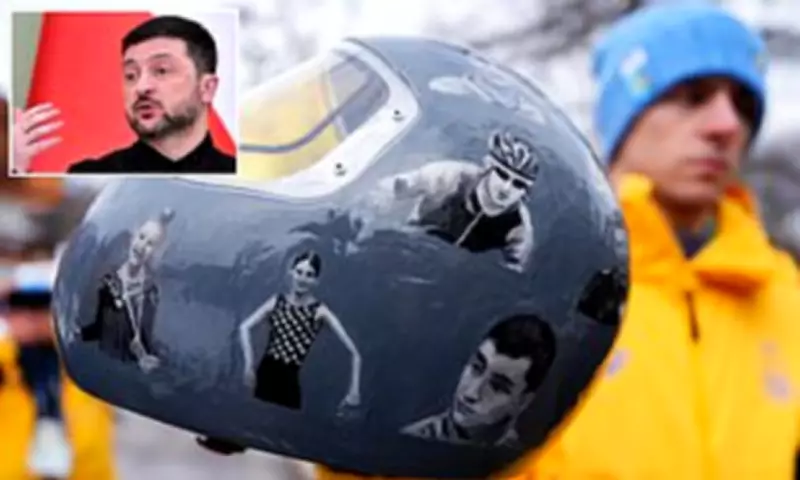
Ukrainian President Volodymyr Zelenskyy has delivered a powerful statement of support for skeleton athlete Vladyslav Heraskevych, declaring that "courage is worth more than any medal" following the athlete's disqualification from the Winter Olympics. The controversy stems from Heraskevych's refusal to replace a helmet featuring portraits of Ukrainian athletes killed during Russia's invasion, leading to his expulsion just hours before competition.
Olympic Standoff Ends in Disqualification
After days of intense negotiations between Olympic authorities and the Ukrainian athlete, the International Olympic Committee confirmed Heraskevych's disqualification less than an hour before his scheduled skeleton heat on Thursday morning. The decision followed his steadfast refusal to comply with IOC guidelines prohibiting political messaging during competition, despite multiple meetings including a final appeal from IOC President Kirsty Coventry.
Zelenskyy's Emotive Response
In a 272-word social media statement, President Zelenskyy strongly criticised the IOC's decision, arguing that "sport shouldn't mean amnesia" and that the Olympic movement should work to stop wars rather than "play into the hands of aggressors." He emphasised that Heraskevych's helmet served as "a reminder to the whole world of what Russian aggression is and the cost of fighting for independence."

The Ukrainian leader highlighted what he described as inconsistencies in Olympic policy, noting that while Heraskevych faced disqualification, thirteen Russian athletes are competing as neutrals in Italy despite some having documented links to support for the war in Ukraine. Zelenskyy pointed to Russia's history of waging conflicts during Olympic periods, citing the 2008 war against Georgia, the 2014 occupation of Crimea, and the full-scale invasion of Ukraine in 2022.
The Human Cost of Conflict
Zelenskyy's statement included sobering statistics about the impact of the war on Ukrainian athletes, revealing that 660 athletes and coaches have been killed since Russia's full-scale invasion began. "Hundreds of our athletes will never again be able to take part in the Olympic Games or any other international competitions," he wrote, contrasting this with the continued participation of Russian competitors.
Emotional Fallout at Cortina
The disqualification has created significant emotional turmoil for the Ukrainian delegation. Heraskevych's father and coach, Mykhailo, was seen crying on a snowbank upon learning the news, while IOC President Coventry appeared visibly emotional during her press conference, stating she "really wanted Heraskevych to race" and describing it as an "emotional morning."
The Athlete's Defiant Response
Heraskevych immediately took to social media following his disqualification, posting: "This is the price of our dignity." In subsequent comments to reporters, he expressed profound disappointment, saying: "I am disqualified from the race. I will not get my Olympic moment." The athlete, who had been considered a serious medal contender, described feeling "emptiness" at missing his opportunity to compete.
The Ukrainian skeleton racer maintained his position throughout the controversy, telling Coventry that the IOC's decision "plays along with Russia's narrative" and vowing: "Even though the IOC wants to betray the memory of these athletes, I will not betray them." He plans to appeal to the Court of Arbitration for Sport, though this is unlikely to affect the competition outcome.
IOC's Position and Guidelines
The International Olympic Committee released a detailed statement explaining their decision, emphasising that the issue was not about Heraskevych's message but about "where he wanted to express it." The organisation noted they had offered multiple compromises, including allowing him to display the helmet during training runs and in the mixed zone after competition.
The IOC defended its Guidelines on Athlete Expression, which were developed following global consultation with 3,500 athletes in 2021 and have support from athlete commissions worldwide. They highlighted their support for Heraskevych through Olympic scholarships and their establishment of a solidarity fund for Ukrainian sport following Russia's invasion.

Broader Implications
Behind the scenes, Daily Mail Sport understands the IOC's position was influenced by concerns that allowing Heraskevych's helmet would set a precedent for athletes from other nations to display political messages, potentially including support for questionable regimes. The organisation now faces significant public backlash for what many perceive as an insensitive application of rules during an ongoing conflict.
Heraskevych had made a final plea to the IOC just hours before his disqualification, requesting three specific actions: lifting the ban on his "Memory Helmet," apologising for the pressure he had faced, and providing electric generators for Ukrainian sports facilities damaged by shelling. The IOC's response was not what he had hoped for, culminating in his accreditation being withdrawn and potentially his removal from the Olympic Village entirely.





