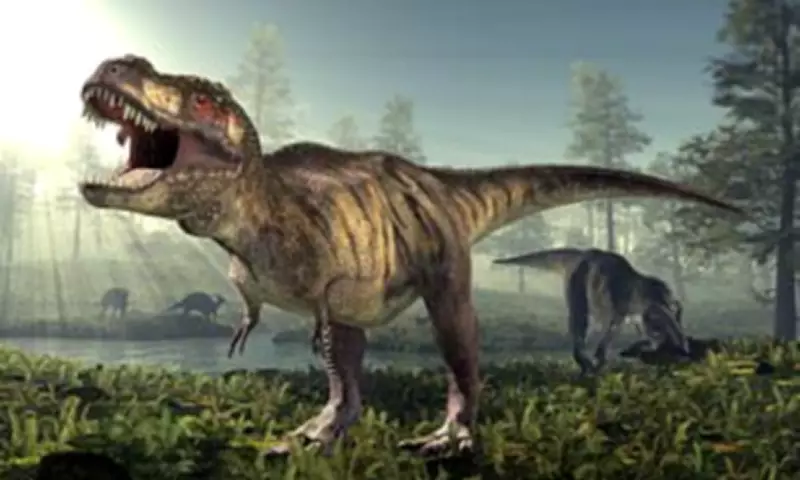
It is a question that has baffled scientists for decades: why did Tyrannosaurus rex have such tiny arms? The 45-foot dinosaur possessed arms measuring just three feet long—the equivalent of a six-foot human with five-inch arms. Despite years of research, the reason remained elusive until now.
New Research from University College London
Researchers from University College London believe they have finally solved the mystery. They claim that the evolution of the dinosaur's tiny arms was likely driven by the development of its strong, powerful head. Charlie Roger Scherer, lead author of the study, explained: 'Everyone knows the T. rex had tiny arms, but other giant theropod dinosaurs also evolved relatively small forelimbs. The Carnotaurus had ridiculously tiny arms, smaller than the T. rex. We sought to understand what was driving this change and found a strong relationship between short arms and large, powerfully built heads.'
According to the study, the head took over from the arms as the primary method of attack. It became a case of 'use it or lose it'—the arms were no longer useful and reduced in size over time.

Analysis of Theropod Species
T. rex first appeared in the Late Jurassic period and reached its peak in the Late Cretaceous before becoming extinct about 65.5 million years ago. Previous studies had shown that the species—also known as the 'King of the Dinosaurs'—had tiny arms, but the reason remained a mystery.
To investigate, the researchers analyzed data on 82 species of theropod—two-legged, mainly meat-eating dinosaurs. Their analysis revealed that shortening of the forelimbs occurred across five groups: tyrannosaurids, abelisaurids, carcharodontosaurids, megalosaurids, and ceratosaurids.
While the researchers initially expected that smaller arms would be linked to larger overall body size, surprisingly, this was not the case. Instead, tiny arms were found to be closely linked to the development of powerful skulls and jaws. The secondary importance of overall body size was highlighted by the fact that some theropods with strongly built heads and tiny arms were not very large.
Possible Reasons for Limb Shortening
The reason for this limb shortening remains unclear, but the researchers suggest that as prey increased in size, T. rex shifted to hunting using its jaws and head instead of its claws, resulting in the shrinking of its arms. Mr. Roger Scherer explained: 'These adaptations often occurred in areas with gigantic prey. Trying to pull and grab at a 100-foot-long sauropod with your claws is not ideal. Attacking and holding on with the jaws might have been more effective.'
While the study identifies correlations and cannot establish cause and effect, it is highly likely that strongly built skulls came before shorter forelimbs. 'It would not make evolutionary sense for it to occur the other way round, and for these predators to give up their attack mechanism without having a back-up,' he added.
Previous Theories
Previous studies have suggested a range of weird and wonderful theories to explain T. rex's tiny arms. In 2022, researchers from the University of California, Berkeley, claimed that T. rex had short arms to stop them getting bitten by other dinosaurs during feeding frenzies. Meanwhile, a wacky study later that year by experts at the Ernesto Bachmann Paleontological Museum in Neuquén, Argentina, claimed the tiny arms allowed the dinosaurs to grip each other tightly during sex.
Speaking at the time, project leader Dr. Juan Canale said: 'Actions related to predation were most likely performed by the head. I am inclined to think their arms were used in other kinds of activities. They may have used the arms for reproductive behaviour such as holding the female during mating or support themselves to stand back up after a break or a fall.'
Background on T. rex
Tyrannosaurus rex was a species of bird-like, meat-eating dinosaur. It lived between 83–66 million years ago in what is now the western side of North America. They could reach up to 40 feet (12 metres) long and 12 feet (4 metres) tall. More than 50 fossilised specimens of T. rex have been collected to date. The monstrous animal had one of the strongest bites in the animal kingdom.

For example, the Majungasaurus, an apex predator in Madagascar 70 million years ago, weighed just 1.6 tonnes—about a fifth of the T. rex.
The Extinction Event
Around 66 million years ago, non-avian dinosaurs were wiped out and more than half the world's species were obliterated. This mass extinction paved the way for the rise of mammals and the appearance of humans. The Chicxulub asteroid is often cited as a potential cause of the Cretaceous-Paleogene extinction event. The asteroid slammed into a shallow sea in what is now the Gulf of Mexico, releasing a huge dust and soot cloud that triggered global climate change, wiping out 75 per cent of all animal and plant species.
Researchers claim that the soot necessary for such a global catastrophe could only have come from a direct impact on rocks in shallow water around Mexico, which are especially rich in hydrocarbons. Within 10 hours of the impact, a massive tsunami wave ripped through the Gulf coast, experts believe. This caused earthquakes and landslides in areas as far as Argentina.
While investigating the event, researchers found small particles of rock and other debris that were shot into the air when the asteroid crashed. Called spherules, these small particles covered the planet with a thick layer of soot. Experts explain that losing the light from the sun caused a complete collapse in the aquatic system, as the phytoplankton base of almost all aquatic food chains would have been eliminated. It is believed that more than 180 million years of evolution that brought the world to the Cretaceous point was destroyed in less than the lifetime of a Tyrannosaurus rex, which is about 20 to 30 years.