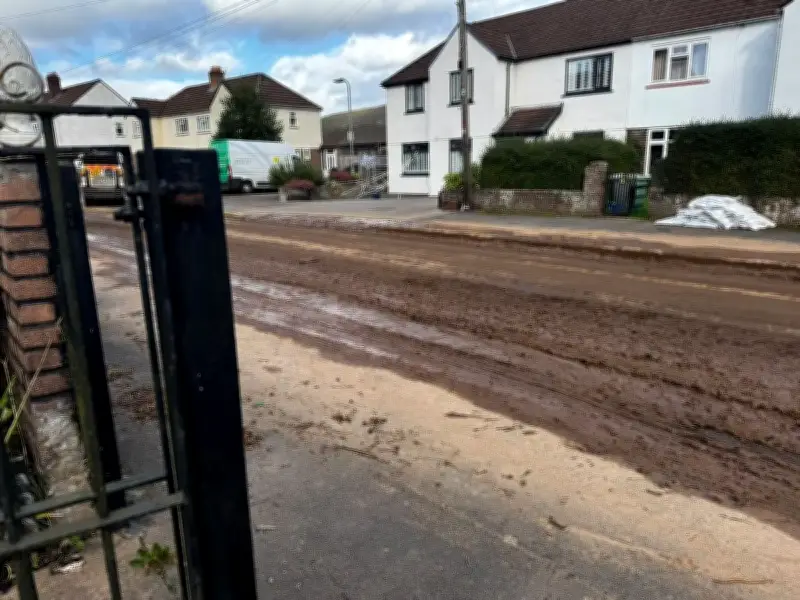
The Welsh Government has promised to review planning rules after a blast from a quarry in Taff's Well flooded 13 homes in a Cardiff village.
Housing minister Siân Gwenllian said she would examine whether an overhaul of the current policy, known as Minerals Technical Advice Note 1 and dating from 2004, was needed. The issue was discussed in the Senedd after a debate tabled by Plaid Cymru's Caerdydd Penarth MS Kiera Marshall.
Residents 'living in fear'
Ms Marshall warned that residents in Gwaelod y Garth have been left "living in fear" after homes were flooded with up to five feet of water following a planned blast at the neighbouring quarry this summer, forcing 13 households to evacuate.
She told the chamber that one uninsured family lost everything just two weeks after moving to the village, while an older couple "sat in their living room in ankle-deep water, in the cold, in candlelight with no electricity".
Calling for quarry blasting rules to be "urgently reviewed", she questioned the effectiveness of the planning guidance in protecting communities and labelled it "completely out of date". Ms Marshall said this was not about opposing quarrying but "ensuring that industry operates safely alongside the communities that have to live with it".
Buffer zone concerns
She urged ministers to examine whether minimum buffer zones between homes and blast sites are wide enough and to ensure individual local geography and public health impacts are properly weighed in planning decisions.
Welsh Labour MS for Pontypridd Cynon Merthyr, Vikki Howells, raised similar concerns about Craig-yr-Hesg quarry, which sits next to the village of Glyncoch. Although current guidance recommends a minimum 200m buffer between quarries and housing, she said the quarry has "crept closer and closer to people's homes".
She continued: "The latest expansion granted in 2022 brought the working area within 142m of many houses, and just 109m from the nearest property. There was even a primary school, at that point, just 164m away." She also told members that dust was a "major issue" for those who live near quarry sites with chronic lung conditions.
Economic impact weighed
Welsh Conservative enterprise spokesperson Janet Finch-Saunders urged caution over tightening restrictions on an industry that contributes £700m to the Welsh economy and employs 3,800 people, many from rural areas. While recognising the importance of protecting communities, she said the "positive impact" quarrying has had on Wales' local and national economies must not be overlooked.
Accepting that a reduction of the 200m buffer zone would worry her, she said the "right balance" needed to be struck, noting that quarry operators already have legal duties to monitor and manage dust emissions.
Responding for the Welsh Government, Ms Gwenllian said she could not comment on specific quarries to avoid prejudicing ministers' legal role in future planning decisions. She said a formal call for evidence would test whether national guidance needs changing without requiring a new law, though she noted any updated rules would only apply to new quarries or future extensions rather than existing operations.
The motion was passed with 55 votes in favour, 13 against, and 19 abstentions.