

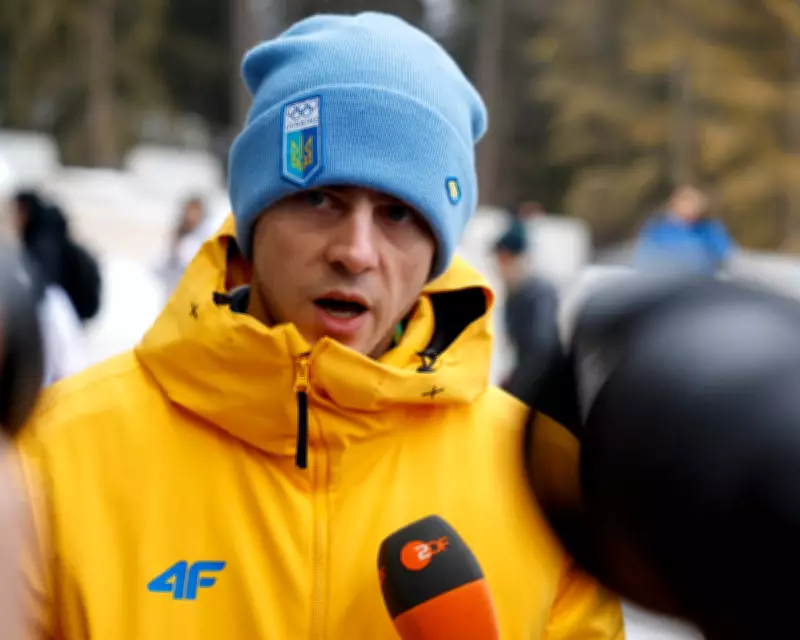
Ukrainian Skeleton Athlete Disqualified Over War Memorial Helmet at Winter Olympics
The Ukrainian skeleton racer Vladyslav Heraskevych has been expelled from the Winter Olympics after he declined to cease wearing a "helmet of memory" dedicated to Ukraine's war casualties. The International Olympic Committee announced the disqualification merely 21 minutes before the men's skeleton competition commenced in Cortina on Thursday, following unsuccessful last-minute negotiations between IOC President Kirsty Coventry and Heraskevych.
IOC Cites Violation of Expression Guidelines
In a concise statement, the IOC confirmed it had revoked Heraskevych's accreditation due to "his refusal to comply with the IOC's Guidelines on Athlete Expression." The decision was enforced by the International Bobsleigh and Skeleton Federation jury, which ruled the helmet non-compliant with competition regulations. Consequently, Heraskevych, viewed as a medal contender, must depart the Olympic Games immediately and is barred from re-entering the athletes' village.
Reacting to his expulsion, Heraskevych expressed profound disappointment to reporters, stating, "It's hard to say or put into words. It's emptiness." He affirmed plans to appeal to the Court of Arbitration for Sport, though prospects appear slim with the event already underway.

Criticism from Olympic Champion and Emotional Fallout
The ruling faced immediate condemnation from British skeleton Olympic champion Lizzy Yarnold, who asserted the IOC owes Heraskevych an apology. "It's actually quite shocking," Yarnold remarked. "Lots of the sliding community have been in contact straight away. There is shock and confusion. The reaction to something which was an act of memorial, and incredibly emotionally important to him, I'm quite shocked. I think the IOC owes him an apology. I think this was the wrong decision. He was also a medal contender for the race. He's a phenomenal athlete."
Under Article 50 of the Olympic Charter, political statements are prohibited during competition. The Ukrainian delegation argued all week that the helmet, displaying 24 images of athletes and children killed since Russia's invasion, constituted remembrance rather than a political act. However, this stance was ultimately rejected by the IOC.
Failed Compromises and Emotional Appeals
The IOC noted that despite multiple discussions and in-person meetings, including a final attempt with President Coventry, Heraskevych "did not consider any form of compromise," such as wearing a black armband instead. Coventry, visibly emotional, addressed reporters with tears, stating, "I was not meant to be here but I thought it was really important to come here and talk to him face to face. No one, especially me, is disagreeing with the messaging, it's a powerful message, it's a message of remembrance, of memory. The challenge was to find a solution for the field of play. Sadly we've not been able to find that solution." She added, "I really wanted to see him race. It's been an emotional morning."
Earlier on Thursday, Heraskevych made a final plea to the IOC, urging them to permit his helmet use, apologise for the pressure exerted on him, and provide electric generators for Ukrainian sports facilities affected by shelling. "I never wanted a scandal with the IOC, and I did not create it," he declared. "The IOC created it with its interpretation of the rules, which many view as discriminatory. Although this scandal has made it possible to loudly speak about Ukrainian athletes who have been killed, at the same time the very fact of the scandal distracts a tremendous amount of attention away from the competitions themselves and from the athletes participating in them." His appeal, however, went unheeded.






