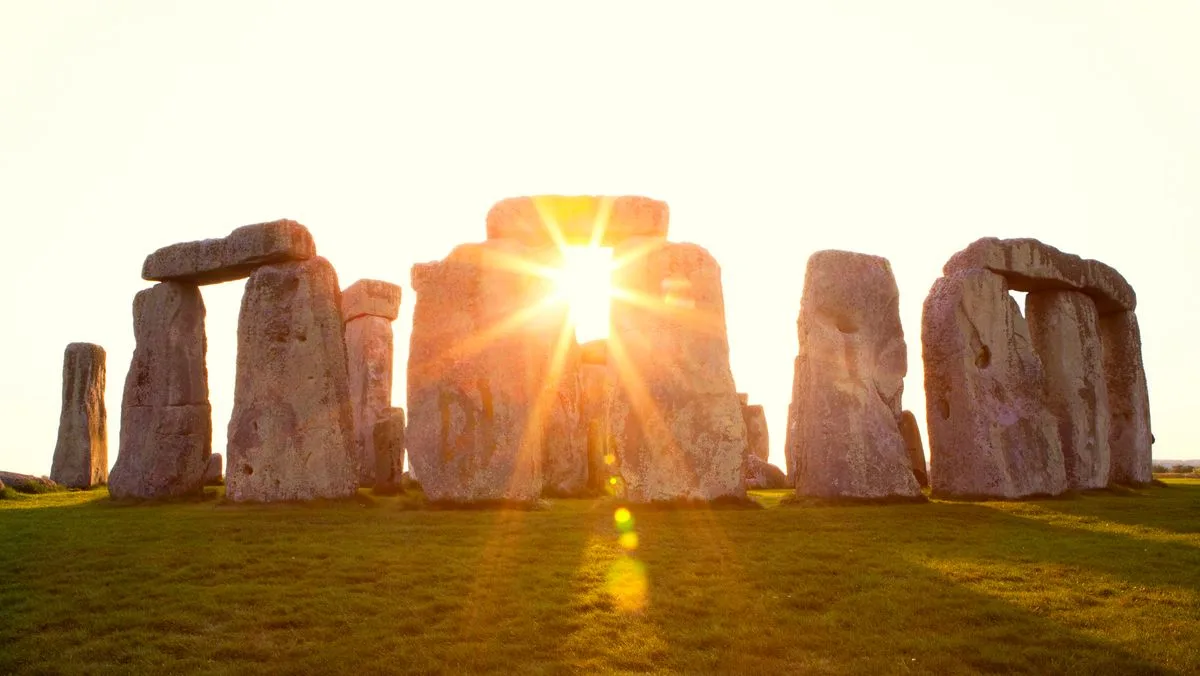
Researchers believe they have solved the mystery of how the six-tonne altar stone of Stonehenge travelled from Scotland to England. A study suggests the sandstone monolith may have been carried by a glacier during the last Ice Age to Doggerland, a now-submerged land off the east coast of England, before being moved by prehistoric Britons to Salisbury Plain.
The stone is thought to have originated in the Orcadian Basin in north-east Scotland, around 435 miles from its final resting place. Scientists from Sheffield Hallam University and Curtin University in Australia used computer modelling to propose that glacial transport deposited the stone in Doggerland, which once connected Britain to mainland Europe but was submerged by rising sea levels.
Dr Remy Veness, co-lead author from Sheffield Hallam University, said: 'We recently discovered that the origin of the altar stone is north-east Scotland, but how it travelled 700km to Salisbury Plain is widely debated. Our research gives a new plausible explanation for part of the journey.' She added that the stone's cultural significance may have prompted its relocation to avoid submersion as ice sheets melted.

Dr Anthony Clarke, co-lead author from Curtin University, emphasised that the journey was likely deliberate and multi-stage. 'Rather than being carried naturally by ice, the evidence points to a deliberate, carefully planned movement across a challenging and varied landscape,' he said. The study, published in the Journal of Quaternary Science, suggests human transport was required for the final leg, possibly using overland hauling and river or coastal routes.
The findings indicate that the altar stone may have been moved first to the Berkshire Ridgeway, Europe's oldest road, before reaching Salisbury Plain. Future research aims to pinpoint the exact source in north-east Scotland and refine the transport routes.