

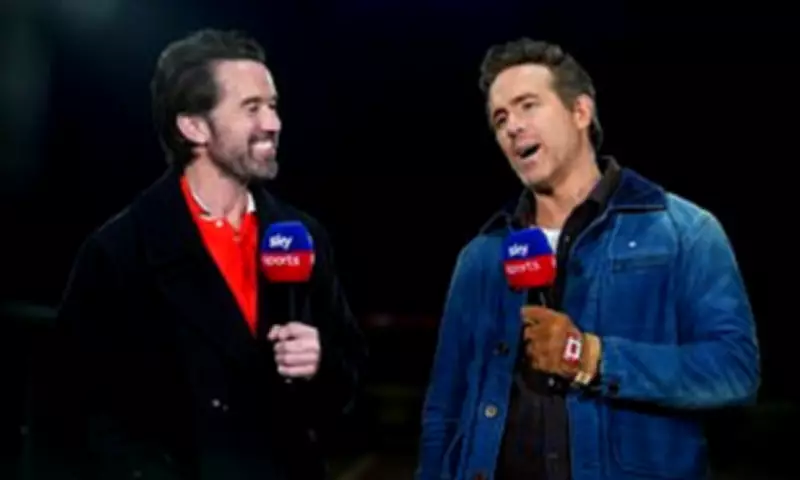
Sky Sports' Wrexham Broadcast Sparks Football Impartiality Debate
During his commentary on Wrexham's match against Swansea, Ryan Reynolds humorously remarked that the show might feel like it lasted twenty hours. Unfortunately, his prediction proved accurate for many viewers. Welcome to Wrexham, the only football club permitted to broadcast what essentially amounted to a party political advertisement on Sky Sports' airwaves throughout an entire match, entirely free from critical scrutiny.
The Charming Owners and Their Impact
Reynolds and his co-owner Rob McElhenney are undoubtedly charismatic individuals who have demonstrated a genuine affection for Wrexham, revitalising the club beyond its most ambitious aspirations. They appear grounded and amiable, and while financial investment is crucial, it only goes so far. Manager Phil Parkinson, the players, and the entire staff are collaboratively forging a remarkable period for both the club and its community. Their achievements in this regard deserve significant commendation and recognition.
A Broadcast Lacking Balance
However, the spectacle presented on Friday night was, for many, an affront to the principles of fair football coverage. Sky Sports, displaying an increasingly sycophantic attitude towards Wrexham, granted the club an entire evening of self-indulgent, boastful, and monotonous self-promotion. The broadcasters completely abandoned their duty to provide balanced reporting. This failure rests squarely with Sky Sports, not with Wrexham. Naturally, any club would eagerly accept such an opportunity.

Consequently, viewers were treated to effusive praise describing Reynolds and McElhenney as 'brilliant,' heard striker Kieffer Moore labelled a 'handsome devil,' and were presented with a revisionist narrative of a proud Welsh city where, allegedly, smiles were scarce just five years ago. When Swansea striker Zan Vipotnik came close to scoring, Reynolds exclaimed, 'That's not what we want!' This was not even a pretence at impartial broadcasting and, to be fair, it never purported to be. Sky Sports did air a standard match broadcast on their primary channel and advertised this alternative during the stream, offering fans a choice.
Partisanship Over Commentary
Those who opted to watch the special stream witnessed pure partisanship. Credit must be given to Reynolds and McElhenney, who were guided by the adept David Prutton, for offering unique insights into their club that no external commentator could replicate. Reynolds painted a vivid picture of Wrexham's dressing room following their recent FA Cup defeat by Chelsea, sharing, 'If you went in the locker room after the match, it looked like they'd come out of a war.' McElhenney recounted his journey to acquiring Wrexham, revealing, 'I Googled how to buy a football club,' and admitted he only learned about promotion and relegation during the Covid-19 pandemic.
Ultimately, the broadcast felt like an elevated version of a club's internal television channel. Former players Ben Foster, Ben Tozer, and Steven Fletcher were brought in to reminisce about their experiences. Reynolds and McElhenney celebrated goals with unrestrained enthusiasm. Swansea City, in whom rapper Snoop Dogg recently acquired a stake, received scant mention during their 2-0 defeat.
Why This Matters for Football
One might question why this issue holds significance. After all, Reynolds and McElhenney are far from the worst owners—preferable to despotic regimes or indifferent foreign businessmen. If audiences enjoy such content, what is the harm? Some social media reviewers expressed approval, while others were incensed. One viewer commented, 'Think they’re renaming the channel to Sky Sports Wrexham.'
It matters because this episode represents another instance of football becoming a mere sideshow to the entertainment industry in the modern era. This trend explains why personalities like KSI are purchasing clubs like Dagenham & Redbridge and streaming their matchday experiences. It underpins the proliferation of half-time interviews in the Premier League and the introduction of half-time shows at events like the World Cup final.

The Impact on Traditional Supporters
While these developments may seem innocuous, they are adversely affecting traditional supporters. Consider Manchester United as an example. To accommodate Sky Sports and the Premier League's television schedules, by the season's end, they will have hosted only three Saturday 3pm home games across two seasons. Fixtures are frequently rescheduled at short notice, much to the frustration of season ticket holders.
The football industry now confronts an existential question: whom does it truly aim to serve? Who is its primary audience? Is it those with the deepest pockets, those who boast the loudest, or those who actively seek media attention?
A Broader Trend in Broadcasting
This broadcast may signify the culmination of a trend towards partiality for a broadcaster increasingly embracing bias. Pundits such as Gary Neville, Jamie Carragher, and Micah Richards, while often fair and critical, leave little doubt regarding their allegiances. Truly detached observers have become exceedingly rare in this climate.
Even the FA Cup's official social media account appeared to cosy up to Wrexham over the weekend. Their fixture against Chelsea garnered no fewer than nineteen posts, four of which featured Reynolds. One photograph of him, McElhenney, and actress Blake Lively was captioned, 'Name a more iconic trio.' Most football fans could likely suggest several alternatives.
Overlooking Other Sporting Stories
Meanwhile, Mansfield Town's impressive run before their defeat by Arsenal, Southampton's victory at Fulham, and Port Vale's win against Sunderland received considerably less attention, despite arguably constituting superior sporting narratives.
It is high time other clubs were afforded similar privileges. If Wrexham can receive their own dedicated commentary on Sky Sports, an entity supposed to steward the beautiful game, then why not Swansea? Why not Lincoln City, AFC Wimbledon, or Bromley?
A Call for Balanced Broadcasting
Alternatively, here is a superior proposal for the executives at Sky Sports' Osterley headquarters: reserve one-sided broadcasting for fan channels, which rely heavily on such content, and provide your subscribers with the informed, balanced coverage they are paying to receive. The integrity of football broadcasting depends on it.





