Bill Shorten has defended Anthony Albanese's government as it prepares to break an election promise over negative gearing, arguing fairness should trump past commitments.
It has been widely reported Tuesday night's federal budget will contain changes to negative gearing, the policy which allows landlords to reduce their bill at tax time. If so, Mr Albanese will break his repeated election commitment to leave those tax settings alone.
While stressing that any changes are hypothetical until confirmed on budget night, Mr Shorten backed in the policy he unsuccessfully took to the 2019 election. 'It's an idea whose time has well and truly come,' the former Labor leader told AAP.

In breaking an election promise on tax, Mr Albanese's government will be repeating an act from its first term, when it re-designed Mr Morrison's stage three tax cuts to be more generous to those with lower incomes. Then a cabinet minister, Mr Shorten enthusiastically backed that change. 'Tax cuts for more people proved to be more palatable than tax cuts for people who already were pretty well-off,' he said. 'Because there were 13 million, 14 million winners and a relatively smaller number of perceived losers, in a cost-of-living crisis people thought that was pretty fair.'
It's that same fairness principle Mr Shorten applies to the likely negative gearing U-turn. 'The idea that someone who might have three or four investment properties can turn up to bid on a house with a taxpayer subsidy in their wallet, compared to a young couple trying to buy their first home doesn't seem fair to me,' he said.
Labor is taking the view it will be rewarded by an electorate concerned by rampant housing costs. That's a different calculation than with other infamous broken promises. Bob Hawke's 1987 election pledge that 'by 1990, no Australian child will be living in poverty' was over-ambitious and unfeasible. After winning the 1993 election, Paul Keating moved to scrap tax cuts promised as 'L-A-W' because the money wasn't there. Tony Abbott's 2013 election eve promise of no cuts to education, health and public broadcasters were reversed as part of wider cutbacks in the 2014 budget.
What's in the Budget?
- An overhaul of tax breaks for property investors will be framed as a way of giving younger Australians a leg up in the housing market.
- Details will be revealed on Tuesday night, but the government is widely expected to pare back negative gearing and capital gains tax concessions, along with changes to the tax treatment of trusts.
- The budget will show the nation's finances are $44.9 billion better off than forecast in December 2025, the government says.
- There will also be an increase in spending on Australia's military to the tune of $53 billion over the next decade, to deal with intensifying security risks.
- The budget will account for a 26-cent-a-litre cut to the price of petrol and diesel, along with a cut to the heavy vehicle road user charge, which are already in place and scheduled to expire on June 30. There is a chance the government will extend these measures.
- There has been speculation the government could give Australians a one-off payment of between $200 and $300, but no details have been confirmed.
- To reduce pressure on the budget, the government is stripping out about $15 billion a year from the National Disability Insurance Scheme, slashing eligibility and requiring the states to do more to support people with some disabilities.
- Australians over 65 will no longer pay discounted rebates for private health insurance, bringing it into line with other age groups. Older Australians will have to pay more than $200 a year extra for their cover.
- Tax breaks for electric vehicles will also be phased out. Incentives allowing employers to avoid fringe benefits tax on EVs under $91,000 through a novated lease will be changed to a 25 per cent discount.
- The long-running inland rail freight project will be cut, but the government is pouring $3.8 billion into Melbourne's Suburban Rail Loop and $50 million into improving the Sydney-Canberra train line.
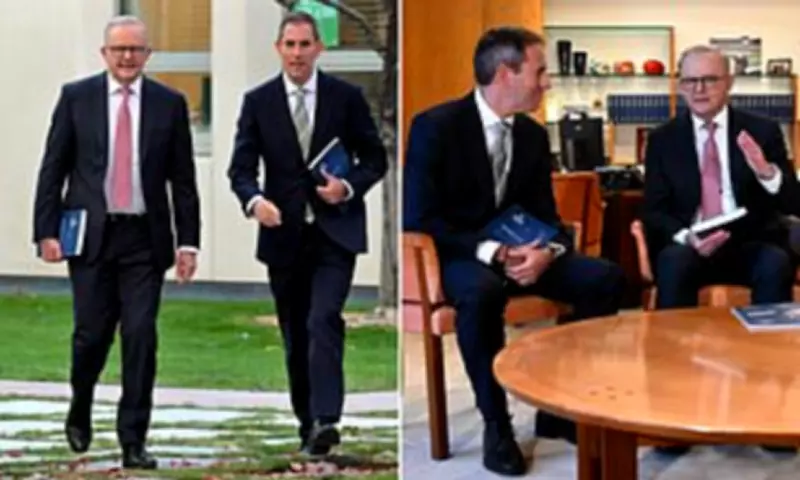
The trio will hand down the federal budget on Tuesday night, May 12. And Julia Gillard's 2010 affirmation that 'there will be no carbon tax under a government I lead' was a casualty of negotiations to form a minority government.

Sean Kelly, an adviser to Labor prime ministers Kevin Rudd and Ms Gillard, argues any broken promise can be powerful with voters as 'it's a betrayal (and) can have an emotional element'. However, it's hard to tell how each pivot will play. 'There is no single cut-through rule when it comes to broken promises. They all land in their own circumstances... and it's very hard to take rules from the past,' he said.
In the case of Australia's first female prime minister, Mr Kelly argues other factors were much more politically challenging. 'Julia Gillard had Kevin Rudd behind her, a wall of misogyny in front of her, and a minority government,' he said. 'Absent those things, I'm not sure that the carbon price broken promise looks quite the way it does.'