

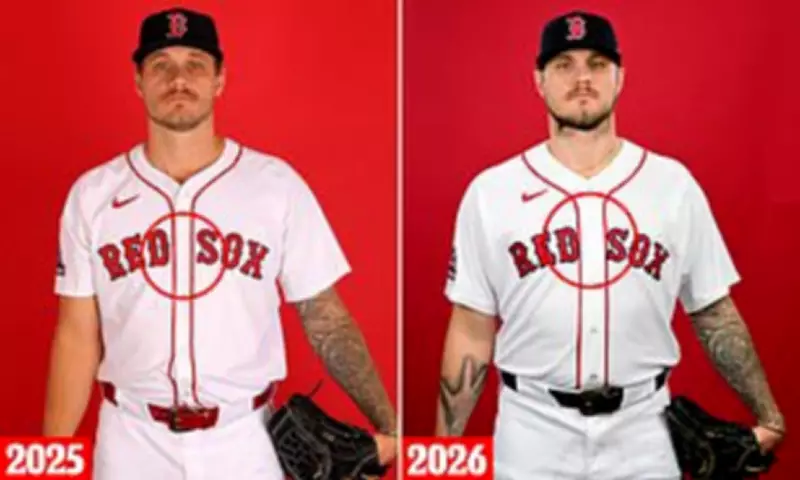
Boston Red Sox fans have unleashed a torrent of criticism against Major League Baseball's official merchandise partner, Fanatics, following the unveiling of the team's new jerseys at spring training in Florida. Supporters are accusing the company of everything from careless design to hyperbolic comparisons with crimes against humanity, despite no official changes being announced by Fanatics, which manufactures the jerseys, or Nike, which designs them.
Design Flaws Spark Online Fury
The controversy centers on Boston's iconic home white jerseys, where the famous red piping now appears to be uncomfortably close to the lettering, particularly affecting the 'D' and 'S'. This subtle alteration has not gone unnoticed by eagle-eyed fans, who have contrasted it with previous versions that allowed more generous spacing between the piping and the team name.
Rather than directing their ire at Nike, the design force behind the uniforms, supporters have primarily targeted Fanatics and its billionaire founder, Michael Rubin. Social media platform X has become a hotbed for vitriolic comments, with one critic dramatically posting, 'MICHAEL RUBIN GET READY FOR THE HAGUE,' in a reference to the International Criminal Court. Others have labeled Rubin a 'terrorist' or wished for him to 'take fanatics with him' to a place 'deeper than hell.'

Injured Pitcher Showcases New Look
The new jerseys were visibly worn this week by injured Red Sox pitcher Tanner Houck during training sessions in Florida, providing a clear look at the contentious design. The Daily Mail has reached out to Fanatics spokespeople for comment on the growing backlash, but no official response has been issued regarding the Red Sox-specific complaints.
A Pattern of Problems for Fanatics
This incident marks just the latest in a series of criticisms leveled at Fanatics, which holds apparel deals with nearly all major professional sports leagues, making it a dominant force in licensed merchandise. Earlier this month, the company was forced to apologize to Seattle Seahawks and New England Patriots fans over supply chain issues ahead of Super Bowl LX.
In a statement on X, Fanatics acknowledged, 'NFL fans, we've seen your jersey feedback, and we take it very seriously. We've let Patriots and Seahawks fans down with product availability, we own that, and we are sorry.' However, supply was not the only concern; some fans who did receive merchandise complained that the items were inferior to the standard game jerseys worn by players.
Fanatics firmly rejected these quality accusations, asserting, 'We've heard questions about the quality of these alternate jerseys and can assure you that, despite some unflattering photos, these jerseys are identical to the standard Nike replica "Game" jersey.'
Exclusivity and Fan Frustration
The company's near-monopoly on official sports apparel is beginning to grate on supporters. One fan on X drew a sharp analogy, writing, 'Imagine if the only place you could buy burgers was McDonald's and they charged $50. That's what fanatics is in the jersey industry.' This sentiment highlights broader discontent with limited options and perceived high prices.
Historical Precedent of Uniform Issues
This is not the first time MLB has faced uniform controversies linked to the Nike and Fanatics partnership. Just two years ago, ESPN reported that the league was compelled to modify uniforms after complaints from both players and fans about see-through fabric, mismatched gray tops and bottoms, and other quality control failures.
At that time, Major League Baseball issued a memo to the players' union, explicitly placing blame on Nike. The memo stated, 'This has been entirely a Nike issue. At its core, what has happened here is that Nike was innovating something that didn't need to be innovated.' The union corroborated this, clarifying that Fanatics was not at fault for those earlier problems, though current frustrations suggest a shifting focus back to the manufacturer.
As the 2024 season approaches, the Red Sox jersey debacle underscores ongoing tensions between sports franchises, their corporate partners, and the passionate fanbases who demand both tradition and quality in their team's gear.






