

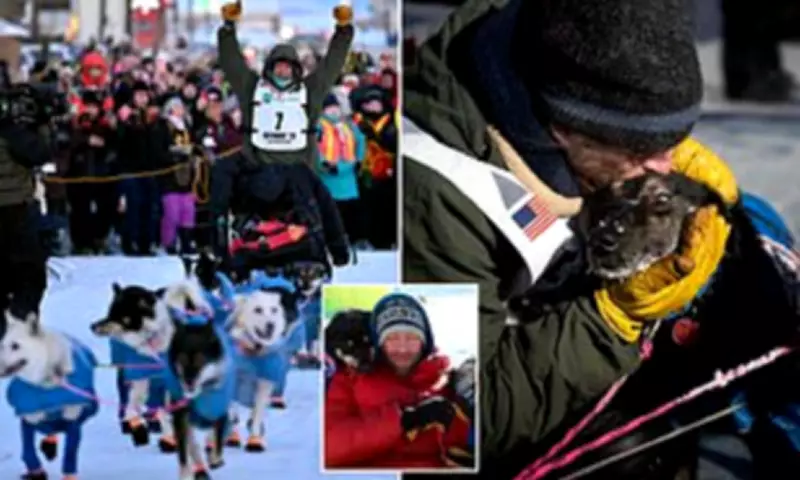
Former Reality TV Star Triumphs in Controversial Iditarod Race
Jessie Holmes, a former cast member of the National Geographic reality series 'Life Below Zero', has successfully defended his title in the Iditarod, the fiercely debated 1,000-mile dog sled race across Alaska. Holmes guided his team across the finish line on Tuesday night in Nome, a historic Gold Rush town on the Bering Sea coast, marking a repeat victory that has reignited tensions with animal rights activists.
Animal Rights Groups Condemn Race as Dog Deaths Mount
People for the Ethical Treatment of Animals (PETA), the race's most vocal critic, asserts that over 150 dogs have perished throughout the Iditarod's history. The organization has directly appealed to Norwegian billionaire Kjell Rokke, who injected significant funds into this year's event, urging him to redirect his investment toward canine welfare rather than subjecting animals to what they describe as 'hazards and misery.'
Melanie Johnson, a senior manager at PETA, emphasized in 2024 that the persistent fatalities demonstrate that mushers must cease endangering their dogs and that the race should be terminated. 'These are not super dogs; they're not indestructible pieces of sporting equipment,' Johnson stated. 'But the Iditarod continues to push them beyond their capabilities, and as a result, dogs continue to suffer and die.'

The Iditarod has never publicly released its own tally of canine deaths. In this year's competition, a 4-year-old female dog named Charly, belonging to musher Mille Porsild's team, died, with a necropsy planned. The 2024 race saw three dogs die during the event and five more in training, sparking renewed demands for Alaska's state sport to be banned.
Race Dynamics and Historical Context
Thirty-four competitive mushers commenced this year's Iditarod, equaling the inaugural 1973 race for the second smallest field in history. The retirement of numerous veteran mushers and soaring costs, including dog food, have contributed to diminished participation in recent years.
The race began on March 8 in Willow, following a ceremonial start in Anchorage. Teams traversed two mountain ranges, navigated the frozen Yukon River, and crossed the perilous Bering Sea ice. Holmes now joins an elite group as only the third competitor in the Iditarod's 54-year history to secure back-to-back victories after a maiden win.
Upon finishing, Holmes' dogs were rewarded with steaks, while he fielded questions alongside his lead dogs, Polar and Zeus. 'Zeus led every single run except one. I just wanted to let someone else have some fun. And Polar deserves it more than anybody,' Holmes remarked. 'He leads by example.'
Financial Boost and Personal Background
Holmes will receive approximately $80,000 for this year's triumph, a substantial increase from the $57,000-plus he earned last year. The enhanced purse was partly funded by Kjell Rokke, who contributed $100,000 in additional prize money and $170,000 to Alaska Native villages serving as checkpoints. Rokke, now residing in Switzerland, also participated in a new noncompetitive amateur category.
Holmes first entered the Iditarod in 2018, securing rookie of the year honors with a seventh-place finish. He has competed nine times, achieving seven top-10 finishes and placing in the top five for the past five races. His eight-year stint on 'Life Below Zero', which documented the challenges of rural Alaskan life, provided the financial means to upgrade his dogs and equipment, as well as purchase raw land near Denali National Park and Preserve.
A carpenter by trade, Holmes has established a homestead in the wilderness, with his nearest neighbor roughly 30 miles away.
Controversy and Rule Violations
The Iditarod faced further scandal in 2024 when musher Dallas Seavey, a five-time champion, was compelled to kill a moose that became entangled with his team about 12 hours into the race. One dog was injured in the encounter and airlifted to Anchorage for treatment.

Seavey violated Iditarod Rule 34, which mandates that any edible big game animal killed in defense of life or property must be properly gutted and reported. Officials determined that Seavey did not sufficiently gut the moose, imposing a two-hour time penalty. 'It fell on my sled; it was sprawled on the trail,' Seavey explained. 'I gutted it the best I could, but it was ugly.'
Despite the controversies, supporters argue that dog mushing holds a storied tradition in Alaska, deeply rooted in the heritage of Native peoples. The debate between preserving cultural practices and ensuring animal welfare continues to intensify as the Iditarod progresses.





