

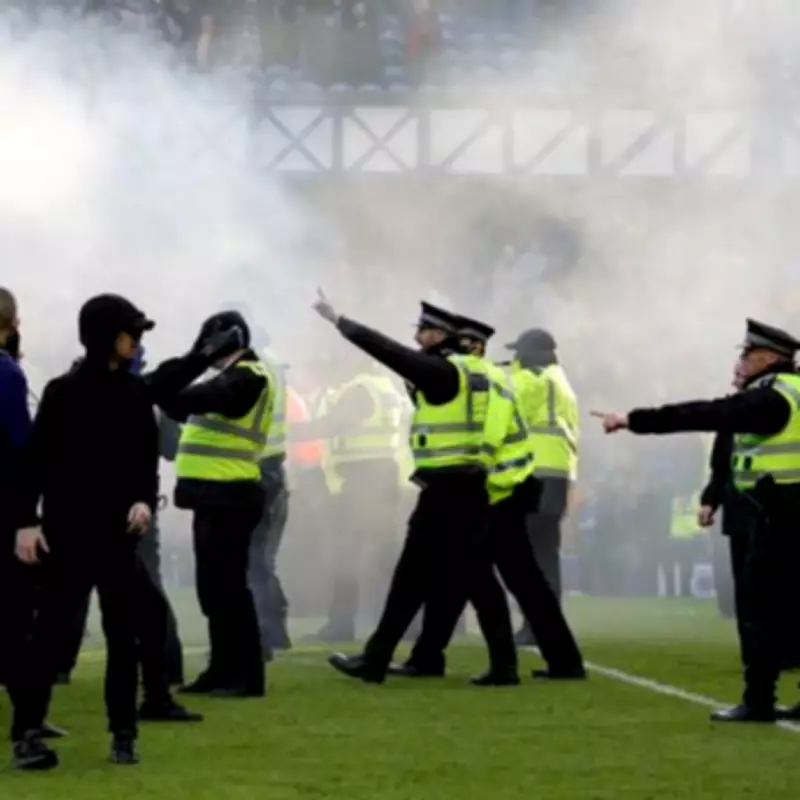
Police Scotland has delivered a clear and forceful message regarding the future of Celtic versus Rangers fixtures, stating that the traditional large away fan allocations may no longer be viable. This warning comes in the direct aftermath of violent and chaotic scenes that marred the Scottish Cup quarter-final clash at Ibrox Stadium on Sunday.
Chaotic Scenes Overshadow Dramatic Cup Exit
Celtic secured a dramatic penalty shootout victory over Rangers to advance to the Scottish Cup semi-finals, with Tomas Cvancara scoring the decisive spot-kick. However, the sporting drama was completely overshadowed by disgraceful post-match violence. As the final whistle blew, fans from both sides invaded the pitch, leading to violent clashes. Flares were hurled into the stands, resulting in injuries to several stewards and police officers.
Online footage further depicted a shocking assault on a member of Celtic's backroom staff by a home supporter. Police have confirmed nine arrests connected to the disorder, with expectations that this number will rise significantly as investigations continue over the coming days.

Police Chief Questions Future of Away Allocations
Emma Croft, Chief Superintendent for Greater Glasgow Division, suggested that the unsavoury events could signal a permanent change to how these iconic fixtures are policed and organised. When questioned by Sky Sports News about whether large away allocations would be repeated, Croft was unequivocal in her assessment of the current situation.
"Our starting position is that that number of away fans is not workable currently," Croft stated. "I think behaviours of fans set football back and put the spotlight wrongly on Scottish football. I can see why general fans would feel disgruntled by that."
When pressed on whether she would personally permit such attendance numbers, she replied firmly, "No, not at this current time."
Injuries and Policing Resources Under Scrutiny
Chief Superintendent Croft revealed that three or four police officers sustained injuries during the disturbances, a figure she cautioned was likely to increase. Despite this, she insisted that there had been a sufficient number of officers deployed inside Ibrox to manage potential trouble, with additional support available outside the ground.
However, Croft framed this within the broader context of policing resources in 2026, emphasising a strategic reluctance to flood football stadiums with officers. "I'm not, in a view, wanting to put more police officers into stadiums. I don't think it's the right thing to do," she explained. Her argument centred on the principle that requiring extra policing due to anticipated poor behaviour represents a fundamental problem for the future of such events.
A Turning Point for Scottish Football?
The match itself saw over 7,500 Celtic supporters fill the Broomloan Stand, the largest away allocation at Ibrox since 2018, facilitated by Scottish Cup rules allowing visiting teams up to 20% of stadium capacity. This policy is now under intense scrutiny.
Croft's comments indicate a pivotal moment for the organisation of one of world football's most intense rivalries. The police stance suggests that future ticket allocations, policing strategies, and the very structure of these fixtures must be reconsidered to prevent a repeat of the despicable violence that unfolded. The actions of a minority have potentially altered the experience for all supporters, casting a long shadow over Scottish football.






