

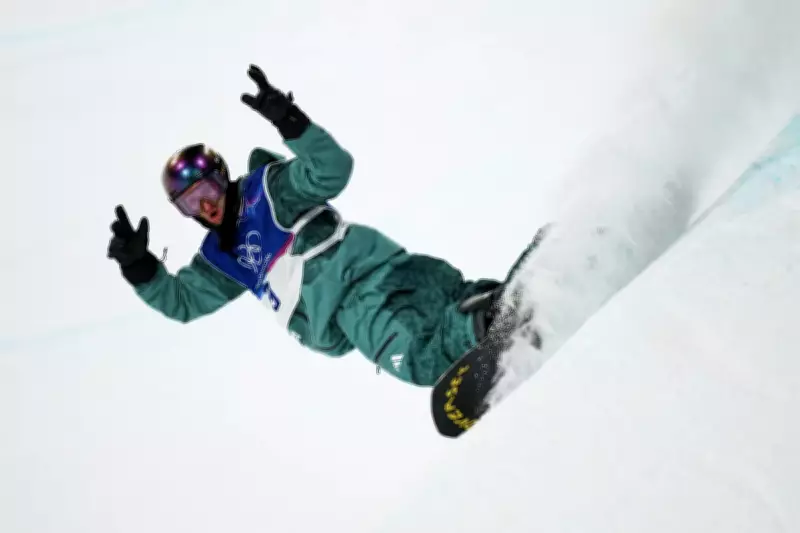
Brazilian Snowboarder Pat Burgener Harmonises Olympic Sport with Musical Passion
Brazilian snowboarder Pat Burgener experiences a profound sense of fulfilment when he intertwines his dedication to the halfpipe with his deep-seated passion for music. The 31-year-old athlete, who previously competed for Switzerland in the 2018 Pyeongchang Games and the 2022 Beijing Olympics, has now embraced his Brazilian heritage, inspired by his mother's background and the country's hosting of the all-Brazil FIFA Club World Championship in 2000.
From Mountains to Melodies: A Dual Journey
On a recent Tuesday, Burgener captivated an audience at Brazil House in Milan, a venue organised by the Brazilian Olympic committee. Approximately fifty revelers enthusiastically danced and clapped along as he masterfully played a guitar with his hands, a harmonica with his mouth, and drum pedals with his bare feet. "This year I fell in love with Brazil and it made me do crazy things," he declared onstage, met with resounding applause from the crowd.
Encouraged by his parents from the age of five, Burgener has developed proficiency in a diverse array of instruments, including the piano, guitar, ukulele, harmonica, trumpet, flute, and the four-string cavaquinho. He later received a diagnosis of ADHD and has found that music significantly aids his focus. "I realised that a big part of society doesn’t want you to do too many things because we’re kind of focused on trying to make one thing really well, which for some people works," he explained in an interview with The Associated Press prior to his performance. "But for me, it’s what I need. I felt it. It was like a balance of life between snowboarding and music."

Olympic Endeavours and Musical Aspirations
Since his first performance at eighteen alongside his brother, Burgener has been steadfast in his pursuit of a musical career. He has recorded dozens of songs, with his debut single in Portuguese released coinciding with the commencement of the Games. His annual schedule is meticulously divided: touring from April to December, encompassing around eighty shows, followed by a shift to the snowboarding season.
Burgener's inaugural year with the Brazilian team aligned with that of Alpine ski racer Lucas Pinheiro Braathen, whose gold medal on Saturday marked South America's first-ever medal in a Winter Olympics. Pinheiro Braathen, who previously competed for Norway until 2023, switched to Brazil last season, incorporating his mother's surname.
However, Burgener's Olympic outcome did not mirror his teammate's success. His journey concluded in Livigno, Italy, on February 11th, with a fourteenth-place finish in the men's halfpipe qualifying event, preventing advancement to the final. Despite this, he remains optimistic about channelling the experience into his music. "It’s like that feeling where, 'wow, I’ve worked so hard for this, and now it’s done,'" he reflected. "And there’s a lot of mixed emotions about this, you know? Happiness, sadness. And I always call it the post-Olympic depression, because this is just reality. If you win, if you lose, it hits pretty hard. And I’m excited for this time to write songs."
The Intersection of Sport and Sound in Athletics
Burgener is not alone in linking athletic performance with auditory stimulation. The sight of athletes relaxing or energising themselves with headphones before competitions has become commonplace across various sports, from basketball and soccer to swimming. Yet, sustaining musical engagement during active participation is a distinct challenge.
During these Games, numerous freestyle skiers and snowboarders brought music to Livigno, the host site for Winter Olympic action sports. For athletes like Evan McEachran, earphones connected to a smartphone are as essential as skis, poles, and a helmet. The Canadian competitor had intense rap music playing inside his crash helmet during Sunday's qualifying session for the men’s big air final. "If I’m feeling like I’m a little low on energy, I’ll put on some high-tempo music," he noted. "That fires me up and gives me a little jolt."
This blend of sport and sound underscores a growing trend among Olympians, highlighting how music can enhance focus, motivation, and emotional balance in high-pressure environments.






