

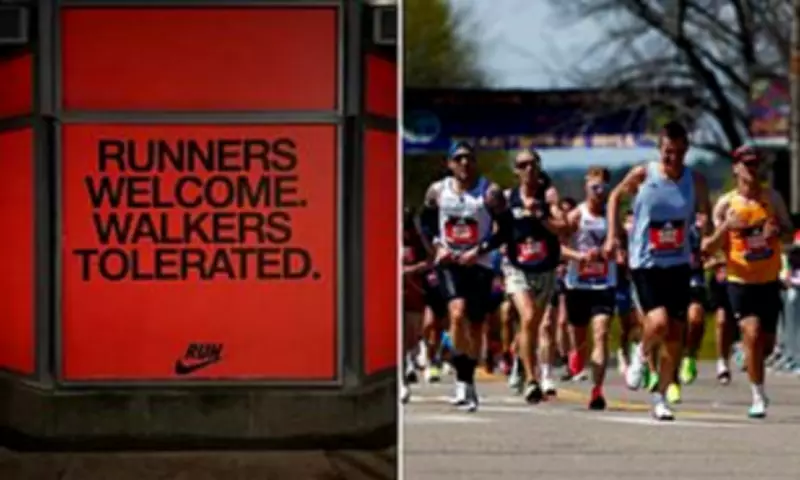
Nike has been compelled to remove a sign displayed at its Boston store intended to motivate participants in the city's upcoming marathon, following a fierce backlash accusing the sportswear giant of 'pace shaming' and insensitivity toward disabled competitors. The incident has ignited a broader conversation about inclusivity in running events.
Controversial Sign Sparks Outrage
The sign, which appeared last week at Nike's Newbury Street store in Boston, read: 'Runners welcome. Walkers tolerated.' Images quickly circulated on social media, drawing immediate condemnation from marathon runners and advocates for disability inclusion. Critics argued the messaging was tone-deaf and perpetuated elitism within the running community.
Nike's Response and Apology
In a statement addressing the controversy, Nike acknowledged the misstep: 'We want more people to feel welcome in running - no matter their pace, experience or the distance. During race week in Boston, we put up a series of signs to encourage runners. One of them missed the mark. We took it down, and we'll use this moment to do better and continue showing up for all runners.' The company emphasized its commitment to fostering an inclusive environment for athletes of all abilities.

Disabled Runners Voice Their Displeasure
Among the vocal critics was Robyn Michaud, who will compete in the adaptive division of the Boston Marathon for a fifth time on Monday. In an Instagram post alongside a picture of the sign, she shared: 'Due to a spinal cord injury I HAVE to take walk breaks. Even with a cyst in my spinal cord, I still regularly break 5 hours in Boston and plan to again this weekend. Thank you for TOLERATING me, @Nike. Perhaps you should swing by the adaptive and para staging area on Monday to see what true grit is all about.'
Nicole Homerin, who will run her ninth marathon despite having a heart condition, told WGBH: 'It doesn’t even acknowledge all the other ways that we can move our bodies - rolling, strolling, dancing, whatever mobility device that allows for freedom of movement. I think it’s, first of all, a very hierarchical kind of thing that running is somehow superior to walking. And then also excludes all of the other forms of movement that are equally celebrated and valued.'
Community Backlash and Broader Implications
The backlash extended beyond individual runners, with many highlighting systemic issues of ableism in sports. Tina Zhu Xi Caruso added: 'The running community is just very ableist… like you need to run fast, you need to run hard, you need to have dedication, you need to just do everything that a disabled person might not be able to do, or an older person.'
On Threads, another runner commented: 'The elitism in running is absolutely ridiculous. No matter the speed, forward is a pace. If you run, you’re a runner. Period. I am still a Boston Marathon finisher. I am proud of my 6:01:37 finish and the more than $21,500 I raised. Stop diminishing back-of-the-pack runners. I’m a dad of two kids, a partner to an amazing woman, a full time employee and a charity marathoner. I am not "tolerated".'
Context of the Boston Marathon
The Boston Marathon, renowned as the world's oldest and most prestigious annual marathon, attracts over 32,000 runners who traverse 26.2 miles through eight Massachusetts cities and towns, finishing on Boston's Boylston Street. Notably, it is one of the most difficult marathons to qualify for, with stringent time requirements such as 2:55 for men aged 18-34 and 3:25 for women in the same category.
This incident underscores ongoing challenges in promoting inclusivity in elite sporting events, as brands like Nike navigate the delicate balance between motivation and marginalization. The removal of the sign serves as a reminder of the importance of sensitive messaging in fostering a supportive athletic community.






