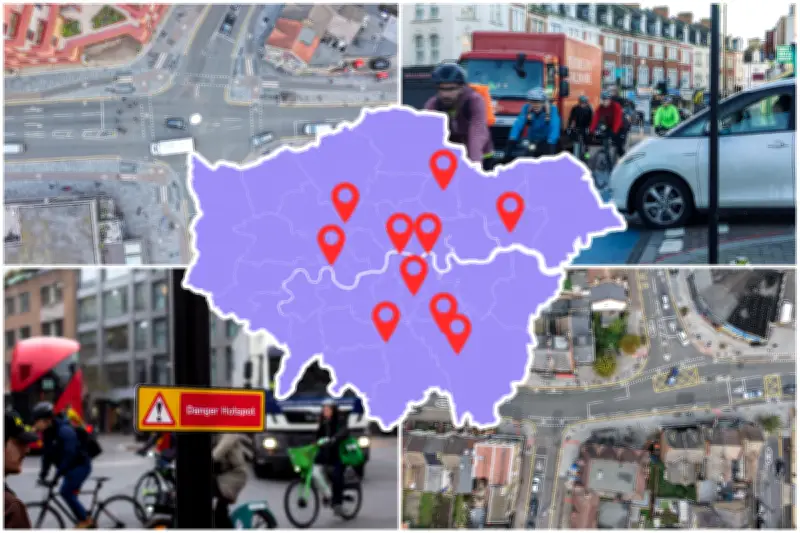
The London Cycling Campaign (LCC) has identified the capital's most dangerous junctions for cyclists and pedestrians after analysing five years of collision data, with a junction in Wandsworth topping the cycling list for the fourth consecutive year.
The group has accused Transport for London (TfL) of prioritising keeping roads "bus-friendly" and avoiding adding time to drivers' journeys over the safety of vulnerable road users.
Most dangerous junction for cyclists
The junction where Ansell Road, Derinton Road, Lessingham Avenue and Price Close meet Upper Tooting Road and Cycle Superhighway Seven (CS7) has recorded eight serious cycling collisions and 19 slight collisions over the past five years.
Around 3,000 cycling trips are made through the junction every day. Campaigners say surrounding roads are heavily used by drivers as "rat runs", with vehicles frequently turning in and out of side streets to avoid traffic on main roads.
Another junction causing concern is near Seven Sisters in Haringey, where Broad Lane and West Green Road meet Tottenham High Road. Appearing on the list for the first time this year, it has recorded eight serious cycling collisions and 10 slight collisions over the past five years.
Top 10 junctions for cyclists
The top 10 most dangerous junctions for cyclists in London are:
- Upper Tooting Road/CS7 at Ansell Road, Derinton Road, Lessingham Avenue and Price Close, Wandsworth
- Broad Lane at West Green Road and High Road, Tottenham/C1, Haringey
- Great Eastern Street at Curtain Road, Hackney
- King Street/C9 at Weltje Road, Hammersmith & Fulham
- Stratford High Street at Carpenters Road, Newham
- London Bridge at Duke Street Hill, Southwark
- Old Kent Road at Dunton Road, Southwark
- Wood Lane at Westway, Hammersmith & Fulham
- New Bridge Street at Bridewell Place, City of London
- Old Kent Road at St James's Road, Southwark
The London Cycling Campaign first launched its dangerous junctions campaign in 2022, following the deaths of Dr Marta Krawiec and Shatha Ali at Holborn.
Rising serious injuries
In 2025, a total of 1,196 cyclists were killed or seriously injured on London's roads, up 20.3 per cent from 994 in 2024. That is the highest figure recorded since at least 2017.
However, while the overall number of people killed or seriously injured has risen, cycling deaths have fallen. Six cyclists were killed in 2025, compared with nine in 2024, the lowest annual total since 2020 and the second-lowest ever recorded in the capital.
Mayor Lord Sadiq Khan has set a target of eliminating all road deaths in London by 2041.
Most dangerous junctions for pedestrians
The LCC also highlighted the junctions posing the greatest danger to pedestrians. Topping the list is the junction where Brixton Hill meets Coldharbour Lane in Lambeth, which has seen one fatality and ten slight collisions over the past five years.
It is followed by Monument Junction in the City of London, where eight serious collisions and seven slight collisions have been recorded over the same period.
The 10 most dangerous junctions for pedestrians are:
- Brixton Hill at Coldharbour Lane, Lambeth
- Monument Junction, City of London
- Commercial Road at Butcher Row, Tower Hamlets
- Tottenham Court Road at Oxford Street, Camden & Westminster
- Great Eastern Street at Holywell Lane, Hackney
- Blackhorse Road at Forest Road, Waltham Forest
- Tooting High Street at Mitcham Road & Garratt Lane, Wandsworth
- Burdett Road at St Paul's Way, Tower Hamlets
- Neasden Lane at Birse Crescent, Brent
- Commercial Road at East India Dock Road, Burdett Road and West India Dock Road
The LCC argues that TfL and London councils are too slow to address known danger spots, despite many road deaths and serious injuries being preventable. Campaigners say road safety must take priority over minor delays to drivers, with protected junctions and traffic restrictions essential to achieving London's Vision Zero goal of eliminating deaths and serious injuries.
Tom Fyans, chief executive of London Cycling Campaign, said: "Less than a handful of London boroughs so far have delivered 'all round protected' junction designs, despite a growing list of cities and towns outside London managing to.
"Why haven't TfL yet managed a single one, why are so few boroughs delivering them and why does filtering side road junctions with significant collision patterns seem so difficult also?
"Concerns over drivers facing a few seconds more on journey times all too often seems to trump dealing with fatal and serious collisions for those cycling, walking and wheeling."