

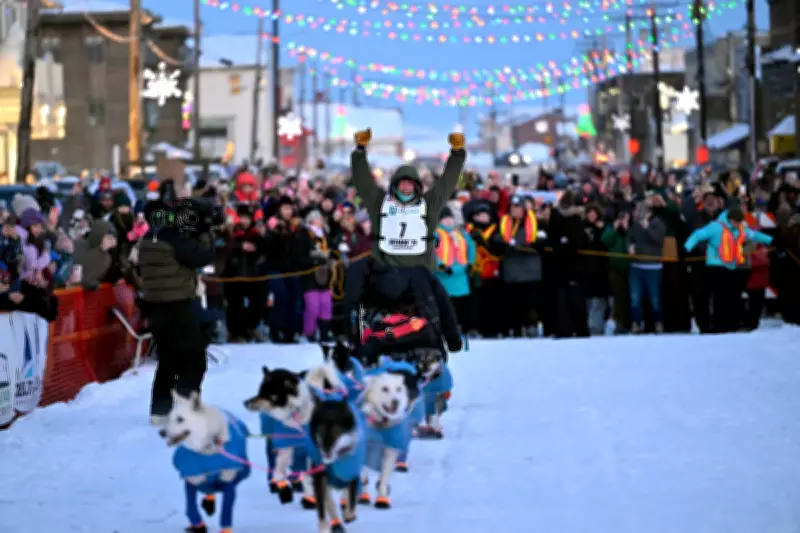
Former reality television personality Jessie Holmes has successfully defended his Iditarod Trail Sled Dog Race championship, securing a repeat victory in the demanding 1,000-mile Alaskan competition. Holmes guided his team of sled dogs across the finish line in Nome on Tuesday night, cementing his status as one of the event's elite modern mushers.
A Grueling Journey Through the Alaskan Wilderness
The arduous race commenced on March 8th in Willow, following a ceremonial start in Anchorage, challenging participants with treacherous terrain that included two mountain ranges, the frozen Yukon River, and unpredictable Bering Sea ice. Holmes navigated these harsh conditions with precision, demonstrating exceptional endurance and skill alongside his canine companions.
Joining an Exclusive Club of Champions
This consecutive win places Holmes in rarefied company within the Iditarod's 54-year history. He becomes only the third competitor to achieve back-to-back victories following an initial win, joining legendary mushers Susan Butcher (1986-1987) and Lance Mackey (2007-2008), both of whom eventually claimed four championships each.

Before this year's race, Holmes described the Iditarod as the most crucial of his career, telling The Associated Press: "That's hard to put that on yourself because you got to live with that pressure every day. And if I do not make it, it is going to absolutely crush me." His triumph represents a significant personal and professional milestone.
Financial Rewards and Philanthropic Contributions
Holmes will receive approximately $80,000 for this year's victory, a substantial increase from the $57,000-plus prize he earned last year. The enhanced prize fund was bolstered by Norwegian billionaire Kjell Rokke, who also participated in a new non-competitive amateur category.
Rokke, who now resides in Switzerland, contributed $100,000 in additional prize money and $170,000 to Alaska Native villages serving as race checkpoints. Another non-competitive musher, Canadian entrepreneur Steve Curtis, pledged $50,000 to support youth sports programs in these communities, though he did not complete the race.
From Television to Trailblazer
Holmes first competed in the Iditarod in 2018, earning rookie of the year honors with a seventh-place finish. He has now completed nine races, achieving seven top-10 placements and securing top-five positions in his last five attempts.
His eight-year stint on National Geographic's "Life Below Zero" provided crucial financial resources that enabled him to acquire superior dogs and equipment. The television earnings also allowed Holmes to purchase raw land near Denali National Park and Preserve, where the carpenter has established a remote homestead with his closest neighbor approximately 30 miles away.
Controversy and Challenges Facing the Iditarod
The race continues to face criticism from animal rights organization People for the Ethical Treatment of Animals (PETA), which claims over 150 dogs have died throughout the event's history. PETA urged Rokke to direct his financial contributions toward helping dogs rather than supporting what they describe as "hazards and misery." The Iditarod has never officially disclosed its count of canine fatalities.
Tragically, one dog died during this year's competition: a four-year-old female named Charly from musher Mille Porsild's team. The Iditarod confirmed the death in a Tuesday statement, announcing that a necropsy would be conducted to determine the exact cause.
Declining Participation Numbers
This year's race featured 34 competitive mushers at the starting line, matching the 1973 inaugural event for the second-lowest participation in Iditarod history. The dwindling field size is attributed to multiple factors including the retirement of seasoned veterans and escalating operational costs, particularly for essential supplies like dog food, which have kept participant numbers modest throughout this decade.
Despite these challenges, Holmes's repeat victory demonstrates that exceptional athleticism and dedication continue to define this iconic Alaskan tradition, blending human endurance with canine partnership across one of the planet's most unforgiving landscapes.






