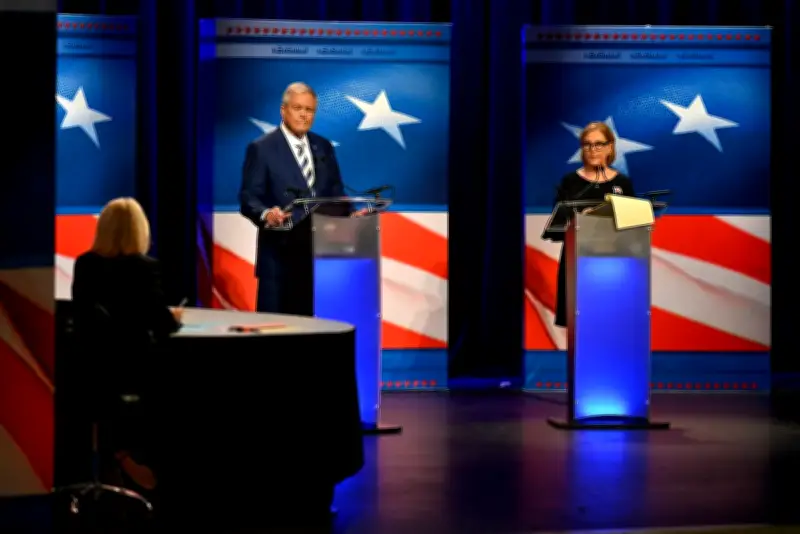
Republican fill-in senator Darline Graham admitted during a televised debate on Tuesday night that she is “not that informed on national security,” drawing gasps and boos from the audience.
When asked whether Taiwan and the South China Sea threaten US national security, Graham hesitated. “I’m just going to be honest here,” she told the debate audience. “I’m – not that informed on national security, so – but I do support the military.”
Graham’s Honest Admission
Graham did not retreat from her statement. “I’m not a polished politician up here,” she added. “National security is not my thing, not my area of expertise, but I do support the military.”

The debate was the only one before next week’s Republican runoff, a race to succeed her brother, Lindsey Graham, who was one of the Senate’s most committed rightwing foreign policy hawks before his sudden passing in July.
Norman’s Contrasting Stance
Her opponent, ultra-conservative representative Ralph Norman, who once advocated for martial law to keep Joe Biden from the presidency after his 2020 election win, needed no such disclaimer. He walked through Taiwan’s economic ties to the US and made the case that it was worth protecting from Chinese aggression.
Graham, endorsed by Donald Trump and leaning on her outsider credentials, recovered later in the evening. She described her family’s reliance on social security survivor benefits after her parents died, and accused Norman of being unable to decide whether he wants to work in South Carolina or Washington, citing his gubernatorial loss just this year.
Broader Taiwan Context
Norman, who backed his state’s former governor Nikki Haley over Trump in 2024, used the debate to distance himself from the president over the war with Iran. He said Trump “is going to have to tell the American people what it’s going to take” if the Strait of Hormuz remains under the control of a country the administration has claimed to have decimated.
Since 1979, the US has stuck to what’s called “strategic ambiguity” on Taiwan: refusing to say whether it would actually send troops if China invaded, on the theory that being vague keeps the peace. Trump has largely kept up that dodge, but with his own twist. At his May summit with Xi Jinping in Beijing, he said he wasn’t looking to fight a war “9,500 miles” away and wanted “China to cool down”, and put a pending $14bn Taiwan arms package on hold, calling it a “very good negotiating chip”. Xi, meanwhile, told him mishandling the Taiwan issue could lead to “clashes and even conflicts”. Last August, Trump said Xi had personally told him China wouldn’t invade Taiwan while he’s in office – a claim Beijing brushed off, reaffirming its commitment to “reunification”.
In South Carolina, early voting begins on Wednesday, ahead of the 25 August primary.