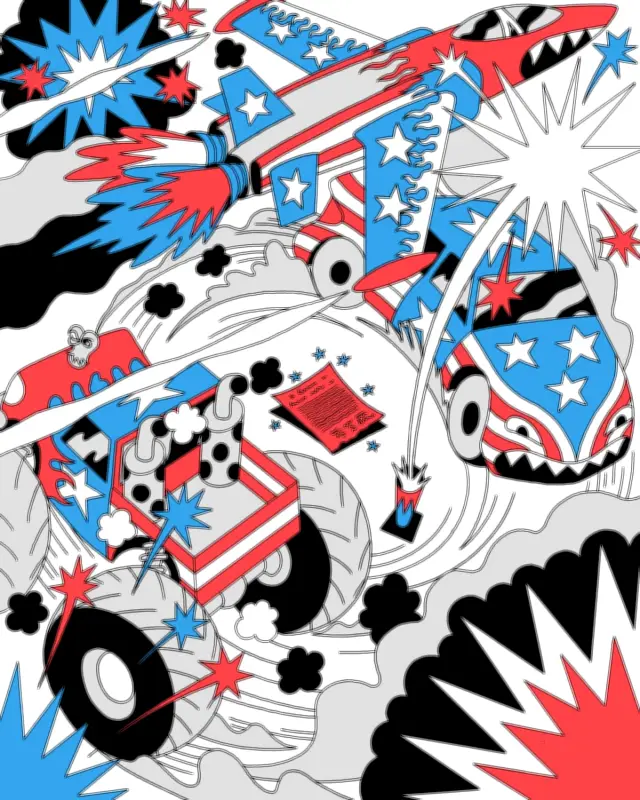
The United States is celebrating its 250th birthday with ear-splitting pyrotechnics, a Great American State Fair featuring fighter jet flyovers, and an Indy car race on the National Mall scheduled for 22 August. Yet the Declaration of Independence, the document that launched the nation, has been curiously absent from the lead-up festivities, according to historian Ted Widmer.
Absence from Celebrations
An advertisement for a recent UFC event at the White House featured the slogan: “History is made by revolutionary ideas.” But the only “idea” behind the cage fight was Mike Tyson’s classic insight: “Everyone has a plan until they get punched in the face.” President Donald Trump in 2019 praised the continental army for taking over airports during the revolutionary war, suggesting a disconnect from historical accuracy.
The declaration has been “setting off its own fireworks for a long time now, simply by speaking truth to power,” Widmer writes. In 1776, it launched a new nation by listing 27 defects of King George III, including cutting off trade, discouraging immigration, sending “swarms of officers to harass our people,” and transporting colonists overseas for trial.

Timeless Language and Contradictions
While the declaration contains problematic language about “merciless Indian savages” and “domestic insurrections” (a euphemism for slave rebellions), its core principles of equality, rights, and consent of the governed have served as a check on government overreach. It is “the ultimate No Kings statement,” Widmer says.
The drafting process was contentious. Thomas Jefferson, the primary author, felt Congress “mangled” his draft, though Widmer notes they improved it. The 56 delegates were not always united, as reflected in the tiny letters of “united” on the signed document. Slavery divided them, and delegate George Read voted against independence but signed anyway.
A Living Document Through History
“All men are created equal” became a potent rallying cry. Black leaders like Lemuel Haynes, a mixed-race veteran, wrote about the declaration’s meaning in 1776, and James Forten, who heard its first public reading at age nine, became a lifelong abolitionist. The 1848 Seneca Falls convention revised the phrase to “all men and women are created equal.”
The declaration was repurposed for different causes. Texas secessionists in 1836 used it to justify slavery, while African American settlers in Liberia in 1847 wrote a version condemning human bondage. During the Civil War, both sides claimed its authority—Jefferson Davis for secession, Abraham Lincoln for equality.
Lincoln called the declaration an “electric cord” tying Americans together, a “beacon,” and a “fountain.” In a pre-presidency note, he described it as an “apple of gold” surrounded by the Constitution’s “picture of silver.” His Gettysburg Address returned to its themes, emphasizing “all” as an essential word.
Modern Interpretations and Conflicts
In the 20th century, labor leaders and immigrants read the declaration from the left. Eugene Debs said, “I like the Fourth of July. It breathes a spirit of revolution.” Franklin D. Roosevelt translated it into “four freedoms” against Hitler. Martin Luther King Jr. in 1963 called it a “promissory note” that had become a “bad check,” and in 1968 urged the nation to “be true to what you said on paper.”
Conservatives also claimed the declaration. Presidents Theodore Roosevelt and Calvin Coolidge used it to praise free enterprise. The anti-abortion movement cited “life, liberty and the pursuit of happiness.” The Tea Party in 2010 drafted a version attacking “the tyranny of government.” On 6 January 2021, rioters claimed it was “1776” again.
Warnings for the 250th
John Adams predicted that future governments might destroy historical records they disliked. Widmer warns that current celebrations risk being “anti-historical,” citing a planned 250-foot arch in Washington and a $1.776bn slush fund. He echoes Lincoln’s view that the declaration remains “a perpetual rebuke and stumbling-block to tyranny.”

“As tempting as it will be to enjoy the fireworks on 4 July, it will be a missed opportunity if we ignore the deeper meaning of the declaration,” Widmer concludes. “Remember: ‘Be true to what you said on paper.’”