
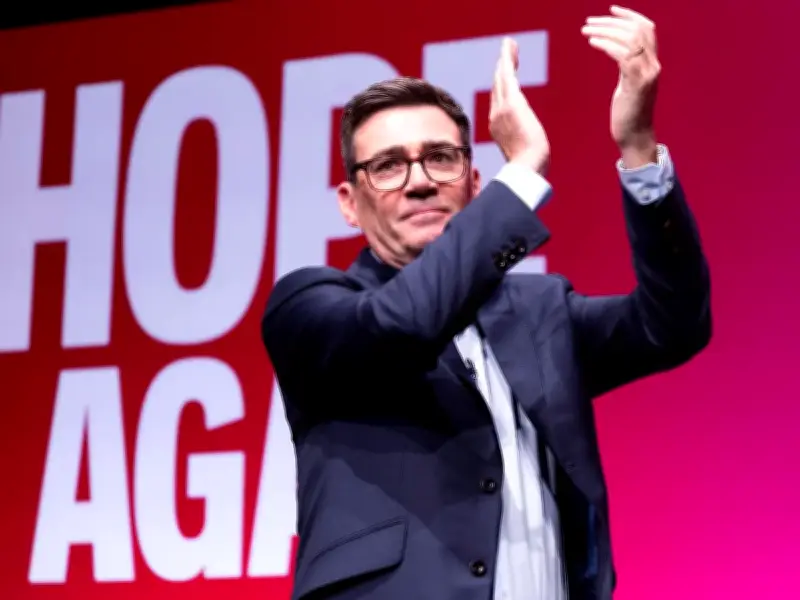
Andy Burnham set out his plan to transform Britain in his first major address to Labour's conference since becoming Prime Minister. He vowed to overturn a series of Thatcher-era reforms, giving the public greater control over housing, water and energy. Speaking to Labour delegates in Liverpool on Tuesday, he said: "This country isn't where any of us would want it to be."
Mr Burnham said: "We built the common good. Or at least we did until the 1980s. Suddenly, the common wealth we had created for the many was seen as an opportunity for the few. Homes. Water. Energy. Transport. Care. Broken up and sold off. The British right talk about 'taking back control'. Never let them forget: they are the ones who gave it away in the first place."
State pension triple lock and National Care Service
The triple lock on state pensions will be overhauled from 2030 if Labour wins the next election. No political leader of the last decade has dared to touch the policy, fearing the electoral consequences, and the Prime Minister admitted he may pay the political price.
At present, the triple lock ensures the state pension increases each year by the highest of inflation, earnings growth, or 2.5% - and it will remain for the rest of this Parliament. But Mr Burnham said it will be adjusted from 2030. He said: "From then the state pension will continue to rise every year at least by prices or 2.5%. And it will hold its value relative to earnings over time so that pensioners will always share in the rising prosperity of the nation."
Significant savings from the shake-up will be used to fund the National Care Service. Mr Burnham made clear the new service will be founded on the same principles of the NHS and provide free personal care to older people, protecting the homes and savings they built up. Labour said it will also widen people's care options, including staying at home longer if they wish. Baroness Louise Casey is expected to report back next summer with recommendations on how to build the new system. The PM has repeatedly warned that without reform of the crisis-hit social care sector, the NHS could collapse.
Water companies, energy and housing
Margaret Thatcher's 1989 ban on public ownership of water companies will be repealed with a new bill. This would close loopholes to allow failing bosses to get handed big bonuses, and give greater public control over water companies, where mayors would be handed new powers to hold them to account. He described this as a "10-year journey to a very different water system", with nothing off the table when it comes to sanctioning failing companies - including nationalisation. He said: "Where private companies serve the public interest, we will support them. But the consequences will be clear for those who do not, including taking back control or public ownership."
Britain's broken energy market will be reformed with plans for a Great British Grid. The energy grid, privatised by Thatcher in the 1980s, is responsible for getting electricity and gas flowing around the country to homes and businesses. GB Grid, a new publicly-owned company, will aim to speed up grid connections for businesses and drive down costs by increasing competition in the market. It will also make it easier for firms waiting to connect to build infrastructure themselves so they don't have to wait. The project will sit with GB Energy, the state-backed energy firm set up by Keir Starmer's government to drive investment in clean power.
Councils will have greater power to take over homes if rogue landlords refuse to make improvements. Mr Burnham also confirmed plans to reduce the size of the deposit needed to buy a home - opening it up "to those not backed by the bank of mum and dad". The Prime Minister also promised long overdue leasehold reform, saying leaseholders would no longer be squeezed for every penny. A bill will be introduced before Christmas, he said. Reforms to Right to Buy will exempt new-build council homes from the scheme for 35 years, and new-build homes in rural areas - which are more difficult to replace - will also be excluded. This will ensure public housing stock is not depleted, the government argues.
Brexit and electoral reform
The PM dropped his strongest hint yet that a return to the EU may be an option for the UK - if it has public backing. He said Brexit had done the UK more harm than good. Mr Burnham is set to hold a summit with the 27-member bloc later this year to redefine Britain's relationship with Europe. He said: "We will not give Britain the clear path we need into the rest of the century until we decide on a long-term relationship with what is still our largest market. I cannot say to you that where we are is good enough. Brexit has done more harm than good."
Britain's first-past-the-post voting system could be overhauled after the next election. The Prime Minister said the existing system leaves too many people out and that every vote should count in the make-up of a Parliament. He vowed to contest the next election "with a manifesto commitment to change the electoral system". Mr Burnham said he will establish a new National Commission on Electoral Reform. In theory, this could lead to the current system of first-past-the-post being replaced by proportional representation. Under the current system, an MP is elected when they win the vote in one of 650 constituencies, which means the portion of the vote doesn't necessarily align with seats won. For instance, in the 2024 General Election, Labour won 63% of the seats in Parliament on just 33.7% of the vote. Under a proportional representation system, if a party won 33.7% of the vote, they would gain 33.7% of the seats.




