
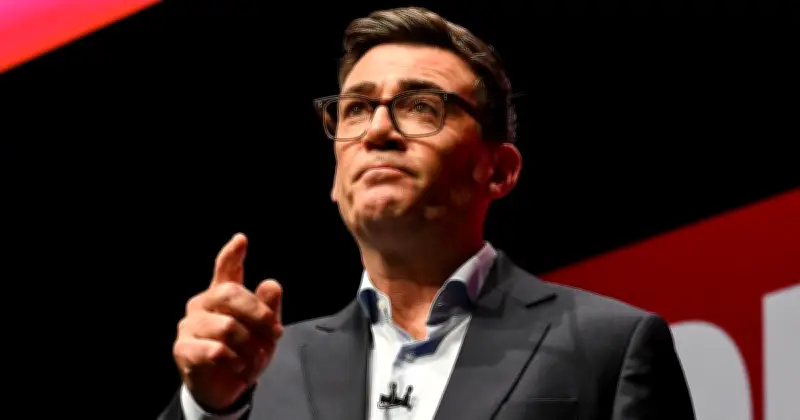
Andy Burnham’s plan to change the voting system may be designed to reassure the European Union that Nigel Farage will never become Prime Minister, according to a leading polling expert.
Peter Kellner, the former President of polling company YouGov, said introducing proportional voting would “reassure our European neighbours”.
Prime Minister announces electoral reform commission
The Prime Minister announced during his speech to the Labour Party conference that he would set up a national commission on electoral reform, to look at ways of changing the UK’s political system.
He said: “We will contest the next election with a manifesto commitment to change the electoral system so that everyone’s vote counts and everyone’s voice is heard.”
This is likely to mean a form of proportional representation, in which the number of seats each party receives in Parliament is more directly linked to the number of votes they receive across the country. In today’s “first past the post” system, it is possible for a party to win an overwhelming majority of seats despite receiving less than half the vote nationwide.
Burnham targets 'divisive' parties
Mr Burnham made it clear his plan was about keeping “divisive” parties out of power. He said: “I want to underpin our plan for Britain with a new politics.
“We will all have failed in our public duties if we carry on as we are and open the door of Number 10 to a divisive government on less than 30% of the vote.”
Separately, Mr Burnham said he would “lay out to the country what I believe the different options are for Britain’s long-term relationship with our European partners” around the time of an EU summit, expected on November 20. The options are likely to include fully rejoining the EU, or rejoining some elements such as the single market.
Kellner links voting reform and EU relations
Mr Kellner said these policies may be connected. In an email newsletter on the topic of Reform’s election chances, he wrote: “First, if we adopt one of the more proportional systems – such as those operating in Scotland, Wales, Ireland or Germany – it will become much harder for any one party to win an absolute majority in Parliament. Coalitions, or at least minority governments, are likely to be the norm.
“Second, this has specific relevance to Britain’s relationship with the European Union. Under the present voting system, EU leaders would be justified in resisting a close relationship for fear that a future populist-nationalist government might scrap the deal.
“Burnham singled out the need to remove the danger of a ‘divisive’ party winning outright power with 30 per cent of the vote. Proportional voting would remove that danger, and so reassure our European neighbours.”
Mr Kellner also predicted that under the current electoral system, Reform could be threatened by people voting tactically against it.
He said: “It is not only that Lib Dem and Green voters would switch to Labour to ensure Reform’s defeat; many supporters of all three left-of-centre parties are also willing to lend their vote to the Tories in reform-Conservative battles.
“That’s why the Tories could benefit even more than Labour from tactical voting.”




