
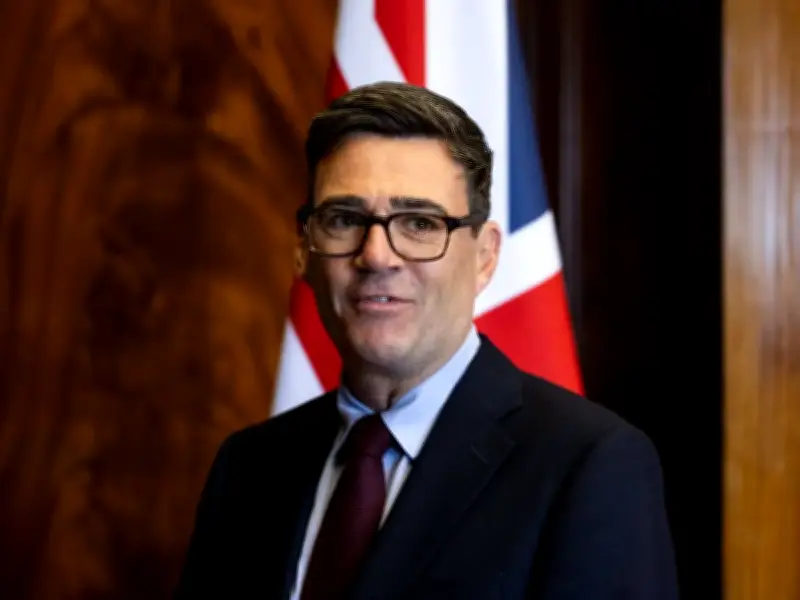
Prime Minister Andy Burnham has unveiled eight major changes to the British public in his first Labour Party conference speech as leader. One reform is "long overdue", he said, as he pledged significant changes across large parts of the British public realm.
The Prime Minister outlined proposals over housing, pensions, unemployment as well as free social care in England among other policies. He revealed reforms to the pensions triple lock to fund the initiative.
Below are the key points from his Tuesday address in Liverpool:
Housing and leasehold reform
Mr Burnham outlined proposals to extend home ownership "to those not backed by the bank of mum and dad" by cutting the deposit requirement for buyers. He committed to introducing a Bill before Christmas for "long overdue" leasehold reform, assuring leaseholders that "the days of you being squeezed for every penny are coming to an end".
Local councils will be granted authority to take ownership of substandard properties should landlords refuse to carry out improvements, with Mr Burnham said: "We don't let people sell food which damages health, so why allow it with homes? From now on, we won't."
Triple lock revamp and social care
Mr Burnham revealed his social care transformation will be financed through amendments to the pensions triple lock – which presently ensures that pensions will increase in line with inflation, 2.5% or average earnings, whichever is the largest rise. Labour will "adjust" the policy from 2030, removing the link to average earnings, he said.
The Prime Minister stated that he would honour the pledge made in the 2024 Labour manifesto to keep the triple lock unchanged throughout this Parliament. He continued: "In April 2030 we will adjust it. The state pension will continue to rise every year at least by prices or 2.5%. And it will hold its value relative to earnings over time so that pensioners will always share in the rising prosperity of the nation. But this change will generate significant savings which we will use to build up our National Care Service."
Mr Burnham committed to establishing a "National Care Service" which will be "free at the point of use" and impose no charges on the basic state pension, in what he characterised as a "landmark policy as significant as the creation of the NHS itself". He said it will be "a person-centred, high-quality" care service where "everyone contributes and everyone is covered" and care "is about people not profit", does not erode savings and gives "proper recognition" to care workers.
He said the Government will begin preparing the groundwork immediately for the service and launch it in the next Parliament. The Prime Minister said: "I accept I may pay a political price. But someone has to go through the pain barrier and rip the plaster off." He added that it "will be fully funded, and not through borrowing".
Youth unemployment and education
Pledging to show "the same boldness for our young people," Mr Burnham said he wanted to "invest" in them rather than "pay for failure through the benefits system". Too many young people are "drifting" towards the benefits system, he warned.
He drew attention to Alan Milburn's review into the growing number of young people not in education, employment or training, which is due to be published this autumn. He restated what he said was Labour's intentions to reform the education system, introducing academic and technical pathways from the age of 14.
And he also offered work placements and apprenticeships, alongside reducing waiting times for young people requiring mental health support. "We will need a fundamental rethink of the welfare system to find the money for these opportunities upfront, and we will require young people to take up the help presented to them, guaranteeing in-work support and not leaving those out of work losing confidence and connection," he said.
Great British Grid and utilities
Mr Burnham unveiled a new publicly-owned "Great British Grid" designed to "challenge the private sector operators" to "increase competition, drive down costs and speed up delivery". The newly established body, operating under the Great British Energy umbrella, aims to simplify access to energy grid connections, tackling one of the key obstacles widely regarded as hampering economic growth and inflating costs.
It will mark the first publicly-owned presence in electricity networks since privatisation under former prime minister Margaret Thatcher.
Mr Burnham promised to strengthen public control of the water system with a Bill that will repeal "Margaret Thatcher's ideological ban on public ownership of water companies". He stated this would "start a 10-year journey to a very different water system", granting local leaders fresh powers to hold water companies accountable and eliminating loopholes exploited to award substantial bonuses.
The Labour leader characterised the water industry as a "symbol of what has gone wrong with Britain" in which "shareholders never lose and the public never win, from which some have syphoned out easy money while the public picked up the bill for the sewage in our seas".
Electoral reform and EU relations
Mr Burnham pledged to contest the next election with a manifesto commitment to reform the electoral system "so everyone's vote counts and everyone's voice is heard". He unveiled a new national commission on electoral reform, extending an invitation to all political parties to participate in its work.
The Prime Minister has previously backed proposals to replace the first-past-the-post system with a form of proportional representation. He said: "We can't succeed in the eyes of the world if we continue with the levels of political turbulence we have seen in recent times. It is always in my mind that I'm the seventh Prime Minister in 10 years. It is why I want to underpin our plan for Britain with a new politics. We will all have failed in our public duties if we carry on as we are and open the door of No 10 to a divisive government on 30% of the vote or less."
The Prime Minister also pledged to outline proposals for closer ties with the European Union later this year, suggesting he may abandon the 2024 Labour manifesto's red lines against rejoining the customs union or single market.
He remarked in his address: "We will not give Britain the clear path we need into the rest of the century until we decide on a long-term relationship with what is still our largest market. I cannot say to you that where we are is good enough. Brexit has done more harm than good. So I will take the opportunity around the (UK-EU) summit to lay out to you, to lay out to the country, what I believe are the different options for Britain's long-term relationship with our European partners. And there are different options. And I will see if we can find consensus around one which will give us clarity about our position and the future of the continent that we live in."




