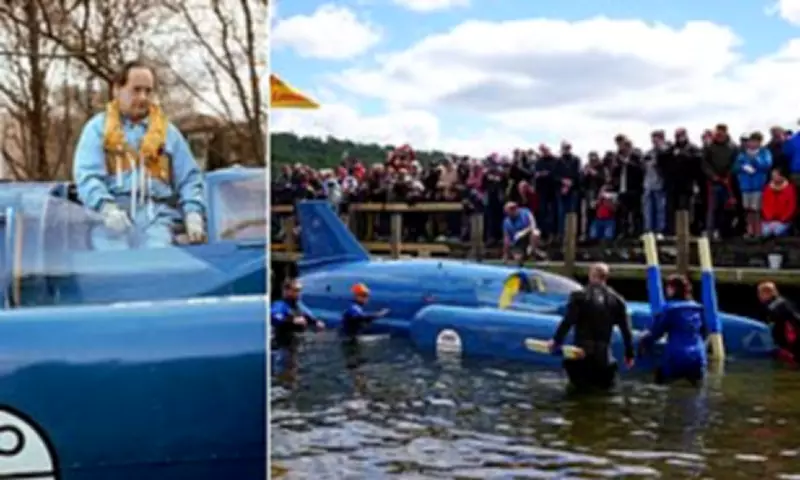
The iconic hydroplane Bluebird K7 has returned to Coniston Water for the first time in nearly six decades, marking its first appearance since the tragic crash that killed its pilot, Donald Campbell. The jet-propelled vessel, which reached speeds of 276 mph and set multiple water speed records, crashed on Coniston Water in the Lake District on January 4, 1967, while Campbell was attempting to break the 300 mph barrier.
Bluebird K7 Festival and Final Runs
After spending almost 60 years submerged 142 feet below the surface, the restored Bluebird K7 is making one final series of outings this week. Thousands of spectators lined the lakeside at Coniston for the Bluebird K7 Festival, running from May 11 to 17. Weather permitting, the hydroplane will run each day, with the final runs piloted by Australian Dave Warby, son of the late Ken Warby MBE, the current water speed record holder at 317.6 mph.
No speed records will be attempted due to safety concerns, and the Bluebird is expected to reach a top speed of around 150 mph. Donald Campbell's daughter, Gina Campbell, attended the first day of the festival to see her father's hydroplane running in its former glory.

Historical Context and the Fatal Crash
This year marks the 70th anniversary of Campbell's first world water speed record, set on September 19, 1956, at 225.63 mph. He set four of his water speed records on Coniston Water, with his fastest at 260.35 mph in May 1959. The Bluebird was 11 years old at the time of the fatal crash. Despite warnings from his engineer Leo Villa, Campbell pushed the vehicle 70 mph beyond its design limits, reaching an estimated 320 mph when the hydroplane lifted out of the water, somersaulted, and disintegrated. Campbell, aged 45, was killed instantly. His teddy bear mascot, Mr Whoppit, was one of the few relics to surface.
Campbell set eight speed records on land and water during the 1950s and 1960s, becoming the first and only person to set both a land and water speed record in the same year. The fatal run was intended to generate publicity for his rocket car project, Bluebird 1.1.
Recovery and Restoration
The wreckage was discovered soon after the crash, but Campbell's family requested it be left in the lake as a memorial. In 2001, both the hydroplane and Campbell's body were recovered, with his race suit intact. The hull was restored in Tyneside by the Bluebird Project, led by engineer Bill Smith. The vessel returned to running at Loch Fad on the Isle of Bute, Scotland, in 2018. Gina Campbell later decided to donate the Bluebird to Coniston's Ruskin Museum.
A legal dispute arose when Smith claimed part-ownership and trademarked the name. The Intellectual Property Office ruled in 2024 that Smith had acted in "bad faith," and the boat was surrendered to the museum. Smith remarked, "He won the day. Big deal." The Bluebird is now on display at the Ruskin Museum.
The Bluebird K7 Festival continues until Sunday, offering a final chance to see the historic hydroplane in action.