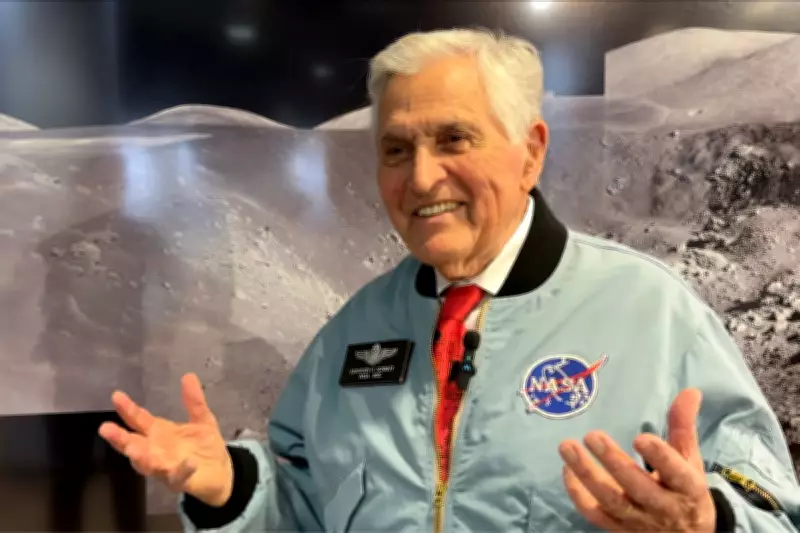
Apollo astronaut Harrison “Jack” Schmitt, now 90, recalls the thrill of the Artemis II lunar flyby and shares his vision for humanity’s future in space. In an interview with The Associated Press, the former U.S. senator from New Mexico and one of the four surviving Apollo moonwalkers discussed lunar bases, the importance of helium-3, and whether we are alone in the universe.
On the Importance of a Lunar Base
Schmitt emphasized that a lunar base is essential for geopolitical presence in deep space and as a stepping stone to Mars. “The moon has resources that will reduce the cost of going to Mars and provide experience,” he said. He noted that Artemis II gave ground crews real risk experience, moving beyond simulations.
Apollo 17 Mission and the Taurus-Littrow Valley
As a field geologist, Schmitt helped answer key questions about the moon’s origin. The Taurus-Littrow valley, deeper than the Grand Canyon, offered a three-dimensional geological challenge. “We were more efficient at gathering meaningful samples,” he explained, which furthered understanding of the moon’s relationship to Earth and the sun’s history.

The Moon as a Library of Solar System History
Schmitt highlighted that the moon has recorded solar system history for 4.5 billion years. His recent work suggests the sun became more active around the time life exploded in Earth’s oceans, warming them and fostering diversity. “Mammals appeared soon after, and life moved onto continents,” he added.
Moon Rocks and Helium-3
Schmitt described a basalt lava sample rich in titanium, which concentrates hydrogen and helium. The isotope helium-3, rare on Earth but abundant on the moon, could revolutionize energy production. “It offers nuclear energy without nuclear waste,” he said, and it is useful for quantum computing and cancer therapy.
Helium-3 as a Driver of the New Space Race
Schmitt sees helium-3 as a major technological driver in the current space race, particularly involving China. “It’s an energy race as much as a space race,” he noted.
Living and Working on the Moon
Schmitt described the ease of moving in one-sixth gravity, calling it “like being a kid again.” However, he warned that weightlessness can make the brain lazy. After splashdown, he instinctively let go of a water cup, which broke. “It took three days to get comfortable back on Earth,” he recalled.
Challenges of Long-Term Lunar Civilization
Radiation remains a major issue, but Schmitt is confident it can be managed. For Mars missions, fusion rockets will likely be needed to shorten travel time.
On UFOs and Extraterrestrial Life
Schmitt acknowledged the statistical likelihood of life elsewhere given billions of sunlike stars, but he is skeptical about visitation. “If they’re so advanced, they’d communicate better,” he said. He finds it plausible but unlikely.
Would He Go Back to the Moon or Mars?
“Oh surely,” Schmitt replied, adding that his wife Teresa would want to join him. He stressed the importance of youth education in mathematics and praised NASA’s integration of commercial technologies for deep space exploration.