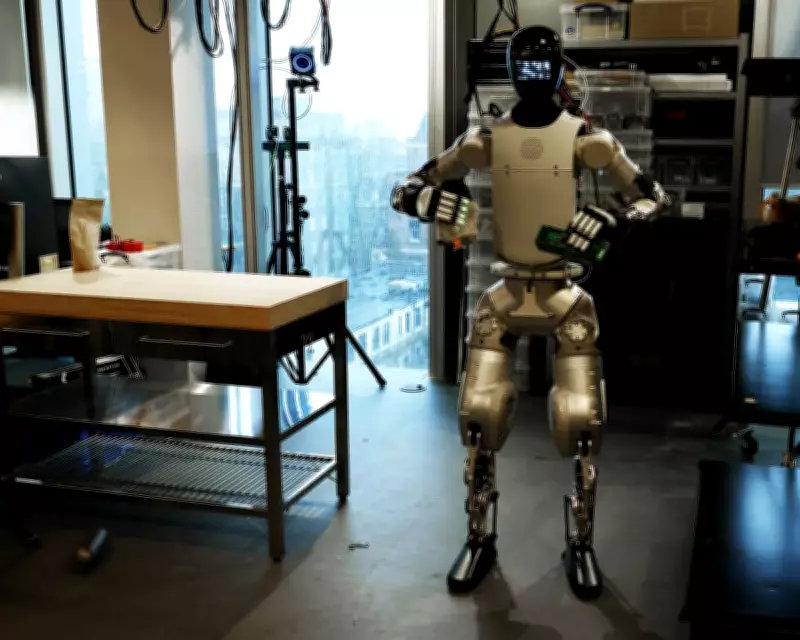
Jack Clark, the co-founder of Anthropic, has predicted that an artificial intelligence system will collaborate with humans to achieve a Nobel prize-winning discovery within the next 12 months. Speaking at Oxford University, Clark also forecast that bipedal robots would assist tradespeople within two years, and that companies run entirely by AI could generate millions of dollars in revenue within 18 months. By the end of 2028, he anticipates AI systems will be capable of designing their own successors.
Vertiginous Progress and Profound Changes
Clark described a 'vertiginous sense of progress' in AI technology, warning that while it brings immense potential, there remains a 'non-zero chance of killing everyone on the planet.' He stressed that this risk has not diminished and that humanity must prepare for a technology that will 'soon be more capable than all of us collectively.'
Risks and Competition
He noted that the rapid development of AI is driven by commercial and geopolitical rivalries, often overshadowing existential concerns. 'It would be better if we could slow down to give ourselves more time as a species,' Clark said, but acknowledged that this is unlikely given the competitive landscape involving multiple actors and countries.

Criticism and Denial
Anthropic, a $900 billion company founded by former OpenAI researchers, has faced accusations from the Trump administration and AI accelerationists of 'fear-mongering' to encourage regulation that benefits its market position. Clark disputes this, arguing that many are in denial about AI's progress. He compared the lack of preparedness for AI to the failure to prepare for pandemics like Covid-19, warning that inaction could lead to forced reactivity.
Single Point of Failure and Cognitive Atrophy
Critics of frontier AI companies fear that over-reliance on a few models, backed by massive profit-seeking capital, could create a 'single point of failure' in global systems. Professor Edward Harcourt from the Institute for Ethics in AI, which co-hosted the lecture, warned that AI doing more for humans could lead to 'cognitive atrophy,' weakening decision-making and judgment. He advocated for 'Socratic' AI models that encourage human thinking.
Crazy Predictions
Clark's predictions include a machine economy decoupling from the human economy, robots gaining brains, science progressing without humans, and scientific equipment beyond current conception. He admitted some of these ideas 'sound crazy,' but emphasised that vast swathes of the economy and society will undergo profound changes.