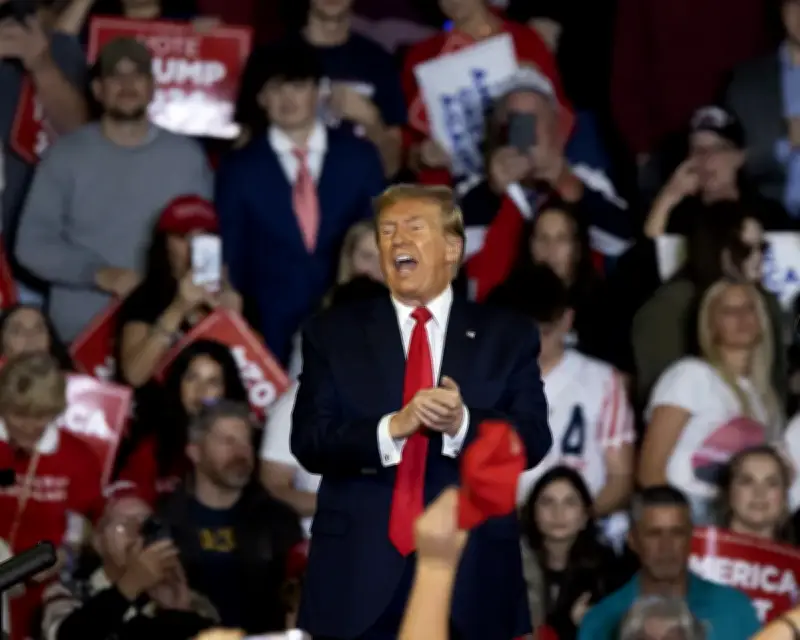
Donald Trump's actions ahead of the looming midterm elections suggest he may not care about Republican defeat—or might even secretly desire it. The first postal ballots were sent out today, and the president's behaviour, from a failed war with Iran to a trade war with Canada, appears to be calculated self-sabotage.
A pattern of self-sabotage
At the centre is Trump's reckless, failed war of choice against Iran. Despite repeated declarations of mission accomplished, the facts tell a different story. In the past week, the two sides shifted from an economic standoff back to a shooting war, with the US firing on Iranian targets that included a wedding party, killing four, and Tehran striking Iraq, Kuwait, Jordan and Bahrain.
The impact on US voters is severe, felt through rising petrol prices and grocery bills. The cost the US government pays to borrow money has climbed steeply since 28 February, the day the war began, hitting a fresh high on Tuesday. That rise translates into an expected jump in interest rates, meaning many voters will cast ballots just as they start paying more on credit card bills and mortgages. Given that Trump was elected on a promise to bring down inflation, it's hard to think of a worse environment for a governing party facing the voters' verdict.

Trade wars and electoral damage
Iran may not be the most electorally damaging of Trump's foreign adventures. He is leading his country into a state of war with Canada. The economic confrontation is serious—and seriously damaging to Republicans' electoral prospects. Canada's "dollar-for-dollar" response to Trump's tariffs hits hardest in Michigan, Ohio, Maine, Iowa and Texas, all of which have key senate contests this year. Canada takes nearly a third of Iowa's exports, for example, and that market has suddenly turned icy.
Trump's trade wars are also wars of choice, hurting especially badly a reliable Republican constituency: farmers. Democrats have not won a senate seat in Iowa for nearly 20 years, yet now they have a genuine shot.
Datacentres and unpopular endorsements
Trump's support for datacentres is perhaps the most egregious illustration of his determination to ruin Republican chances. Seven in 10 Americans say they would not want one near where they live. Even among Republicans, there is deep concern over their environmental impact, energy consumption and water use. "The only reason that communities throughout the USA should not want data centres is if they want to end up being backwards and poor," the president posted on Monday, putting himself at odds with most voters.
Trump has also hobbled his party by endorsing radioactively unpopular candidates. Ken Paxton, attorney general of Texas, was impeached by his fellow Republicans on charges including bribery and abuse of public trust, yet Trump backed him as the Republicans' senate choice in Texas, making even that red-state stronghold shaky.
A narcissistic calculation
These look like the actions of a man who has no fear of the blue wave and could not care less if it sweeps away Republicans' majorities in Congress. Congress's most potent weapon—the power of subpoena and investigation—holds no terror for Trump, as the house and Senate have no means to enforce their will. He can ignore their writs, comforted by near-blanket immunity from the supreme court, and promise pardons to aides who follow his lead.
The bestselling new book Regime Change, by Maggie Haberman and Jonathan Swan, spells it out: "If Republicans were wiped out in the 2026 midterm elections, or in 2028, he could simply boast that they couldn't win without him." Such is Trump's narcissism, he will take an epic Republican defeat not as a repudiation, but as a compliment. And he is doing all he can to earn it.